
Qualitas Uses Anritsu VNA for Interconnect Testing
Anritsu ShockLine analyzer strengthens signal integrity verification for high-speed PHY interface development.
www.anritsu.com
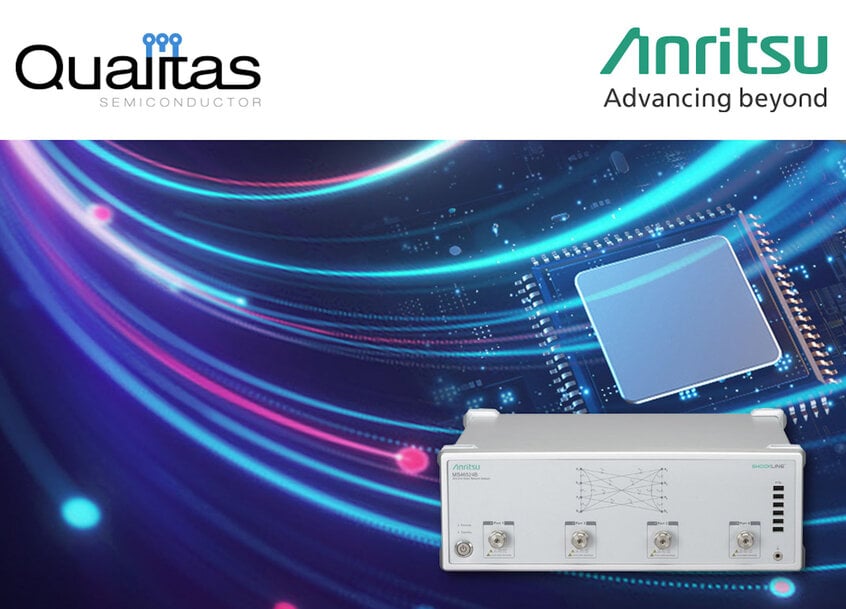
Anritsu Corporation announced that Qualitas Semiconductor Co., Ltd. has adopted the ShockLine™ 4-Port Performance Vector Network Analyzer MS46524B to improve signal integrity verification in the development of high-speed interface IP.
By integrating the analyzer into its verification workflow, Qualitas has created a measurement environment capable of performing highly accurate and repeatable signal-integrity analysis across complete high-speed interconnect systems.
Supporting high-speed interface development
Qualitas Semiconductor Co., Ltd. develops high-speed interface IP solutions including:
- SerDes PHY IP
- PCI Express PHY IP
- UCIe interconnect solutions
- Ethernet PHY IP
These technologies support advanced semiconductor applications such as AI infrastructure, data centers, automotive systems, and mobile devices.
As transmission speeds continue to increase, evaluating the performance of the entire interconnect channel—including PCB traces, semiconductor packages, and sockets—has become essential for maintaining reliable signal integrity.
Advanced measurement for signal integrity verification
To address these challenges, Qualitas implemented the ShockLine™ MS46524B from Anritsu Corporation.
The system enables engineers to perform detailed signal-integrity verification through:
- Differential S-parameter analysis
- Time-domain reflectometry (TDR) measurements
- High-frequency measurement stability
- Mixed probe and coaxial cable test configurations
These capabilities allow engineers to detect and analyze transmission loss, reflections, crosstalk, and impedance variations within high-speed interconnect structures.
Creating a realistic verification environment
By deploying the analyzer, Qualitas established a verification environment that closely replicates real-world system conditions. This approach allows engineers to evaluate interconnect performance more accurately during the PHY IP development process, improving both reliability and design validation.
The enhanced verification workflow helps ensure that next-generation interface technologies can operate reliably in increasingly demanding high-speed data environments.
Through solutions such as the ShockLine vector network analyzer, Anritsu Corporation continues to support semiconductor developers and system designers in building efficient verification environments for next-generation high-speed interfaces.
Edited by industrial journalist, Lekshman Ramdas.
www.anritsu.com
