
electronics-journal.com
17
'26
Written on Modified on
220 GHz Analyzer Extends Optical Transceiver Validation
Keysight introduces a 220 GHz lightwave component analyzer to support high-speed optical transceiver validation for data center and telecommunications applications.
www.keysight.com
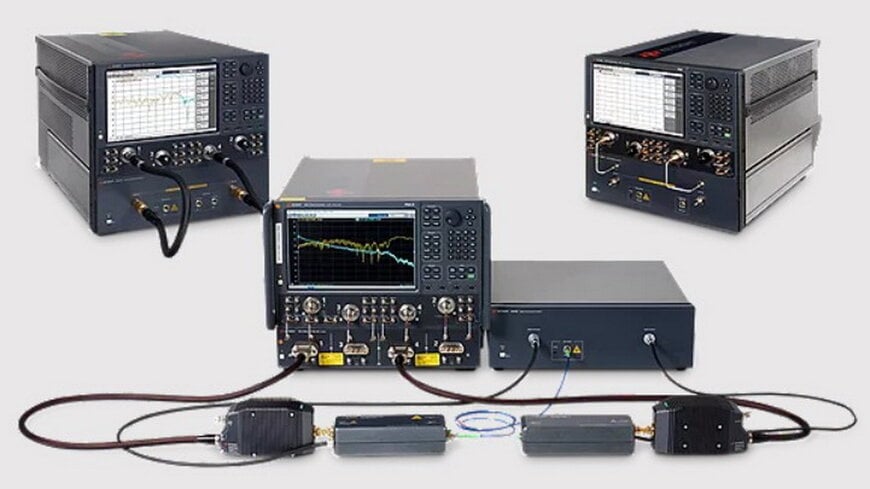
Keysight has introduced a 220 GHz lightwave component analyzer designed to characterize next-generation optical transceivers used in high-speed data center interconnects and telecommunications networks. The system extends frequency coverage to address emerging requirements in the optical data ecosystem, particularly for devices operating beyond 200 Gbaud.
Extending Measurement Capabilities for Optical Systems
The increasing adoption of high-speed modulation schemes such as PAM4 and coherent transmission is driving the need for precise characterization of optical components at higher bandwidths. Conventional test solutions are typically limited below 110 GHz, creating constraints when validating components designed for 224 Gbps per lane and beyond.
The new analyzer expands measurement bandwidth up to 220 GHz, enabling engineers to assess electro-optical (E/O) and opto-electrical (O/E) responses with higher fidelity. This is critical for validating modulators, photodiodes, and driver amplifiers used in 800G and 1.6T optical transceivers. By providing broader frequency coverage, the system allows accurate extraction of S-parameters, bandwidth limitations, and signal integrity characteristics across the full operational spectrum.
Relevance for Data Center and Telecom Applications
The solution targets applications in hyperscale data centers, metro networks, and long-haul optical communications, where increasing data throughput must be balanced with power efficiency and signal integrity. As data rates scale, component-level validation becomes a limiting factor in system performance.
Engineers can use the analyzer to identify bandwidth bottlenecks, impedance mismatches, and frequency-dependent losses that directly impact bit error rate (BER) and overall link reliability. This supports the development of optical transceivers aligned with industry roadmaps for 1.6T Ethernet and future optical interconnect standards.
Measurement Architecture and Technical Approach
The analyzer integrates optical and electrical measurement domains, combining a lightwave component analyzer architecture with high-frequency signal generation and detection. This enables calibrated measurements of amplitude and phase response across extended frequency ranges.
By leveraging vector network analysis techniques, the system provides traceable and repeatable results, which are essential for design verification and model correlation. The extended frequency range also improves the accuracy of behavioral models used in system simulation, contributing to more reliable digital supply chain processes in photonic design and manufacturing.
Positioning Within Optical Test Ecosystem
Measurement systems in this category are typically benchmarked by bandwidth, calibration accuracy, and integration with optical interfaces. Extending bandwidth to 220 GHz positions the solution beyond standard 110 GHz platforms, addressing a gap in validation capabilities for emerging high-speed optical technologies.
As optical transceiver speeds continue to increase, test equipment must evolve accordingly. The introduction of higher-frequency characterization tools reflects a broader shift toward tighter integration between photonic component design, system validation, and manufacturing workflows.
www.keysight.com
