
electronics-journal.com
18
'26
Written on Modified on
MOSFET ORing Modules Improve Power Redundancy Efficiency
TDK Corporation introduces compact MOSFET-based ORing modules designed to enhance power redundancy and reduce losses in industrial and communication systems.
www.tdk.com
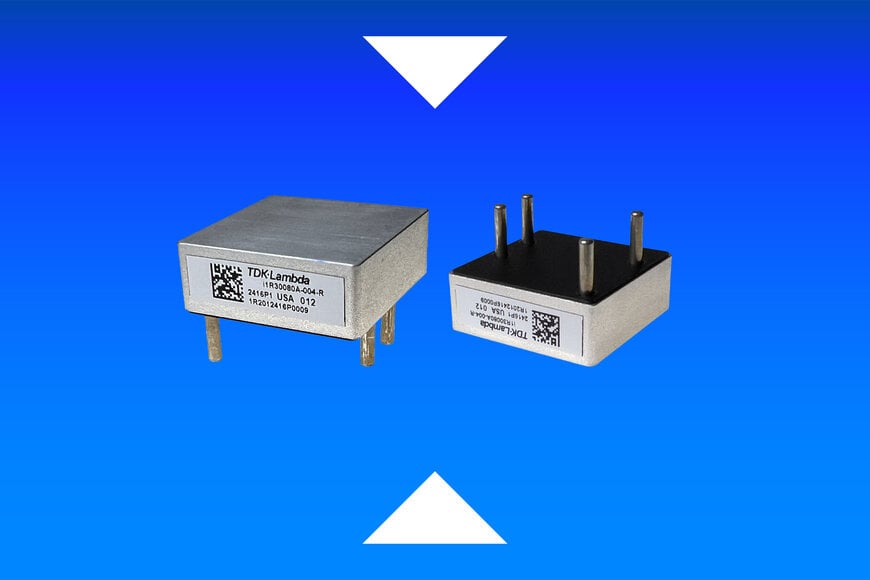
TDK Corporation has released a series of MOSFET-based ORing modules designed to replace traditional diode-based solutions in redundant power architectures. The modules target high-reliability applications such as industrial automation, communications infrastructure, and test systems, where efficiency and fault protection are critical.
MOSFET-Based ORing for Efficient Power Path Control
ORing circuits are commonly used in redundant power systems to ensure uninterrupted operation by allowing multiple power sources to operate in parallel. Conventional implementations rely on diodes, which introduce significant forward voltage drops and associated power losses.
The i1R series replaces diodes with MOSFET-based circuitry, reducing conduction losses through low on-resistance values of 2.5 mΩ and 1.5 mΩ. This enables efficiencies of up to 99.5%, improving overall power conversion performance in industrial power electronics and distributed power architectures.
By minimizing voltage drop across the ORing element, the modules also reduce heat generation, which simplifies thermal management and supports higher power density designs.
Fast Fault Isolation and Reverse Current Protection
A key functional requirement in redundant systems is the ability to prevent reverse current flow during fault conditions. The modules implement a fast turn-off mechanism with a typical response time of 500 ns, significantly limiting reverse current transients.
This rapid response improves system protection by isolating faulty power sources before they affect the load or other parallel supplies. Such behavior is particularly relevant in digital supply chain infrastructure, including telecom base stations and data acquisition systems, where uptime and fault containment are critical.
Compact Design for High-Density Power Systems
The modules are housed in a shielded metal package measuring 26.3 × 26.3 × 10.1 mm, enabling integration into space-constrained designs. The compact footprint supports high-density PCB layouts while maintaining effective thermal dissipation.
Operation without external components further simplifies system integration, reducing design complexity and component count. This is advantageous in modular power systems and embedded platforms where board space and reliability are key constraints.
Electrical Characteristics and Operating Range
The series includes variants supporting input voltage ranges from 3.3 Vdc to 60 Vdc and output currents of 60 A and 80 A. Maximum output power reaches 3600 W, depending on the model and operating conditions.
The modules are specified for case temperatures up to 120°C and comply with CE and UKCA requirements, supporting deployment in regulated industrial environments.
Application Scope in Harsh and High-Reliability Environments
The modules are designed for use in communications systems, test and measurement equipment, and industrial robotics operating under high shock and vibration conditions. These environments require robust power redundancy mechanisms to maintain operational continuity.
The architecture allows compatibility with a wide range of DC-DC converters and filtering solutions, enabling flexible deployment across heterogeneous power systems.
Positioning Against Diode-Based ORing Solutions
Compared to Schottky or standard diode-based ORing implementations, MOSFET-based designs offer substantially lower conduction losses due to reduced forward voltage drop. For high-current applications (tens of amperes), this difference translates into measurable efficiency gains and lower thermal stress.
The integration of fast switching control and low on-resistance positions MOSFET ORing modules as a more suitable solution for modern high-efficiency power systems, particularly where energy efficiency and compact design are required simultaneously.
Edited by an industrial journalist, Sucithra Mani, with AI assistance.
www.tdk.com
