
electronics-journal.com
13
'26
Written on Modified on
High-Efficiency DC-DC Power Modules for Battery Systems
TDK Corporation introduced a non-isolated buck-boost DC-DC converter platform designed to improve power efficiency and thermal management in industrial and mobile electronic systems.
www.tdk.com
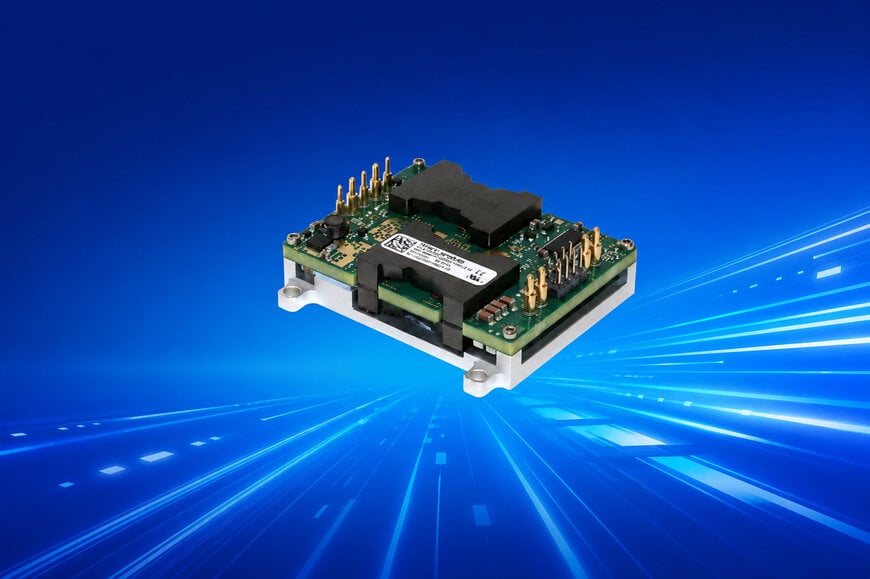
TDK Corporation released the TDK-Lambda i9C series, a 1500 W DC-DC power module targeting industrial automation, robotics, communications, and battery-powered equipment. The series combines wide input-voltage support with a patented pass-through architecture intended to reduce conversion losses in applications such as AGVs, AMRs, commercial drones, humanoid robotics, and test systems.
The first configuration in the i9C series supports a 9 V to 80 V input range and delivers regulated outputs from 9.6 V to 60 V at up to 30 A. TDK indicated that a second variant supporting 9 V to 40 V input and 5 V to 36 V output at up to 50 A is planned to expand the available operating range for different power architectures.
Pass-Through Architecture Reduces Conversion Losses
The main technical feature of the i9C platform is TDK-Lambda’s patented programmable high-efficiency pass-through (PHEPT) technology. The mechanism allows system designers to define a voltage range in which the converter bypasses active switching regulation and directly connects the input source to the output stage.
In conventional DC-DC conversion, switching and regulation stages introduce conduction and switching losses that generate heat and reduce overall efficiency. By bypassing conversion during defined operating conditions, the i9C can achieve efficiency levels of up to 99 %, according to the company. Reduced power dissipation lowers thermal stress on components and can extend operating time in battery-powered systems.
The approach is particularly relevant for applications within the digital supply chain sector, where autonomous mobile equipment often operates under constrained thermal and energy budgets. Lower heat generation may also reduce cooling requirements and improve long-term reliability in enclosed or low-airflow installations.
Wide Input Range Supports Industrial Power Architectures
The i9C series is designed as a non-isolated buck-boost converter, enabling operation when the input voltage is either above or below the required output voltage. This flexibility allows a single module to support varying battery states and distributed DC bus configurations commonly used in industrial automation and mobile robotics.
TDK packaged the module in a wide quarter-brick format with an integrated baseplate compatible with convection, conduction, or forced-air cooling methods. The thermal design targets high-ambient industrial environments where airflow may be limited.
Integrated protection and control functions include negative-logic on/off control, remote sensing, power-good signalling, adjustable overcurrent protection, and automatic recovery protection. The module also includes a configurable low-power sleep mode intended to reduce standby power consumption during idle or light-load conditions.
The adjustable overcurrent protection feature allows engineers to tune current limits according to system requirements, potentially reducing the need for additional external protection circuitry.
Applications in Robotics and Battery-Powered Equipment
The converter series targets several segments of the automotive data ecosystem and industrial mobility infrastructure, particularly systems requiring compact, high-efficiency power conversion. Typical applications include autonomous guided vehicles (AGVs), autonomous mobile robots (AMRs), commercial drones, humanoid robotic platforms, communications equipment, and portable test systems.
Battery-operated robotic systems can benefit from higher conversion efficiency because lower energy losses directly affect runtime and thermal management. In mobile platforms, reduced heat generation can simplify enclosure design and decrease dependence on active cooling components.
The modules comply with IEC/UL/CSA/EN 62368-1 safety requirements and carry CE and UKCA markings covering Low Voltage, EMC, and RoHS directives.
Edited by an industrial journalist Sucithra Mani with AI assistance.
www.tdk.com
