
electronics-journal.com
03
'26
Written on Modified on
GaN Gate Drivers for High-Speed Power Conversion
STMicroelectronics introduces GaN drivers enabling efficient motion control and compact power conversion system design.
www.st.com
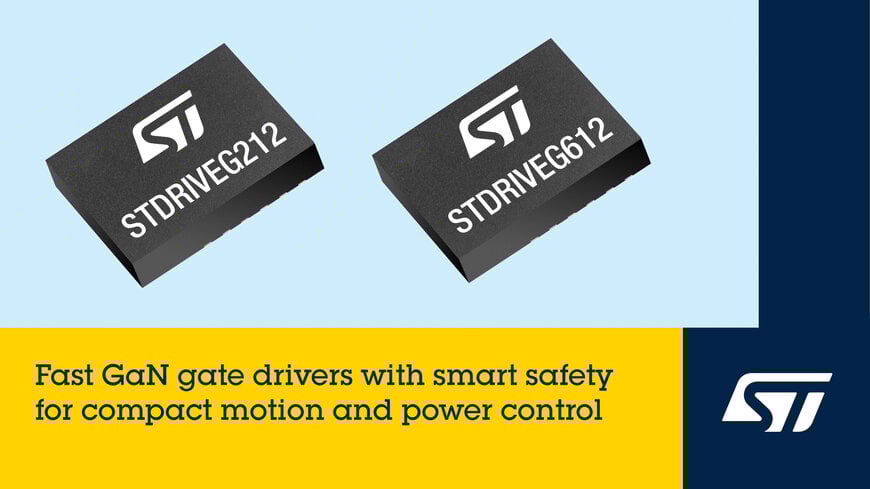
STMicroelectronics has released two half-bridge gate drivers designed for enhanced-mode GaN HEMTs, targeting motion control and power conversion applications that require high switching speeds, thermal efficiency, and compact system integration.
Enabling high-frequency switching in power electronics
Gallium-nitride (GaN) devices are increasingly adopted in power electronics due to their fast switching capability and reduced losses compared to silicon-based alternatives. The newly introduced drivers support these characteristics by delivering controlled 5 V gate-drive signals with high transient immunity.
The two variants support different voltage classes: one operates up to 220 V and the other up to 600 V, enabling deployment across a range of industrial systems, including motor drives, power supplies, and converters.
A propagation delay of 50 ns, closely matched between high-side and low-side channels, supports synchronized switching. In addition, ±200 V/ns dV/dt immunity allows stable operation in high-speed switching environments, which is critical for achieving higher motor rotational speeds and improved system efficiency.
Integrated architecture reduces design complexity
The drivers integrate multiple functions typically implemented as discrete components. These include high-side and low-side low-dropout regulators (LDOs), a bootstrap diode, and protection mechanisms such as under-voltage lock-out (UVLO).
An internal fast-startup regulator stabilizes the gate-drive supply, ensuring consistent switching behavior during power-up. This reduces the need for external circuitry and contributes to a lower bill of materials.
The output stage architecture provides separate source and sink paths, with current capabilities of up to 1.8 A (sink) and 0.8 A (source). This enables designers to independently tune turn-on and turn-off characteristics, optimizing dV/dt and dI/dt without requiring external turn-off diodes. As a result, systems can achieve faster switching while minimizing parasitic effects such as gate-loop inductance.
Embedded protection and smart shutdown mechanisms
To address reliability requirements in industrial environments, the drivers include multiple protection features. An integrated comparator detects overcurrent conditions and disables both GaN switches when thresholds are exceeded.
A smart shutdown mechanism maintains the switches in an off state long enough to allow thermal recovery, while a dedicated fault pin reports overcurrent, overtemperature, and UVLO events to the system controller. These features support safer operation in demanding applications such as motion control systems and high-density power converters.
Design flexibility for industrial applications
The devices accept logic inputs tolerant up to 20 V and include a dedicated shutdown pin to reduce power consumption during idle periods. This flexibility simplifies integration into existing digital control architectures.
Both drivers are qualified for operation across an industrial temperature range from −40 °C to 125 °C and are packaged in a compact 4 mm × 5 mm QFN form factor. Their small footprint supports high power density designs, particularly in space-constrained applications.
Application scope and positioning
The drivers are intended for hard-switching applications where GaN devices provide measurable efficiency gains, including motor control, industrial automation, and power conversion systems.
Compared with conventional silicon-based gate drivers, GaN-optimized drivers offer higher switching speeds and reduced losses, enabling smaller passive components and improved system-level efficiency. The integration of protection, regulation, and control features further aligns with industry trends toward compact and highly integrated power electronics within the digital supply chain of industrial systems.
Evaluation hardware is available to support system development, and both devices are in volume production for industrial applications.'
Edited by an industrial journalist Sucithra Mani with AI assistance.
www.st.com
