
electronics-journal.com
23
'26
Written on Modified on
Quantum chip manufacturing scales in Europe
Infineon Technologies contributes industrial expertise to European quantum pilot lines to enable scalable quantum chip production and strengthen the regional semiconductor ecosystem.
www.infineon.com
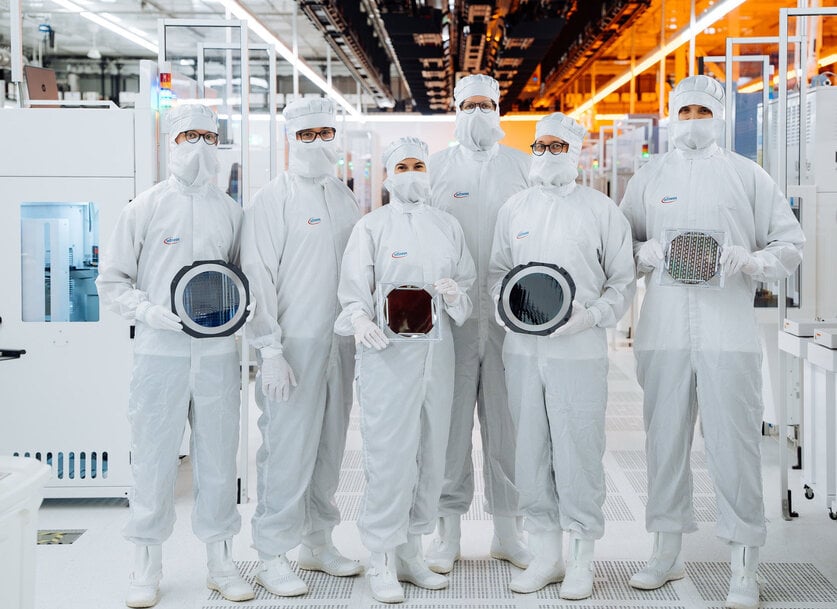
Quantum chips: Infineon contributes industrialization know-how to three European quantum pilot lines © Infineon
Quantum computing, semiconductor manufacturing, and advanced research infrastructures are converging as Europe moves to industrialize quantum technologies. Infineon Technologies AG is participating in multiple European pilot line initiatives aimed at transitioning quantum chips from laboratory prototypes to industrial-scale production.
Bridging research and industrial manufacturing
European quantum pilot lines are designed to provide open-access industrial environments for startups, SMEs, and research institutions. These facilities support the development of quantum computing, communication, and sensing technologies using production-grade processes.
The initiatives address a central challenge in quantum technology: ensuring that critical components such as quantum processing units can be manufactured reliably, with repeatability and at scale. Without this transition from research to fabrication, large-scale deployment of quantum systems remains limited.
The projects contribute to broader European industrial policy frameworks, including the European Chips Act, which aims to strengthen regional semiconductor capabilities and digital sovereignty.
Multi-technology approach to quantum chips
Infineon contributes engineering and manufacturing expertise across three quantum technology platforms: ion traps, superconducting circuits, and semiconductor spin-based systems. This diversified approach reflects the absence of a single dominant quantum hardware architecture and supports parallel development paths.
Dedicated laboratories connected to semiconductor production facilities enable alignment between experimental development and industrial fabrication. This integration is critical for scaling quantum devices beyond small-scale prototypes.
Pilot lines and technical objectives
The company is involved in three major pilot line projects:
Quantum computing, semiconductor manufacturing, and advanced research infrastructures are converging as Europe moves to industrialize quantum technologies. Infineon Technologies AG is participating in multiple European pilot line initiatives aimed at transitioning quantum chips from laboratory prototypes to industrial-scale production.
Bridging research and industrial manufacturing
European quantum pilot lines are designed to provide open-access industrial environments for startups, SMEs, and research institutions. These facilities support the development of quantum computing, communication, and sensing technologies using production-grade processes.
The initiatives address a central challenge in quantum technology: ensuring that critical components such as quantum processing units can be manufactured reliably, with repeatability and at scale. Without this transition from research to fabrication, large-scale deployment of quantum systems remains limited.
The projects contribute to broader European industrial policy frameworks, including the European Chips Act, which aims to strengthen regional semiconductor capabilities and digital sovereignty.
Multi-technology approach to quantum chips
Infineon contributes engineering and manufacturing expertise across three quantum technology platforms: ion traps, superconducting circuits, and semiconductor spin-based systems. This diversified approach reflects the absence of a single dominant quantum hardware architecture and supports parallel development paths.
Dedicated laboratories connected to semiconductor production facilities enable alignment between experimental development and industrial fabrication. This integration is critical for scaling quantum devices beyond small-scale prototypes.
Pilot lines and technical objectives
The company is involved in three major pilot line projects:
- CHAMP-ION focuses on ion-trap quantum chips. Led by Silicon Austria Labs, the project develops integrated systems combining electronics and photonics on a single chip. The objective is to establish a full value chain from design to testing for miniaturized and manufacturable ion-trap devices.
- SUPREME, coordinated by VTT Technical Research Centre of Finland, targets superconducting quantum technologies. A key milestone is the development of a 200-qubit, 3D-integrated module designed to improve stability, yield, and reproducibility using semiconductor-compatible processes.
- SPINS, led by imec, focuses on silicon and silicon-germanium quantum chips. The project leverages CMOS manufacturing to enable scalability and introduces standardized design kits and multi-project wafer runs.
Industrialization and scalability
Across all three pilot lines, the objective is to align quantum device development with high-volume semiconductor manufacturing principles. This includes process standardization, yield optimization, and integration into existing fabrication ecosystems.
By combining multiple hardware platforms with industrial production capabilities, the initiatives aim to accelerate the commercialization of quantum technologies. Application areas include drug discovery, materials science, logistics optimization, and energy systems, where quantum computing could address complex computational challenges beyond classical systems.
Strategic impact for Europe
The pilot lines are co-funded by the European Union under the Chips for Europe initiative and the Chips Joint Undertaking. They represent a coordinated effort to build a competitive quantum ecosystem by linking research excellence with industrial production capacity.
The collaboration model enables knowledge transfer across the value chain, from design and materials science to fabrication and system integration. This approach supports the development of scalable quantum hardware and strengthens Europe’s position in the global semiconductor and quantum technology landscape.
Edited by an industrial journalist, Lekshman Ramdas, with AI assistance.
www.infineon.com
Across all three pilot lines, the objective is to align quantum device development with high-volume semiconductor manufacturing principles. This includes process standardization, yield optimization, and integration into existing fabrication ecosystems.
By combining multiple hardware platforms with industrial production capabilities, the initiatives aim to accelerate the commercialization of quantum technologies. Application areas include drug discovery, materials science, logistics optimization, and energy systems, where quantum computing could address complex computational challenges beyond classical systems.
Strategic impact for Europe
The pilot lines are co-funded by the European Union under the Chips for Europe initiative and the Chips Joint Undertaking. They represent a coordinated effort to build a competitive quantum ecosystem by linking research excellence with industrial production capacity.
The collaboration model enables knowledge transfer across the value chain, from design and materials science to fabrication and system integration. This approach supports the development of scalable quantum hardware and strengthens Europe’s position in the global semiconductor and quantum technology landscape.
Edited by an industrial journalist, Lekshman Ramdas, with AI assistance.
www.infineon.com
