
electronics-journal.com
29
'26
Written on Modified on
Ultralow-Power Vision Sensors for Edge AI Devices
STMicroelectronics introduces compact global-shutter image sensors enabling always-on embedded vision for wearables, AR/VR systems, and energy-constrained smart devices.
www.st.com
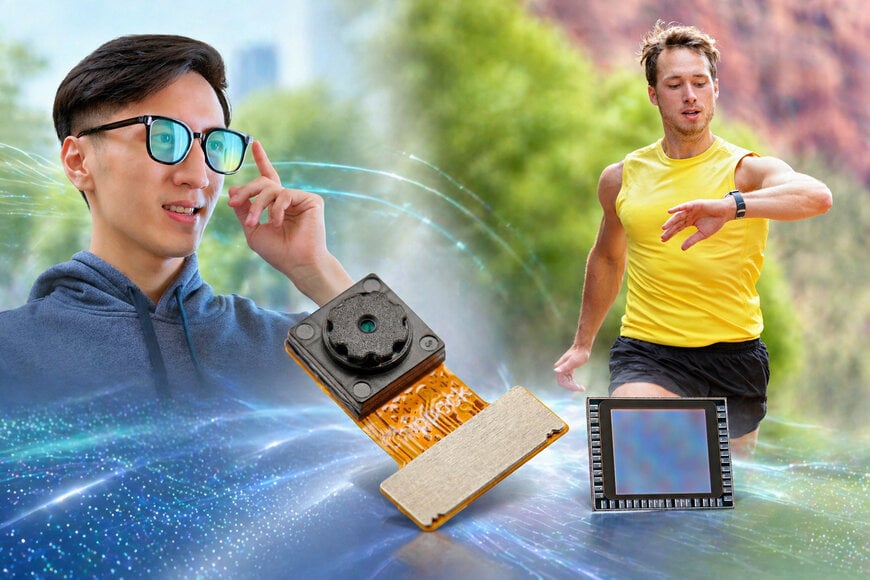
STMicroelectronics has introduced a new generation of ultralow-power image sensors designed to enable continuous, embedded vision in compact electronic systems. The VD55G4 (monochrome) and VD65G4 (RGB) sensors target applications requiring persistent visual awareness under strict power and size constraints, including wearables, extended reality devices, and intelligent IoT nodes.
Enabling Always-On Vision in Energy-Constrained Systems
The new sensors extend the company’s BrightSense portfolio with a focus on edge AI vision and microcontroller-based architectures. Designed for integration into compact systems, they combine a global-shutter architecture with a detect-and-wake mechanism that allows the sensor to monitor a scene continuously while minimizing energy consumption.
This architecture supports event-driven operation, where the sensor activates the host processor only when relevant visual changes are detected. Such a mechanism reduces the need for continuous data streaming and lowers system-level power consumption, which is critical for battery-powered and energy-harvesting devices.
The sensors operate at approximately 800 × 700 resolution and 10 frames per second, with power consumption reported to be up to ten times lower than conventional global-shutter sensors under comparable conditions. This reduction is achieved through optimized pixel design, low-power readout circuitry, and a dedicated always-on mode.
Application Across Wearables, XR, and Smart Devices
The VD55G4 and VD65G4 are designed for a range of applications where embedded vision systems must operate continuously without compromising device autonomy.
In wearable devices, the sensors enable functions such as presence detection, gesture recognition, and contextual awareness while maintaining all-day battery life. Their compatibility with low-power microcontrollers simplifies system design and reduces reliance on more energy-intensive processors.
For AR/VR and XR headsets, the sensors support spatial tracking and environmental awareness. The global-shutter design eliminates motion artifacts, which is essential for accurate positioning and user interaction in immersive environments.
In smart home appliances, medical devices, and industrial IoT nodes, the sensors enable local data processing, reducing dependency on cloud-based systems. This contributes to lower latency, improved privacy, and reduced network energy consumption. Their efficiency also supports deployment in systems powered by solar cells or other energy-harvesting methods.
Sensor Architecture and Integration
The sensors are manufactured using a 3D-stacked semiconductor architecture combining 65 nm and 40 nm process technologies on 300 mm wafers. This approach enables separation of photodiode and processing layers, optimizing both image quality and power efficiency.
Their compact optical format and integrated image processing reduce the need for additional external components, lowering system cost and simplifying integration into space-constrained designs. Interfaces are optimized for direct connection to microcontrollers and cost-efficient system-on-chip platforms, supporting streamlined embedded development.
Development Ecosystem for Embedded Vision
To support rapid adoption, STMicroelectronics provides a development ecosystem that includes evaluation boards compatible with STM32 and Raspberry Pi platforms, camera modules, software drivers, and a dedicated software development kit.
These tools are designed to accelerate prototyping and deployment of always-on vision applications, particularly in distributed edge AI environments where processing is performed locally rather than in centralized cloud infrastructure.
Positioning Within the Image Sensor Landscape
Compared to conventional global-shutter sensors, which typically prioritize image quality and speed over energy efficiency, the VD55G4 and VD65G4 emphasize low-power operation and event-driven functionality. This positions them within a growing category of sensors optimized for edge AI vision and low-power IoT systems, where continuous sensing must coexist with limited energy budgets.
By combining reduced power consumption with microcontroller compatibility and compact integration, these sensors address a design space not fully served by traditional high-performance imaging solutions.
Edited by an industrial journalist Sucithra Mani with AI assistance.
www.st.com
