
electronics-journal.com
01
'26
Written on Modified on
Broadcom Expands Wi-Fi 8 and 10G PON Portfolio
Broadcom introduces optimized Wi-Fi 8 chips and a 10G PON SoC to facilitate large-scale migration to high-speed fiber-based connectivity.
www.broadcom.com
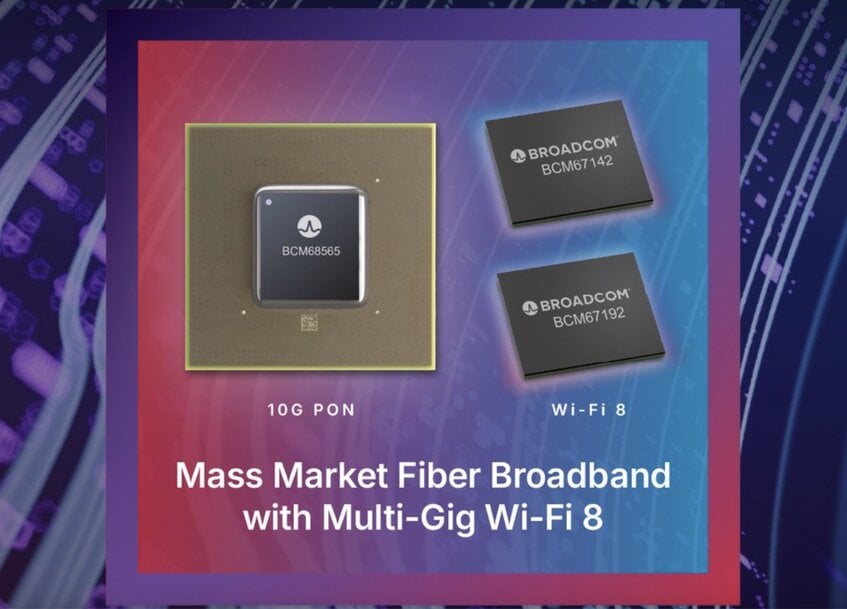
Broadcom has announced its fourth wave of Wi-Fi 8 (IEEE 802.11bn) chips alongside an optimized 10G PON chip. These solutions are designed to help service providers in competitive broadband markets transition from legacy copper and cable technologies to modern fiber-based networks while managing cost structures.
Optimized 10G PON Gateway SoC
The BCM68565 is a system-on-a-chip (SoC) engineered to balance power, performance, and features for mass-market fiber deployments. It integrates a 10-Gbps fiber WAN interface that supports XGSPON, GPON, and Active Ethernet modes. To ensure performance during heavy usage, a dedicated network processing engine manages traffic, allowing the high-performance CPU complex to handle operator-specific applications and open-source middleware like RDK and prplWare.
Integrated Dual-Band Wi-Fi 8 Radios
Broadcom also introduced the BCM67142 and BCM67192, which are highly integrated dual-band Wi-Fi 8 radios. These chips consolidate 2.4-GHz and 5-GHz radios into a single piece of silicon, reducing the physical footprint and bill of materials (BOM) costs.
- Hardware Efficiency: An integrated hardware offload engine leverages the host CPU to manage performance without increasing system costs.
- Power Optimization: The radios include third-generation digital pre-distortion, which reduces peak power by 25%, and advanced eco-modes for lower energy consumption.
- RF Integration: On-chip 2.4-GHz power amplifiers reduce the need for external components and improve radio frequency efficiency.
Architectural Breakthrough for Scalability
This expansion introduces a new level of efficiency by optimizing CPU and memory resources between the broadband SoC and the Wi-Fi chips. By simplifying board design and lowering power consumption, Broadcom aims to make "Ultra-High Reliability" accessible in high-volume markets, supporting multi-gigabit performance even in average revenue per user (ARPU) constrained environments.
Additional Context
The introduction of Wi-Fi 8 (802.11bn) marks a technical evolution from Wi-Fi 7, shifting the focus from peak theoretical speeds to "Ultra-High Reliability" and consistent performance in dense environments. In broadband markets where ARPU is low, the cost of hardware is a significant barrier to upgrading infrastructure. Broadcom’s integration of dual-band functionality into a single chip directly addresses this by reducing the complexity of the printed circuit board (PCB) and the number of discrete components required.
Technically, the move to 10G PON (Passive Optical Network) provides the necessary symmetric backhaul capacity to support Wi-Fi 8's capabilities. While legacy cable (DOCSIS) or copper (DSL) often suffer from high latency and asymmetric speeds, 10G PON provides a stable, low-latency foundation. By utilizing digital pre-distortion and integrated power amplifiers, Broadcom is also addressing the thermal management challenges inherent in small-form-factor home gateways, allowing these devices to maintain high throughput without specialized cooling solutions.
Edited by Romila DSilva, Induportals Editor, with AI assistance.
This expansion introduces a new level of efficiency by optimizing CPU and memory resources between the broadband SoC and the Wi-Fi chips. By simplifying board design and lowering power consumption, Broadcom aims to make "Ultra-High Reliability" accessible in high-volume markets, supporting multi-gigabit performance even in average revenue per user (ARPU) constrained environments.
Additional Context
The introduction of Wi-Fi 8 (802.11bn) marks a technical evolution from Wi-Fi 7, shifting the focus from peak theoretical speeds to "Ultra-High Reliability" and consistent performance in dense environments. In broadband markets where ARPU is low, the cost of hardware is a significant barrier to upgrading infrastructure. Broadcom’s integration of dual-band functionality into a single chip directly addresses this by reducing the complexity of the printed circuit board (PCB) and the number of discrete components required.
Technically, the move to 10G PON (Passive Optical Network) provides the necessary symmetric backhaul capacity to support Wi-Fi 8's capabilities. While legacy cable (DOCSIS) or copper (DSL) often suffer from high latency and asymmetric speeds, 10G PON provides a stable, low-latency foundation. By utilizing digital pre-distortion and integrated power amplifiers, Broadcom is also addressing the thermal management challenges inherent in small-form-factor home gateways, allowing these devices to maintain high throughput without specialized cooling solutions.
Edited by Romila DSilva, Induportals Editor, with AI assistance.
