
Verification of Lower Layer Triggered Mobility for 5G Networks
Anritsu introduces test cases for 3GPP Release 18 to minimize handover interruption in time-critical communication and extended reality applications.
www.anritsu.com
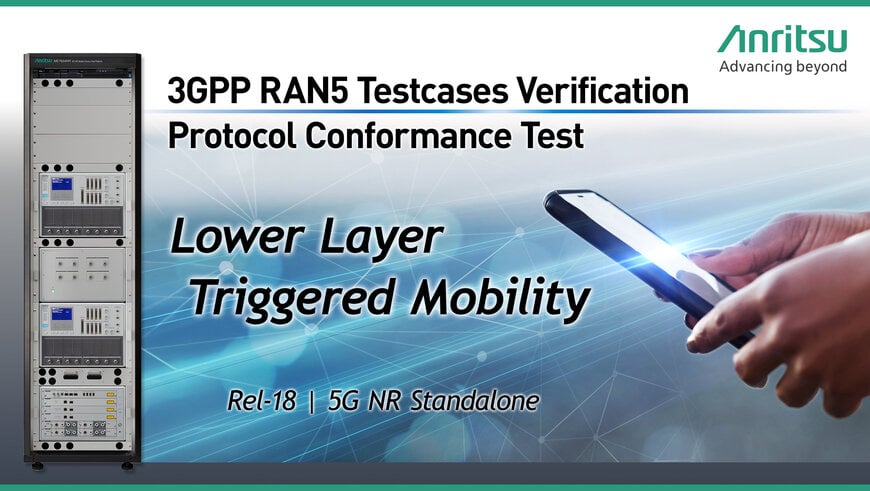
The transition to 5G Standalone networks requires reduced latency in high-mobility environments to support time-critical communications (TCC) and extended reality (XR) services. To facilitate this operational shift, test frameworks are expanding to validate new network mobility mechanisms. Anritsu has introduced test cases for 3GPP RAN5 Release 18 Lower Layer Triggered Mobility (LTM) on its 5G NR mobile device test platform, enabling the verification of device conformance and interoperability.
Limitations of Layer 3 Handover in 5G Networks
In cellular networks, handover procedures transfer user equipment (UE) between serving and neighboring cells to maintain signal integrity. In existing 5G deployments, this procedure is initiated by the base station via a Radio Resource Control (RRC) message operating at Layer 3 (L3). Because L3 handover involves higher-layer signaling, it introduces a service interruption typically ranging from 50 to 90 milliseconds. While sufficient for standard broadband applications, this latency degrades the operational stability of TCC and XR services, which require continuous data transmission without disruption.
Lower Layer Triggered Mobility Mechanism
To address handover latency, 3GPP Release 18 defined Lower Layer Triggered Mobility. This mechanism shifts handover initiation from Layer 3 to Layer 2, relying on Layer 1 measurements executed and reported by the UE. Using lower-layer signaling allows the UE to synchronize uplink and downlink channels in advance with a neighboring candidate cell. This proactive synchronization accelerates the execution of cell transitions, reducing signaling overhead and minimizing service interruption times during physical movement between coverage zones.
Conformance Verification and Implementation
Validating LTM functionality requires mobile device test platforms to simulate these lower-layer transitions accurately. The implementation of NR LTM test cases enables operators and equipment vendors to measure handover interruption and ensure adherence to 3GPP Release 18 standards before commercial deployment.
"Support for 3GPP Release 18 NR Lower Layer Triggered Mobility test cases enables faster handover performance, which is critical for time-sensitive 5G services," stated Daizaburo Yokoo, General Manager of the Mobile Solutions Division at Anritsu. He noted that validating these lower-layer mechanisms assists operators and device vendors in "reducing handover interruption and lowering signaling overhead."
Additional Context: This section details technical specifications and competitive benchmarking not included in the original product announcement.
The verification of 3GPP Release 18 features involves benchmarking conformance test platforms from primary telecommunications test equipment manufacturers. Systems such as the Anritsu ME7834NR compete directly with protocol testing platforms like the Keysight S8704A Protocol Conformance Toolset and the Rohde & Schwarz TS8980. Differentiation among these platforms relies on the speed at which new 3GPP test cases are validated by the Global Certification Forum (GCF) and PTCRB, the supported frequency ranges (FR1 and FR2), and the capacity to automate protocol conformance testing for advanced 5G Standalone features, including LTM and Reduced Capability (RedCap) specifications.
Edited by an industrial journalist, Lekshman Ramdas, with AI assistance.
www.anritsu.com
