
electronics-journal.com
27
'26
Written on Modified on
Integrated Neural Processing Units For High Speed Fiber Gateways
Broadcom announces first edge artificial intelligence gateway system on chip with unified optical and wireless connectivity.
www.broadcom.com
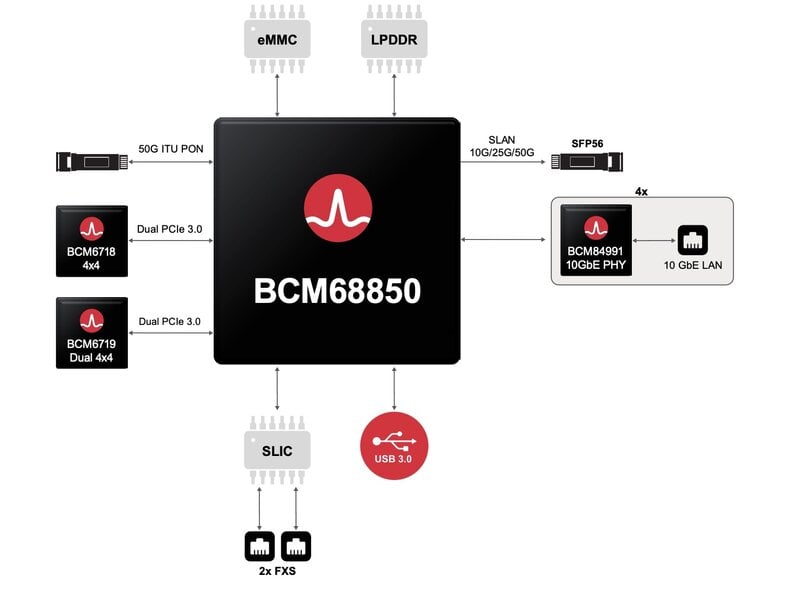
Broadcom has introduced the BCM68850, an integrated hardware solution that combines a 50G passive optical network gateway with an embedded neural processing unit and native wireless compatibility. Designed to act as a centralized edge intelligence hub within residential environments, the architecture addresses the shifting parameters of fiber-to-the-home infrastructures by merging deterministic physical layer optical throughput with localized machine learning acceleration. This approach establishes a unified system topology to handle concurrent multi-gigabit workloads, local edge artificial intelligence processing, and incoming wireless standards.
Physical Layer Throughput and Latency Optimization
The deployment of 50G passive optical network systems is driven by the need to mitigate channel congestion caused by high-density, instantaneous data bursts. Traditional residential traffic profiles are evolving from sustained, predictable data streams into localized edge-compute spikes, necessitating greater network headroom. The BCM68850 addresses this by delivering full symmetric 50G throughput, processing and transmitting high-density payloads within a fraction of a millisecond.
This rapid transmission mechanic follows a burst and release operational profile. By clearing the optical channel immediately following payload execution, the system maintains near-zero jitter for latency-critical tasks such as synchronizing autonomous software agents and streaming multi-stream ultra-high-definition telepresence. This rapid scheduling mechanism prevents node congestion across shared fiber strands, extending the operating lifecycle of consumer premises equipment through upcoming wireless deployment cycles.
Hardware Architecture and Accelerated Edge Processing
Architecturally, the system-on-chip divides operational tasks across distinct, specialized processing engines to optimize internal memory and computing resources:
- Application Engine: A dedicated central processing unit handles third-party and operator applications, leveraging standard open middleware layers to maintain independent execution environments.
- Neural Engine: An integrated hardware neural processing unit accelerates edge artificial intelligence inference directly on the device. By executing mathematical models locally, the system minimizes round-trip cloud latency and improves data privacy by keeping telemetry on premises.
- Integrated Interface Architecture: The system integrates native optical media access control layer components with foundational compatibility for wireless broadband edge standards, ensuring predictable data distribution across the local network.
Beyond raw throughput, the localized processing architecture enables automated network maintenance. Operators can implement continuous anomaly detection and predictive bandwidth allocation algorithms directly at the edge node, reducing operational expenditures through self-healing routines. Security parameters are upgraded via hardware-enforced cryptographic layers, incorporating post-quantum cryptography algorithms to protect data exchanges against future cryptographic vulnerabilities.
Ecosystem Integration and Fiber Infrastructure Continuity
The introduction of the BCM68850 completes an end-to-end 50G hardware pipeline. This semiconductor ecosystem spans from the central office, utilizing the BCM68660 optical line terminal, down to the network endpoint via the BCM55050 optical network unit or the BCM68850 gateway. This unified architectural foundation across fiber, cable, set-top box, and wireless environments allows telecommunications operators to deploy standardized management layers across varied access mediums.
According to market research data from Omdia, operators are actively upgrading central offices and network endpoints with 50G capabilities to meet enterprise and consumer demands for reliable infrastructure. The deployment of integrated gateway solutions acts as a technical stabilizing factor, ensuring that the local physical layer can scale alongside the strict performance requirements dictated by next-generation wireless networks over the coming decade.
Additional Context
This section details technical specifications and competitive benchmarking not included in the original news release.
The transition to 50G passive optical networks represents an evolution defined by the International Telecommunication Union ITU-T G.9804 standard series, providing a fivefold increase in bandwidth over legacy XGS-PON (10G symmetric) networks. Within this semiconductor landscape, competing solutions from manufacturers like Huawei and ZTE have historically approached 50G migration by separating the optical termination unit from the application gateway, or utilizing first-generation application silicon combined with Wi-Fi 7 chipsets.
The BCM68850 alters this benchmark by consolidating the 50G optical media access control, a dedicated application processor, and a neural processing unit onto a single system-on-chip. While earlier 50G customer premises prototypes demonstrated standard Layer 2 throughput caps near 35 to 40 Gbps with upstream latencies averaging 50 to 100 microseconds, the integration of a dedicated neural engine allows the BCM68850 to offload traffic management and pattern analysis from the main application processor. This pipeline optimization ensures the chip achieves full symmetric 50G wire-speed performance while running concurrent on-premises edge artificial intelligence models, establishing an integrated performance baseline for upcoming Wi-Fi 8 architectures.
Edited by Romila DSilva, Induportals Editor, with AI assistance.
Ecosystem Integration and Fiber Infrastructure Continuity
The introduction of the BCM68850 completes an end-to-end 50G hardware pipeline. This semiconductor ecosystem spans from the central office, utilizing the BCM68660 optical line terminal, down to the network endpoint via the BCM55050 optical network unit or the BCM68850 gateway. This unified architectural foundation across fiber, cable, set-top box, and wireless environments allows telecommunications operators to deploy standardized management layers across varied access mediums.
According to market research data from Omdia, operators are actively upgrading central offices and network endpoints with 50G capabilities to meet enterprise and consumer demands for reliable infrastructure. The deployment of integrated gateway solutions acts as a technical stabilizing factor, ensuring that the local physical layer can scale alongside the strict performance requirements dictated by next-generation wireless networks over the coming decade.
Additional Context
This section details technical specifications and competitive benchmarking not included in the original news release.
The transition to 50G passive optical networks represents an evolution defined by the International Telecommunication Union ITU-T G.9804 standard series, providing a fivefold increase in bandwidth over legacy XGS-PON (10G symmetric) networks. Within this semiconductor landscape, competing solutions from manufacturers like Huawei and ZTE have historically approached 50G migration by separating the optical termination unit from the application gateway, or utilizing first-generation application silicon combined with Wi-Fi 7 chipsets.
The BCM68850 alters this benchmark by consolidating the 50G optical media access control, a dedicated application processor, and a neural processing unit onto a single system-on-chip. While earlier 50G customer premises prototypes demonstrated standard Layer 2 throughput caps near 35 to 40 Gbps with upstream latencies averaging 50 to 100 microseconds, the integration of a dedicated neural engine allows the BCM68850 to offload traffic management and pattern analysis from the main application processor. This pipeline optimization ensures the chip achieves full symmetric 50G wire-speed performance while running concurrent on-premises edge artificial intelligence models, establishing an integrated performance baseline for upcoming Wi-Fi 8 architectures.
Edited by Romila DSilva, Induportals Editor, with AI assistance.
