
electronics-journal.com
27
'26
Written on Modified on
Rotary Position Sensors for Next Generation Automotive Actuators
TDK Corporation introduced a single-die Hall-effect position sensor designed to meet automotive safety requirements for electronic braking and steering control systems.
www.tdk.com
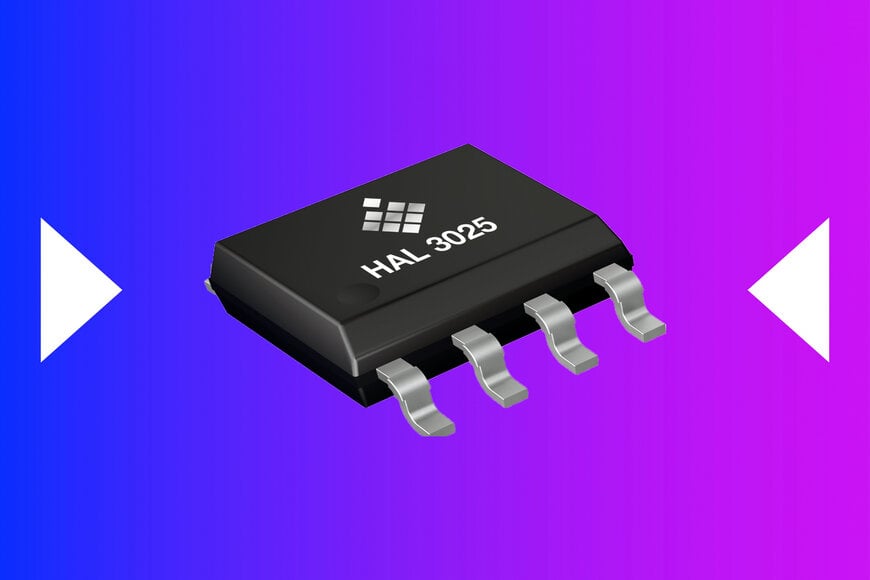
The introduction of the HAL 3025 sensor expands the existing portfolio of magnetic position sensors to address the stringent requirements of x-by-wire applications, including steer-by-wire and brake-by-wire systems. This sensor utilizes vertical Hall-effect technology to measure a full 360-degree rotational angle by evaluating the vertical magnetic field component. A primary technical challenge in modern electric vehicles is the electromagnetic interference generated by adjacent power electronics and electric motors. The component addresses this by incorporating magnetic stray field compensation that complies with the ISO 11452-8:2015 standard. This mechanism suppresses both direct current and alternating current external magnetic fields, allowing for compact motor layouts without the addition of heavy magnetic shielding or oversized target magnets. Consequently, system designers can utilize a standard two-pole ferrite magnet in an end-of-shaft configuration, reducing the overall bill of materials.
Functional Safety Architecture and High-Speed Motor Commutation
Engineered as a Safety Element out of Context, the component is assessed as ASIL D ready according to the ISO 26262:2018 functional safety standard. Unlike traditional architectures that rely on dual-die or multi-die redundancy to achieve high diagnostic coverage, this device implements a single-die failsafe architecture. This design integrates on-chip safety monitoring functions — including wire-break detection as well as overvoltage and undervoltage protection — which minimizes the secondary supervisory workload required by the external Electronic Control Unit.
For high-performance motor control, the analog signal path is optimized to support rotational speeds up to 60,000 rpm. The sensor provides differential or single-ended sine and cosine analog outputs, enabling external microcontrollers to calculate absolute angular positions with minimal latency. This high output bandwidth is critical for the commutation of brushless DC motors, permanent magnet synchronous motors, and high-voltage traction motors.
Thermal Durability and End-of-Line Calibration
The device is packaged in a compact SOIC8 surface-mount device footprint, maintaining pin compatibility with previous generations to facilitate direct hardware upgrades. To withstand harsh automotive environments, the component is rated for a junction temperature range spanning from -40 °C to 170 °C. For end-of-line calibration, the parameters of the internal non-volatile memory can be programmed directly through the output pins. This feature allows technicians to adjust sine and cosine gain, offset, 0-angle, and orthogonality without requiring dedicated programming pins. Samples of the sensor are available, and the start of production is scheduled for the second quarter of 2026.
Additional Context
This section details technical specifications and competitive benchmarking not included in the original product announcement
In the market for automotive functional safety position sensors, achieving ASIL D compliance on a single die represents a distinct architectural approach compared to traditional dual-die solutions, such as those found in the Infineon TLE5014 series or Melexis MLX90380 configurations. While dual-die sensors achieve redundancy by placing two independent sensor elements within the same package, they double the internal silicon area and increase package size constraints. The single-die architecture evaluated here relies instead on comprehensive internal diagnostic circuits to achieve the necessary diagnostic coverage fraction required by ISO 26262, minimizing electronic control unit hardware complexity and board space. Furthermore, the maximum rotational speed specification of 60,000 rpm positions the device at the higher end of automotive magnetic sensor capabilities, where standard tunnel magnetoresistive or conventional Hall sensors frequently cap operational speeds between 30,000 rpm and 45,000 rpm due to propagation delays in the digital processing loop.
Edited by Evgeny Churilov, Induportals Media - Adapted by AI.
www.micronas.tdk.com
