
electronics-journal.com
01
'26
Written on Modified on
Microchip Introduces Cost-Optimized Real-Time Control DSCs
The new controller family targets embedded control applications by combining deterministic processing, integrated analog functions, and automotive-grade reliability in a single device.
www.microchip.com
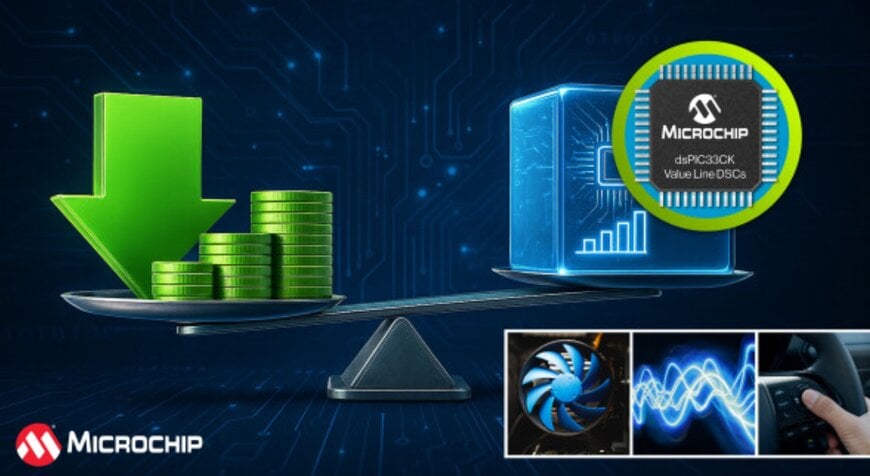
Microchip Technology has introduced the dsPIC33CK Value Line family of Digital Signal Controllers (DSCs), designed for real-time control applications that require a balance of processing performance, peripheral integration, and cost efficiency. The devices target industrial automation, automotive electronics, consumer products, and medical equipment where precise control and reliable operation are critical.
Real-Time Control Requirements Drive Integrated Design
Many embedded control systems require fast response times, accurate sensing, and multiple communication interfaces while maintaining low bill-of-materials costs. Applications such as field-oriented motor control (FOC), capacitive touch interfaces, and precision sensing often depend on deterministic processing and tightly integrated peripherals.
The dsPIC33CK Value Line family addresses these requirements by combining processing, analog, and communication functions within a single controller. By integrating functions that would otherwise require additional components, the devices can reduce printed circuit board complexity, component count, and system-level costs.
The controllers operate at clock speeds of up to 100 MHz and are designed to support deterministic execution, a key requirement in real-time control architectures where predictable response times are essential.
Integrated Analog and PWM Functions for Precision Control
A notable feature of the new DSC family is the integration of analog and control peripherals intended for closed-loop control applications. The devices incorporate a 12-bit analog-to-digital converter (ADC), a 12-bit digital-to-analog converter (DAC), and an on-chip analog comparator.
The ADC supports sampling rates of up to 2 million samples per second (2 MSPS) across eight channels, enabling rapid acquisition of sensor data in motor control and industrial monitoring applications. The integrated pulse-width modulation (PWM) subsystem offers resolution down to 2 nanoseconds, supporting high-precision control of motors, power conversion systems, and other time-sensitive electronic functions.
These capabilities allow designers to implement advanced control algorithms while reducing reliance on external analog components.
Scalable Memory Options and Long-Term Design Flexibility
The dsPIC33CK Value Line family is available with programmable flash memory capacities ranging from 32 KB to 256 KB. This range enables developers to select devices based on application requirements while maintaining compatibility with other members of the dsPIC33CK platform.
Compatibility across the broader dsPIC33CK ecosystem provides a migration path for future product upgrades, allowing developers to scale processing or memory resources without extensive redesign. Such scalability can be particularly valuable in industrial and automotive product development cycles where platform longevity is a key consideration.
Communication Interfaces for Embedded Control Networks
Modern embedded systems increasingly operate within connected environments that require support for multiple communication standards. To address these requirements, the controller family integrates CAN FD, LIN, SENT, UART, SPI, and I²C interfaces.
The inclusion of CAN FD and LIN makes the devices suitable for automotive electronic control units, while SENT support enables communication with automotive sensors. SPI, UART, and I²C interfaces support connectivity with sensors, displays, wireless modules, and other peripheral devices commonly found in industrial automation and consumer electronics.
This broad communication capability allows a single controller platform to support diverse embedded control architectures and connected device ecosystems.
Automotive Reliability and Embedded Security Features
The controllers are qualified to AEC-Q100 Grade 1, an automotive reliability standard that validates semiconductor operation across a temperature range typically extending from -40°C to +125°C. This qualification supports deployment in demanding automotive and industrial environments.
The devices also incorporate security mechanisms including secure boot and secure firmware update functionality. These features help protect system software from unauthorized modification and support secure lifecycle management for connected embedded systems.
By combining reliability certification with integrated security, the controllers are designed to address growing requirements for secure and dependable operation in industrial automation and automotive electronics.
Development Ecosystem Supports Rapid Prototyping
To accelerate evaluation and development, Microchip has introduced a low-cost Curiosity Nano evaluation kit for the dsPIC33CK Value Line family. The kit includes an integrated debugger, eliminating the need for external programming hardware during initial development.
The platform is compatible with the Curiosity Nano Base for Click Boards, touch adapter boards, and a Dual Inline Module (DIM) designed for motor control prototyping. Developers can also use the devices within the MPLAB development ecosystem, including the MPLAB XC-DSC Pro compiler and associated software tools.
This ecosystem enables engineers to prototype, test, and deploy real-time control applications using a common development environment across multiple product generations.
Additional Context
This section details technical specifications and competitive benchmarking not included in the original news release.
The dsPIC33CK Value Line enters a competitive market that includes devices such as the Texas Instruments C2000 F28002x series, the STMicroelectronics STM32G4 family, and the NXP S32K series for control-oriented embedded applications. Common benchmarking criteria in this segment include processor frequency, ADC sampling rate, PWM resolution, communication interfaces, memory capacity, and safety certifications.
With processing speeds of up to 100 MHz, integrated 12-bit ADC functionality reaching 2 MSPS, and 2 ns PWM resolution, the dsPIC33CK Value Line is positioned for motor control and digital power applications that require precise timing and deterministic execution. Compared with general-purpose microcontrollers, Digital Signal Controllers combine microcontroller functionality with digital signal processing capabilities, enabling efficient implementation of control algorithms in industrial automation, automotive electronics, and intelligent sensing systems. The inclusion of CAN FD, LIN, and SENT interfaces also aligns the platform with requirements commonly found in automotive data ecosystem architectures and next-generation embedded control networks.
Edited by Aishwarya Mambet, Induportals Editor, with AI assistance.
www.microchip.com
