
electronics-journal.com
01
'26
Written on Modified on
binder transforms components into intelligent systems through printed electronics
By directly integrating functional layers onto surfaces, binder enables a new era of compact and highly integrated device architectures.
www.binder-connector.com
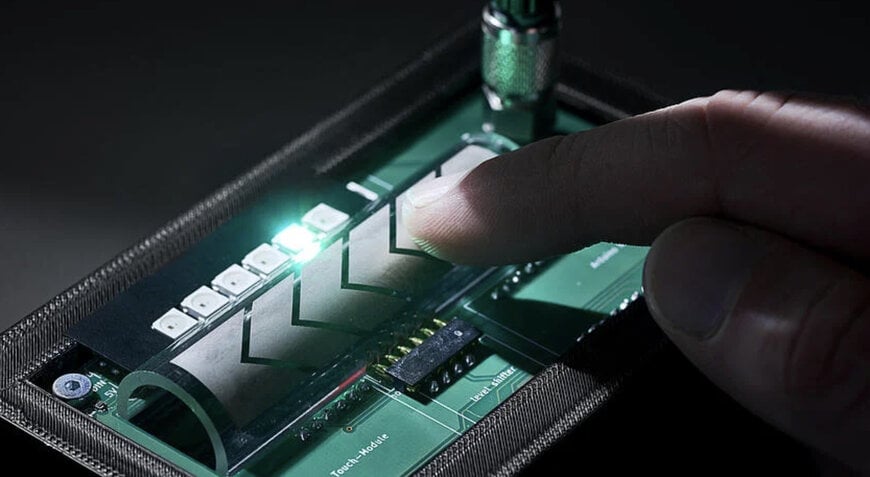
Industrial development has followed a clear trend for years: functions are becoming more compact and decentralized. Controllers are moving from control cabinets directly to field devices, and complex cabling is merging into efficient one-cable solutions. At its Innovation and Technology Center (ITZ) in Bad Rappenau, the binder Group is now taking a decisive step further: the company prints electronically functional structures—such as sensors, heating elements, and conductive tracks—directly onto three-dimensional components. This approach eliminates the need for separate individual parts, saves valuable installation space, and significantly reduces the number of assembly steps.
Overcoming the Limits of Classic Assembly Technology
Modern devices are characterized by increasing connectivity and a high density of sensors. Conventional assembly technology is increasingly reaching its limits: every additional component, every printed circuit board, and every contact element requires space, incurs assembly effort, and represents a potential source of error. Furthermore, integrating conventional electronics onto curved or complexly shaped surfaces is often technically impractical.
This is where binder’s printed electronics come into play. Using high-precision screen and pad printing processes, functional layers are applied directly to substrates made of plastic, metal, glass, or ceramic. Through the use of conductive pastes based on silver, copper, or carbon, as well as dielectric materials, complex conductive tracks and sensors are created in multi-layer printing—even on irregular geometries.
Versatile Applications for Greater Design Freedom
The potential applications are extremely diverse:
- Mechanical Engineering: Printed sensors provide precise data for condition monitoring and predictive maintenance.
- User Interfaces: Printed touch and force sensors replace classic mechanical buttons and offer new design possibilities.
- Temperature Management: Integrated heating elements reliably keep components at the required operating temperature.
- The decisive advantage: function and housing merge into a single unit, leading to lower weight, more compact designs, and enormous freedom in design.
"Printed electronics push the boundaries of what a single component can achieve. We bring conductive tracks, heating functions, or sensor technology directly to the surface, thereby saving an entire series of individual parts and creating intelligent components. At the ITZ, we develop these processes to application maturity. Through the binder Group, the functional prototype becomes a production-ready solution." — Dr.-Ing. Martin Ungerer, Team Leader Printed Electronics at binder ITZ.
Comprehensive Solutions from a Single Source
A key competitive advantage of the binder Group is its vertical integration. While the ITZ researches and matures printing processes for series production, binder solutions handles customer-specific implementation. Thanks to the comprehensive portfolio—ranging from cable assembly and precision-turned parts to zinc die-casting—the printed functional layer can be seamlessly combined with connectors and connection technology into a coordinated overall system. Customers do not receive an isolated component, but rather an end-to-end system solution from prototype to series production.
With this strategic orientation, binder positions itself as a development partner for the next generation of intelligent devices, especially where functions must be integrated in the smallest of spaces and under demanding geometric conditions.
Edited by Maria Brueva, Induportals editor – adapted by AI.
www.binder-connector.com
Comprehensive Solutions from a Single Source
A key competitive advantage of the binder Group is its vertical integration. While the ITZ researches and matures printing processes for series production, binder solutions handles customer-specific implementation. Thanks to the comprehensive portfolio—ranging from cable assembly and precision-turned parts to zinc die-casting—the printed functional layer can be seamlessly combined with connectors and connection technology into a coordinated overall system. Customers do not receive an isolated component, but rather an end-to-end system solution from prototype to series production.
With this strategic orientation, binder positions itself as a development partner for the next generation of intelligent devices, especially where functions must be integrated in the smallest of spaces and under demanding geometric conditions.
Edited by Maria Brueva, Induportals editor – adapted by AI.
www.binder-connector.com
