
electronics-journal.com
02
'26
Written on Modified on
High-Speed Automotive Ethernet Connector System Delivers 25Gbps Network Speeds
Molex has expanded its high-speed interconnect portfolio to meet the growing bandwidth demands of advanced driver-assistance systems and centralized vehicle compute architectures.
www.molex.com
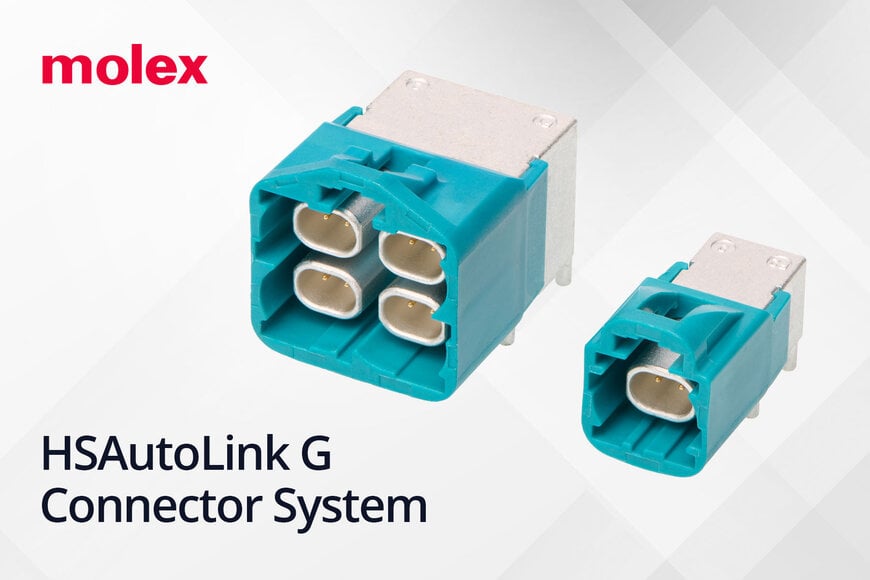
A new automotive Ethernet connector system has been introduced to support data transfer speeds up to 25Gbps across multi-gigabit vehicle networks. The hardware solution targets high-bandwidth applications within the automotive data ecosystem, including Advanced Driver-Assistance Systems (ADAS), radar, LiDAR, and centralized zonal compute modules.
High-Speed Bandwidth Optimization for Vehicle Architecture
As the automotive industry transitions to software-defined vehicles, distributed electronic control unit architectures are increasingly consolidated into centralized computing platforms linked by high-speed networks. This structural shift concentrates data streams, moving vehicle electronics closer to the physical constraints of high-frequency signal transmission. The newly introduced connector system addresses these performance demands by supporting both Shielded Twisted Pair (STP) and Unshielded Twisted Pair (UTP) configurations to sustain data rates reaching 25Gbps.
By scaling up bandwidth capabilities within established footprints, the interface helps vehicle manufacturers eliminate data bottlenecks without requiring extensive packaging re-engineering. Min Kong, regional general manager of Connected Mobility Systems at Molex, indicated that the technology provides vehicle manufacturers with a validated upgrade path to enhance resiliency across the digital supply chain while supporting rising bandwidth requirements.
Mechanical Integrity and Electromagnetic Shielding Compliance
Operating at a 25Gbps threshold introduces severe risks regarding signal integrity, electromagnetic interference, and validation delays. To counteract these challenges, the connector system features advanced electromagnetic interference shielding along with precisely controlled differential impedance. The integration of multiple, uniform ground-contact points increases suppression of stray radiation, which is essential when high-speed data lines run adjacent to high-voltage electric vehicle drivetrains or 48V power architectures.
Physical robustization mechanisms are also integrated to improve assembly yields and component lifecycles during automated manufacturing. A specialized terminal anti-stubbing mechanism protects internal contact interfaces during the mating process to prevent mis-mating errors. Furthermore, a reversible housing shroud offers layout adaptability, allowing field engineers more packaging and routing options inside cramped electronic modules.
Standardized Interfaces for Global Supply Chain Integration
The product line encompasses terminals, connectors, printed circuit board headers, and cable assemblies designed to match standard USCAR footprints. Adhering to these established automotive specifications provides tier-one suppliers and original equipment manufacturers with true sourcing optionality, reducing redesign pressures when updating internal network systems.
The underlying technology and related connectivity solutions—including systems optimized for vehicle electrification, high-vibration battery packs, and durable exterior lighting networks—will be demonstrated at Electronica China 2026 at Booth W1.301. Providing alternate, fully qualified high-speed component sources is particularly crucial for maintaining assembly timelines in high-volume, rapidly scaling electric vehicle markets.
Additional Context: This section details technical specifications and competitive benchmarking not included in the original product announcement
The development of 25Gbps copper-based interconnects aligns with the IEEE 802.3cy standard, which governs multi-gigabit automotive Ethernet physical layer specifications over electrical channels. When benchmarked against alternative high-speed differential connector platforms, such as the TE Connectivity GEMnet system, distinct operational trade-offs emerge. The GEMnet platform offers a broader frequency range up to 15 GHz and supports maximum data rates up to 56Gbps using PAM-4 modulation, making it suitable for multi-protocol backbones encompassing PCIe and high-frequency SerDes applications.
In contrast, the new Molex interface focuses on direct compatibility with standard USCAR Ethernet configurations. While its peak data rate is limited to the 25Gbps threshold specified by IEEE 802.3cy, its adherence to legacy USCAR dimensions allows direct drop-in integration into existing mid-tier module housings. This eliminates the complete PCB layout overhauls often necessitated by smaller, proprietary multi-port alternatives, optimizing the cost-to-performance ratio for mainstream zonal architectures.
Edited by Sucithra Mani, Induportals editor – adapted by AI.
www.molex.com
