
electronics-journal.com
29
'26
Written on Modified on
Solid-State Isolation for Industrial Automation Systems
Infineon introduces coreless-transformer technology to replace traditional electromechanical relays in space-constrained designs.
www.infineon.com
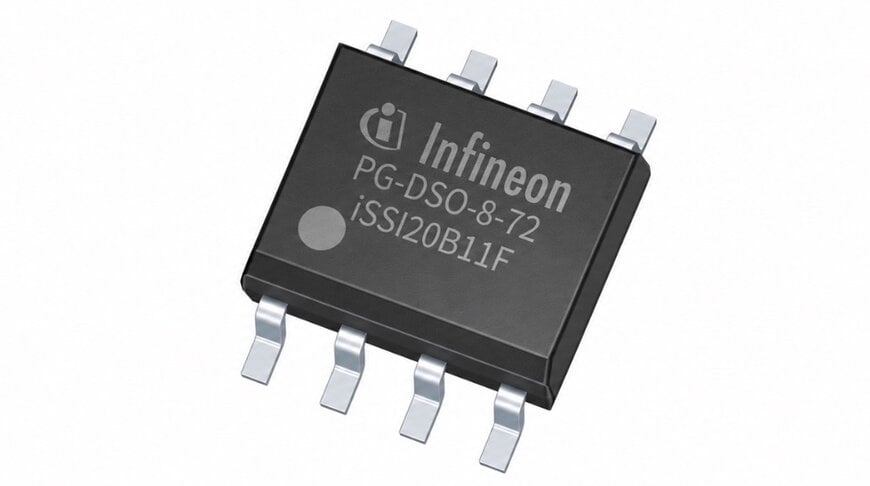
Infineon Technologies AG is releasing the ISSI20BxxF Solid State Isolator (SSI) family, a compact hardware solution designed to upgrade traditional photovoltaic and electromechanical relay systems. This architecture facilitates highly efficient energy and signal transfer for solid-state relay modules, programmable logic controller (PLC) inputs and outputs, and diverse industrial automation applications.
Coreless-Transformer Architecture and Solid-State Isolation Capabilities
Built on proprietary coreless-transformer technology, the ISSI20BxxF series transfers both operational signals and energy across an isolation barrier to drive external power switches, entirely eliminating the requirement for a dedicated isolated gate supply. This structural approach yields a higher output-drive capability than conventional photovoltaic isolator (PVI) solutions, permitting engineers to pair the isolator with a wider range of external power switches based on specific load requirements. Housed in a PG-DSO-8 150 mil package, the series—comprising the ISSI20B02F, ISSI20B03F, and ISSI20B11F variants—matches the physical footprint of existing PVI solutions while extending solid-state isolation into highly space-constrained environments. By substituting electromechanical relays (EMRs), this technology eliminates mechanical wear, contact bounce, and electrical arcing, which inherently enables silent operation and prolongs the service lifespan for high-cycle switching applications.
Integrated Protection Mechanisms and Safety Certifications
To improve overall system robustness and reduce reliance on external discrete circuitry, the isolator family integrates multiple hardware-level protection mechanisms. These features include over-current protection, over-temperature safeguards, fast fault turn-off, and latch-off capabilities. For environments with particularly stringent switching demands, selected device variants incorporate dynamic Miller clamp and fast turn-on functionalities. Ensuring compliance with industrial safety protocols, all three devices provide a 3 kVrms isolation rating and 4 millimeters of physical creepage, validated by UL 1577 certification for basic isolation requirements. The resulting architecture supports a broad spectrum of implementations, extending from automated test equipment and laboratory DC power supplies to telecom infrastructure and low-voltage building automation.
Additional Context
This section details technical specifications and competitive benchmarking not included in the original news release.
In the component isolation market, conventional photovoltaic isolators and relays, such as the Broadcom ASSR series or standard optical PhotoMOS relays, rely on optical coupling utilizing light-emitting diodes (LEDs) paired with photovoltaic receiving arrays. While effective for basic galvanic isolation, optically coupled PVIs typically deliver limited microampere-level gate drive currents, restricting the switching speed of large, high-capacitance external MOSFETs and subjecting the system to long-term current transfer ratio (CTR) degradation as the LED ages.
By contrast, the ISSI20BxxF leverages inductive coreless-transformer technology, utilizing principles similar to the high-speed digital isolation architectures found in Texas Instruments' ISO series or Analog Devices' iCoupler technology. By utilizing an inductive rather than optical transfer mechanism, this solid-state isolation approach provides significantly higher gate drive currents without susceptibility to optical degradation over time. This measurable difference in drive strength allows industrial automation circuits to execute faster switching cycles and operate reliably alongside external power transistors possessing heavier gate charge profiles.
Edited by Aishwarya Mambet, Induportals Editor, with AI assistance.
www.infineon.com
