
electronics-journal.com
02
'26
Written on Modified on
Renishaw launches next-generation RLE interferometric laser encoders
The new product range comprises three systems providing precision position feedback for a wide range of semiconductor manufacturing motion control applications.
www.renishaw.com
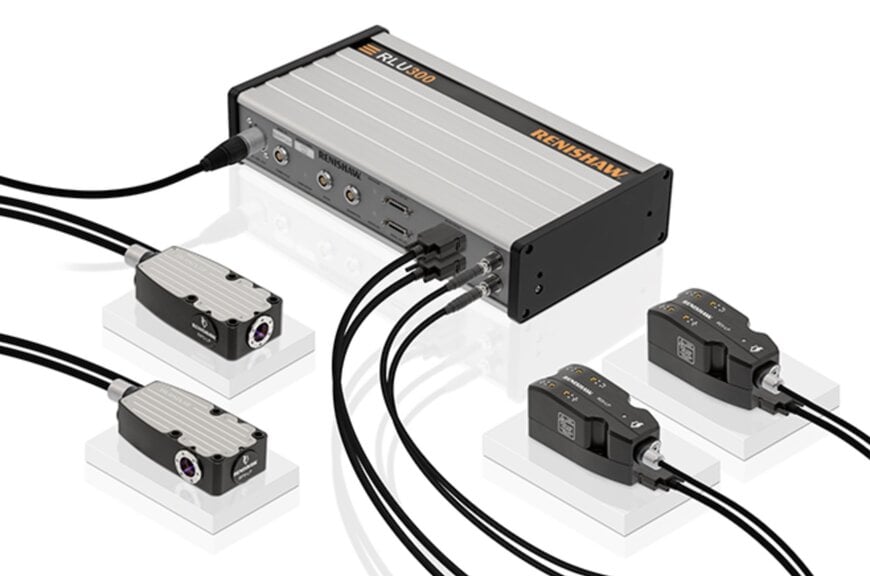
Renishaw announced the release of its new RLE laser encoder family, engineered to provide high-precision position feedback across advanced semiconductor manufacturing motion-control platforms. Succeeding the established RLE10 and RLE20 systems, the updated product line addresses tight feature tolerances by enhancing measurement accuracy, thermal stability, and operational uptime across lithography, wafer inspection, and metrology stages.
Modular Architecture and System Diagnostics
The platform features a modular, plug-and-play architecture designed to simplify cleanroom integration, routine maintenance, and inventory handling:
- Independent Component Replacement: Laser units, detector heads, and optical fiber assemblies can be serviced or exchanged independently without requiring full subsystem removal.
- Detachable Optical Fibers: Detachable fiber connectors allow laser sources to be replaced without disturbing installed detector heads or optical paths, eliminating lengthy optical realignment procedures.
- Integrated Condition Monitoring: An integrated diagnostic interface provides real-time health telemetry—including optical signal quality, operational state, and fault indicators—to support predictive maintenance programs.
- Extended Dynamic Envelope: Doubles the functional operating envelope compared to legacy models, supporting an angular tolerance range of ±400 µrad and a linear measurement range of up to 2 meters.
- Enhanced Installation Features: Incorporates a redesigned beam-steering mechanism for rapid optical alignment, cleanroom-compatible enclosures, and updated detector heads supporting higher stage velocities.
Three-Tier Metrology Architecture
The product lineup is structured into three dedicated performance tiers compatible with existing mechanical mounting footprints to allow drop-in retrofits without machine redesign:
The product lineup is structured into three dedicated performance tiers compatible with existing mechanical mounting footprints to allow drop-in retrofits without machine redesign:
- RLE100: Serves as the direct successor to the RLE10, providing enhanced laser frequency stability for ambient in-air motion stages.
- RLE200: Replaces the RLE20 for high-performance applications, specifically vacuum-chamber environments, incorporating automated Sub-Divisional Error (SDE) compensation.
- RLE300: Represents the flagship ultra-precision tier, combining reduced electronic noise, improved laser frequency stability, and automatic SDE correction to achieve measurement uncertainty down to ±0.2 nm in thermally critical and ultra-stable environments.
The systems will be demonstrated at SEMICON Taiwan 2026 (Booth R8112) from 2–4 September, and at SEMICON West 2026 (Booth 140) in San Francisco from 13–15 October.
Additional Context
This section details technical specifications not included in the original news release.
Homodyne displacement measuring interferometers operate by splitting a frequency-stabilized helium-neon laser beam into a fixed reference optical path and a variable measurement optical path directed toward a retroreflector or plane mirror mounted on the moving stage. Optical interference between the recombined reference and measurement beams produces sinusoidal optical fringe patterns, which are resolved into quadrature phase signals by internal photodiodes inside the detector head. In homodyne architectures, eliminating external acoustic-optic modulators simplifies optical delivery, while high-speed digital signal processing engines sample quadrature waveforms at megahertz clock rates to perform real-time digital interpolation down to sub-nanometer increments without introduce phase-lag latency into closed-loop motion controllers.
Sub-Divisional Error, or cyclic interpolation error, typically arises from optical imperfections including laser beam ellipticity, non-orthogonal polarization states, imperfect optical coatings, and detector gain mismatches that distort pure quadrature lissajous circles into offset ellipses. Dynamic automatic SDE correction algorithms continuously monitor the sine and cosine signal envelopes, executing real-time offset, gain, and phase adjustments across the interpolation matrix to suppress periodic cyclic errors to negligible picometer-level amplitudes across high-acceleration raster scans. To maintain optical frequency accuracy, the remote helium-neon laser tubes utilize dual-mode thermal cavity stabilization referenced against primary gas-absorption cell standards, keeping laser wavelength variations constrained to parts-per-billion tolerances over fluctuating ambient cleanroom conditions.
Edited by Romila DSilva, Induportals Editor, with AI assistance.
Additional Context
This section details technical specifications not included in the original news release.
Homodyne displacement measuring interferometers operate by splitting a frequency-stabilized helium-neon laser beam into a fixed reference optical path and a variable measurement optical path directed toward a retroreflector or plane mirror mounted on the moving stage. Optical interference between the recombined reference and measurement beams produces sinusoidal optical fringe patterns, which are resolved into quadrature phase signals by internal photodiodes inside the detector head. In homodyne architectures, eliminating external acoustic-optic modulators simplifies optical delivery, while high-speed digital signal processing engines sample quadrature waveforms at megahertz clock rates to perform real-time digital interpolation down to sub-nanometer increments without introduce phase-lag latency into closed-loop motion controllers.
Sub-Divisional Error, or cyclic interpolation error, typically arises from optical imperfections including laser beam ellipticity, non-orthogonal polarization states, imperfect optical coatings, and detector gain mismatches that distort pure quadrature lissajous circles into offset ellipses. Dynamic automatic SDE correction algorithms continuously monitor the sine and cosine signal envelopes, executing real-time offset, gain, and phase adjustments across the interpolation matrix to suppress periodic cyclic errors to negligible picometer-level amplitudes across high-acceleration raster scans. To maintain optical frequency accuracy, the remote helium-neon laser tubes utilize dual-mode thermal cavity stabilization referenced against primary gas-absorption cell standards, keeping laser wavelength variations constrained to parts-per-billion tolerances over fluctuating ambient cleanroom conditions.
Edited by Romila DSilva, Induportals Editor, with AI assistance.
