
electronics-journal.com
11
'26
Written on Modified on
Advanced Power-Factor Correction Controller for High-Power Switched-Mode Power Supplies
STMicroelectronics introduces the L4983 controller for continuous conduction mode power-factor correction systems utilized in industrial, medical, server, and consumer electronics applications.
www.st.com
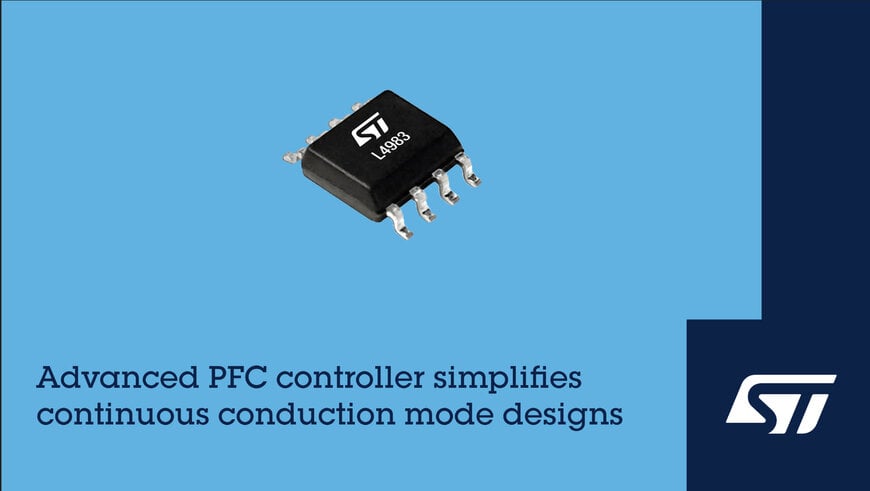
The L4983 power-factor correction controller incorporates a proprietary multiplier emulator and distortion-optimization circuitry to manage continuous conduction mode boost pre-regulators. By utilizing an integrated architecture, the device minimizes the requirement for external passive components while maintaining stable operation across variable loads. The integrated totem-pole output stage delivers a 7A sink and 3A source capability, providing adequate drive current for high-power switching elements.
Target applications span power levels from several hundred Watts to multiple kilowatts, addressing industrial power systems, medical equipment, high-power luminaires, enterprise servers, personal computers, and home electronics. These systems must comply with international harmonic current emissions standards, including EN 61000-3-2 and the Japanese JEIDA-MITI specification.
Efficiency Management and Power-Saving Modes
To comply with international energy efficiency guidelines—such as US Energy Star, the EU Ecodesign Directive, and the European Code of Conduct for power adapters—the controller integrates three distinct low-power operational modes.
Burst Mode: Automatically halts switching activity during light or zero load intervals, and reactivates without requiring a soft-restart sequence when the load increases.
Idle Mode: Suspends switching activity and disables the internal error amplifier via an external pin control.
Disable Mode: Shuts down device operations entirely, requiring a soft-restart sequence to resume switching.
System Protection Mechanisms
Operating reliability is maintained through integrated protection circuits designed to handle electrical transients and fault conditions. Overvoltage protection stabilizes output voltage levels during sudden load transients, while cycle-by-cycle overcurrent protection relies on an internal comparator to monitor peak currents. Inductor-saturation detection guards against abnormal current surges. Line feedforward circuitry compensates for fluctuations in the AC input voltage to stabilize output power. Additionally, startup verification algorithms check voltage-feedback and current-sense signals to mitigate feedback loop failures, while an integrated soft-start mechanism limits inrush currents.
Development Support and Commercial Availability
Hardware evaluation is supported by the EVL4983-350W demonstration board, which implements a 350W power-factor correction pre-regulator operating across a universal input-voltage range. The board delivers a regulated 400Vdc output with a Total Harmonic Distortion profile and a measured efficiency of 97.4% across the load range.
The controller is available in two frequency variants housed in an 8-pin small-outline (SO-8) surface-mount package. The L4983A operates at a switching frequency of 65kHz, and the L4983B operates at 130kHz. Both variants are in volume production, with unit pricing starting from $0.80 for orders of 1,000 pieces.
Additional Context:
This section details technical specifications and competitive benchmarking not included in the original product announcement
Continuous conduction mode power-factor correction controllers in the multi-kilowatt power tier typically compete based on quiescent current consumption, gate-drive capability, and Total Harmonic Distortion reduction techniques at light loads. Traditional analog transition-mode and continuous conduction mode controllers from manufacturers such as Infineon (e.g., ICE2PCS02) and Texas Instruments (e.g., UCC28180) provide standard boost correction features, but often require external circuitry for distortion compensation and multiplier emulation.
The L4983 achieves its performance metrics through a peak current-mode control scheme paired with an off-time modulator that sustains quasi-fixed frequency operation across varying input and load conditions. The internal reference voltage tolerance is specified at 1.2% at a junction temperature of 25°C, ensuring tight regulation for high-density power supply unit designs.
Edited by Sucithra Mani, Induportals editor – adapted by AI.
www.st.com
