
electronics-journal.com
22
'26
Written on Modified on
Autonomous Type-C Power Delivery Integration for Embedded Systems
MIKROE introduces a compact sink controller board designed to negotiate and manage power from standard sources to replace legacy DC inputs.
www.mikroe.com
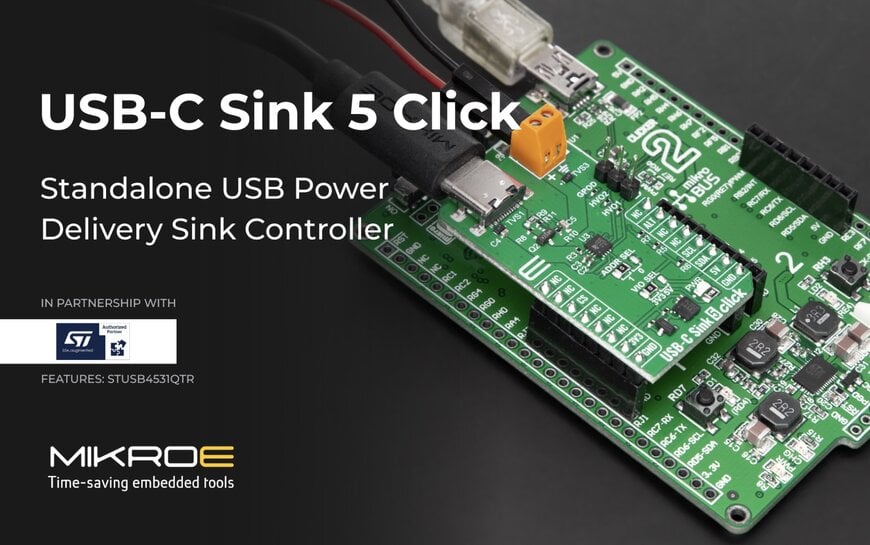
MIKROE is releasing the USB-C Sink 5 Click, an add-on development board that enables embedded systems to receive, negotiate, and manage power from USB Type-C Power Delivery (PD) sources. The hardware targets wearables, high-end instruments, and portable electronics, offering a standardized pathway to retrofit legacy DC barrel or USB micro-B interfaces with universal charging protocols.
Autonomous Power Negotiation and Management
The module is built around the STMicroelectronics STUSB4531QTR, a standalone USB Type-C and USB PD sink controller. It manages power profiles autonomously utilizing an internal Autorun mode. By storing default Power Delivery Object (PDO) configurations in non-volatile memory, the controller negotiates power profiles ranging from 5V to 20V without relying on continuous intervention from a host microcontroller. This autonomous capability reduces firmware overhead while ensuring standard-compliant power delivery for field-deployed electronic devices.
System Protection and Hardware Integration
To ensure operational safety, the hardware integrates VBUS monitoring, input power path control, and high-voltage surge protection equipped with discharge functions. It also supports dead battery mode, allowing systems to initiate a charging handshake even when the local battery is entirely depleted. The board communicates with the host MCU via an I2C interface with selectable addresses. Additionally, it features an active-low open-drain interrupt and high-voltage open-drain general-purpose outputs for comprehensive system signaling.
Standardized Development Infrastructure
Designed for the mikroBUS socket standard, the board incorporates the ClickID function, a mechanism that enables the host system to automatically identify the module upon connection. The hardware operates in tandem with open-source mikroSDK libraries, which provide the software framework required to evaluate and customize the power profiles before integrating the design into custom embedded projects.
Additional Context
This section details technical specifications and competitive benchmarking not included in the original news release.
In the embedded power management sector, standalone USB-C Power Delivery sink controllers like the STMicroelectronics STUSB4531QTR compete directly with solutions such as the Infineon EZ-PD Barrel Connector Replacement (BCR) series and the Texas Instruments TPS65987D. While the TI component offers dual-role port (DRP) capabilities and advanced alternate mode routing for complex video and data hubs, the STMicroelectronics controller utilized in this module is optimized strictly for sink-only (power receiving) applications.
This targeted sink-only architecture lowers the bill of materials cost and eliminates the need for complex firmware development compared to full DRP controllers. Furthermore, unlike generic hardware-configured PD trigger boards that rely solely on resistor dividers for fixed voltage requests, the I2C interface on this module allows developers to dynamically monitor and reprogram Power Delivery Objects (PDOs), providing adaptive power scaling for dynamic electronic loads.
Edited by Aishwarya Mambet, Induportals Editor, with AI assistance.
www.mikroe.com
