
electronics-journal.com
14
'26
Written on Modified on
Vector and Infineon Launch Chiisai Open-Source HAL Specification
The royalty-free standard simplifies hardware abstraction for small microcontrollers to accelerate embedded software development.
www.vector.com
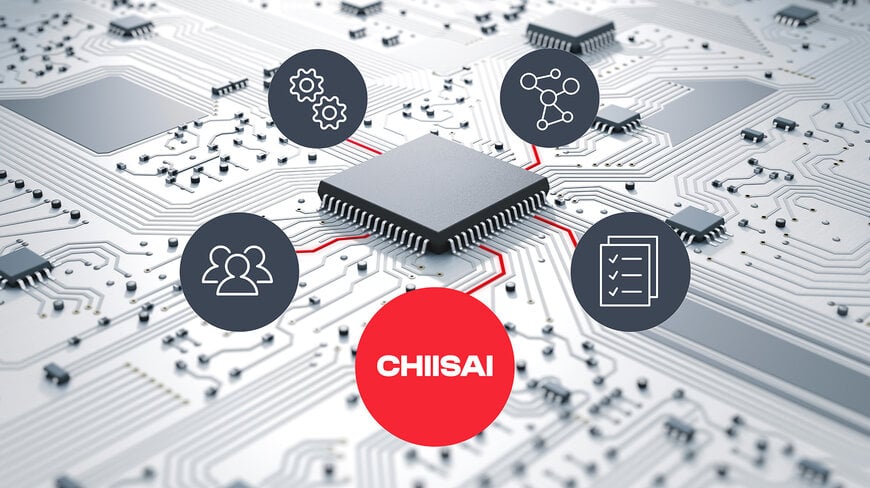
The open Chiisai standard enables cross-vendor development of HALs, middleware, and embedded software for small microcontrollers. Bildrechte: Vector Informatik GmbH
Vector has introduced Chiisai, a fully open and royalty-free Hardware Abstraction Layer (HAL) specification designed to simplify software development on resource-constrained microcontrollers. Developed in close collaboration with Infineon Technologies, the specification defines standardized interfaces for essential core functions and communication peripherals, creating a clear separation between hardware-specific drivers and upper-level middleware.
Named after the Japanese word for "small," Chiisai is specifically tailored for the limited-resource microcontrollers commonly deployed in automotive sensors, actuators, and compact embedded systems. By providing a vendor-neutral standard, the specification lowers the barrier to entry for developing custom HALs. This allows software components to be seamlessly reused across different hardware platforms without restrictive licensing or tight hardware coupling. Leading semiconductor manufacturers, including Infineon and Microchip Technology, are actively supporting the standard to foster a cross-vendor ecosystem that promotes interoperability and reduces integration efforts for OEMs and Tier-1 suppliers.
Additionally, Vector’s lightweight software base layer, MICROSAR IO, is fully compatible with the new specification out of the box. Once a Chiisai-compliant HAL is available for a given microcontroller, MICROSAR IO can be deployed directly on that platform without any further customization, streamlining access to modern Software-Defined Vehicle (SDV) stacks.
Additional Context
This section provides technological and market background not explicitly detailed in the original release.
In the transition toward Software-Defined Vehicles (SDVs), automotive electronic architectures are shifting to centralized high-performance computers (HPCs) and zonal controllers. However, modern vehicles still rely on dozens of small edge nodes—often called "Sub-ECUs" or mechatronic ECUs—for fundamental tasks like reading sensors or driving window and wiper motors. These highly cost-sensitive microcontrollers operate under severe memory constraints, sometimes utilizing less than 32 kBytes of ROM and 8 kBytes of RAM. Historically, writing drivers for these edge nodes required highly proprietary, hardware-specific coding that was difficult to port when supply chain issues forced OEMs to change silicon vendors. By introducing an open, standardized HAL like Chiisai, the industry aims to decouple application logic from the underlying silicon at the very edge of the network. This paradigm allows Tier-1 suppliers to reuse middleware across multiple microcontroller families, dramatically reducing software engineering overhead and accelerating time-to-market for smart sensors and actuators.
Edited by Lekshman Ramdas, Induportals editor – adapted by AI.
www.vector.com
Vector has introduced Chiisai, a fully open and royalty-free Hardware Abstraction Layer (HAL) specification designed to simplify software development on resource-constrained microcontrollers. Developed in close collaboration with Infineon Technologies, the specification defines standardized interfaces for essential core functions and communication peripherals, creating a clear separation between hardware-specific drivers and upper-level middleware.
Named after the Japanese word for "small," Chiisai is specifically tailored for the limited-resource microcontrollers commonly deployed in automotive sensors, actuators, and compact embedded systems. By providing a vendor-neutral standard, the specification lowers the barrier to entry for developing custom HALs. This allows software components to be seamlessly reused across different hardware platforms without restrictive licensing or tight hardware coupling. Leading semiconductor manufacturers, including Infineon and Microchip Technology, are actively supporting the standard to foster a cross-vendor ecosystem that promotes interoperability and reduces integration efforts for OEMs and Tier-1 suppliers.
Additionally, Vector’s lightweight software base layer, MICROSAR IO, is fully compatible with the new specification out of the box. Once a Chiisai-compliant HAL is available for a given microcontroller, MICROSAR IO can be deployed directly on that platform without any further customization, streamlining access to modern Software-Defined Vehicle (SDV) stacks.
Additional Context
This section provides technological and market background not explicitly detailed in the original release.
In the transition toward Software-Defined Vehicles (SDVs), automotive electronic architectures are shifting to centralized high-performance computers (HPCs) and zonal controllers. However, modern vehicles still rely on dozens of small edge nodes—often called "Sub-ECUs" or mechatronic ECUs—for fundamental tasks like reading sensors or driving window and wiper motors. These highly cost-sensitive microcontrollers operate under severe memory constraints, sometimes utilizing less than 32 kBytes of ROM and 8 kBytes of RAM. Historically, writing drivers for these edge nodes required highly proprietary, hardware-specific coding that was difficult to port when supply chain issues forced OEMs to change silicon vendors. By introducing an open, standardized HAL like Chiisai, the industry aims to decouple application logic from the underlying silicon at the very edge of the network. This paradigm allows Tier-1 suppliers to reuse middleware across multiple microcontroller families, dramatically reducing software engineering overhead and accelerating time-to-market for smart sensors and actuators.
Edited by Lekshman Ramdas, Induportals editor – adapted by AI.
www.vector.com
