
electronics-journal.com
01
'26
Written on Modified on
Vector and SCSK Simplify Edge ECU Software Development
A new evaluation bundle accelerates sensor and actuator applications on Renesas RL78/F2x microcontrollers for Software-Defined Vehicles.
www.vector.com
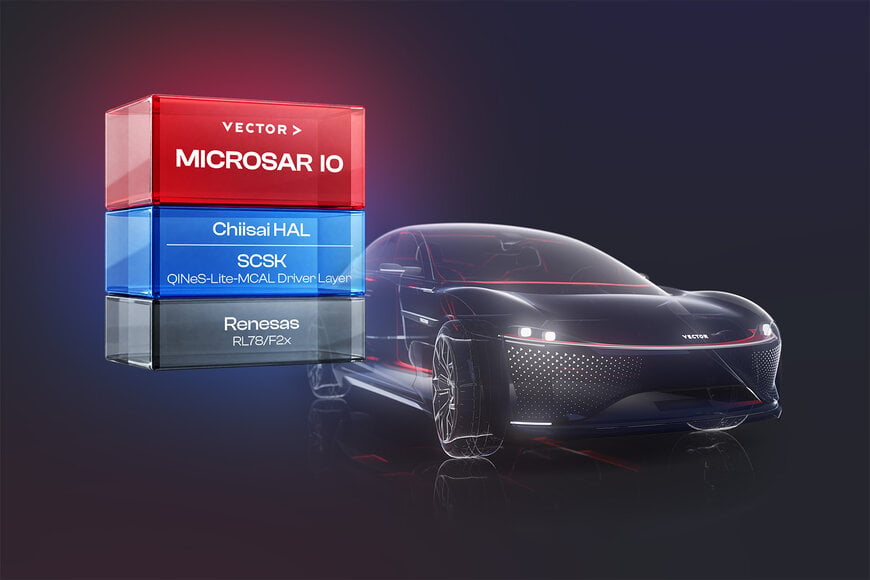
SCSK and Vector join forces to deliver a software platform for resource-constrained automotive ECUs. Image rights: Vector Informatik
Vector and SCSK Corporation have jointly launched an evaluation bundle designed to streamline the development of embedded sensor and actuator applications on resource-constrained microcontrollers. By integrating Vector’s MICROSAR IO with SCSK’s QINeS-Lite platform and associated drivers for the Renesas RL78/F2x family, the solution provides automotive engineers with a pre-configured, ready-to-use software foundation. This out-of-the-box integration significantly reduces the time, complexity, and integration effort traditionally required to set up and evaluate small-scale Electronic Control Units (ECUs).
The bundle addresses the specific needs of modern edge devices. Vector engineered MICROSAR IO as a highly optimized, lightweight software platform specifically for microcontrollers with limited hardware resources, helping developers shorten time-to-market. Complementing this, SCSK’s QINeS-Lite provides a compact automotive software platform tailored for small-scale ECUs that still require advanced capabilities, including high-speed communication, over-the-air (OTA) software updates, cybersecurity, and diagnostics. The hardware abstraction layer (HAL) drivers provided by SCSK are based on the open Chiisai specification, ensuring seamless hardware integration with the Renesas RL78/F2x platform.
Additional Context
This section provides technological and market background not explicitly detailed in the original release.
The automotive industry is undergoing a massive architectural shift toward Software-Defined Vehicles (SDVs). This transition moves away from hundreds of decentralized, single-function ECUs toward a "zonal architecture," where a few high-performance central computers handle heavy processing (like autonomous driving and infotainment).
However, at the very edge of the vehicle's network—right at the physical sensors (e.g., temperature, pressure) and actuators (e.g., window motors, valve controllers)—microcontrollers like the 16-bit Renesas RL78 still dominate. They are chosen for their ultra-low power consumption, cost-effectiveness, and proven reliability. Running a full-blown Classic AUTOSAR stack on these edge devices is often impossible due to severe memory (RAM/ROM) and processing constraints. Lightweight platforms like MICROSAR IO and QINeS-Lite bridge this critical gap. They allow these tiny, resource-constrained edge nodes to participate securely in the modern SDV ecosystem—enabling them to receive OTA updates and communicate via modern protocols like CAN FD or LIN—without requiring OEMs to invest in larger, more expensive hardware for simple actuator tasks.
Edited by an industrial journalist, Lekshman Ramdas, with AI assistance.
www.vector.com
Vector and SCSK Corporation have jointly launched an evaluation bundle designed to streamline the development of embedded sensor and actuator applications on resource-constrained microcontrollers. By integrating Vector’s MICROSAR IO with SCSK’s QINeS-Lite platform and associated drivers for the Renesas RL78/F2x family, the solution provides automotive engineers with a pre-configured, ready-to-use software foundation. This out-of-the-box integration significantly reduces the time, complexity, and integration effort traditionally required to set up and evaluate small-scale Electronic Control Units (ECUs).
The bundle addresses the specific needs of modern edge devices. Vector engineered MICROSAR IO as a highly optimized, lightweight software platform specifically for microcontrollers with limited hardware resources, helping developers shorten time-to-market. Complementing this, SCSK’s QINeS-Lite provides a compact automotive software platform tailored for small-scale ECUs that still require advanced capabilities, including high-speed communication, over-the-air (OTA) software updates, cybersecurity, and diagnostics. The hardware abstraction layer (HAL) drivers provided by SCSK are based on the open Chiisai specification, ensuring seamless hardware integration with the Renesas RL78/F2x platform.
Additional Context
This section provides technological and market background not explicitly detailed in the original release.
The automotive industry is undergoing a massive architectural shift toward Software-Defined Vehicles (SDVs). This transition moves away from hundreds of decentralized, single-function ECUs toward a "zonal architecture," where a few high-performance central computers handle heavy processing (like autonomous driving and infotainment).
However, at the very edge of the vehicle's network—right at the physical sensors (e.g., temperature, pressure) and actuators (e.g., window motors, valve controllers)—microcontrollers like the 16-bit Renesas RL78 still dominate. They are chosen for their ultra-low power consumption, cost-effectiveness, and proven reliability. Running a full-blown Classic AUTOSAR stack on these edge devices is often impossible due to severe memory (RAM/ROM) and processing constraints. Lightweight platforms like MICROSAR IO and QINeS-Lite bridge this critical gap. They allow these tiny, resource-constrained edge nodes to participate securely in the modern SDV ecosystem—enabling them to receive OTA updates and communicate via modern protocols like CAN FD or LIN—without requiring OEMs to invest in larger, more expensive hardware for simple actuator tasks.
Edited by an industrial journalist, Lekshman Ramdas, with AI assistance.
www.vector.com
