
Trelleborg Showcases Fluorosurfactant-Free Semiconductor Seals at SEMICON West
The PureFab portfolio introduces eco-friendly FFKM and FKM materials for aggressive front-end wafer fabrication processes.
www.trelleborg.com
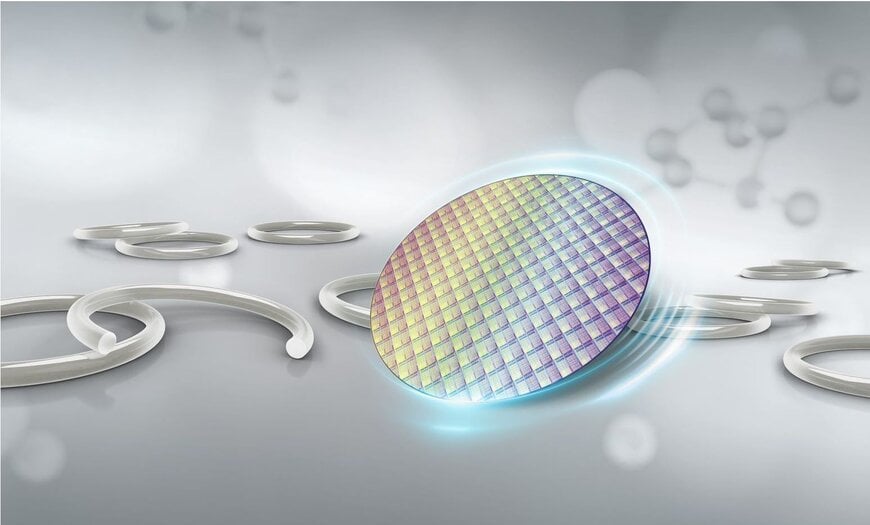
Trelleborg Sealing Solutions is exhibiting its advanced portfolio of seals and engineered components for semiconductor manufacturing at SEMICON West 2026 in San Francisco. Addressing the heightened purity and thermal demands driven by artificial intelligence hardware, advanced packaging, and high-bandwidth memory (HBM), the company is highlighting its PureFab® fluorosurfactant-free material lineup. This includes the JPF50 and JPF58 perfluoroelastomers (FFKMs) and the VPF20 fluoroelastomer (FKM), which eliminate environmentally persistent fluorosurfactants during polymer synthesis without compromising thermal stability, mechanical durability, or purity.
The company is also showcasing its Isolast® PureFab® series, formulated specifically for harsh front-end wafer fabrication processes, including atomic layer deposition (ALD), plasma etching, ash/strip, and chamber cleaning. Characterized by ultra-low trace-metal concentrations and high plasma resistance, these materials minimize particle shedding and outgassing under high-vacuum conditions. Complementing these materials are chemical mechanical planarization (CMP) rolling diaphragms in liquid silicone rubber (LSR) and high-consistency rubber (HCR), dynamic rubber-to-metal bonded slit valve door seals for wafer transfer chambers, and Turcon® Variseal® spring-energized PTFE seals. Additionally, Trelleborg is demonstrating its advanced engineering capabilities using Finite Element Analysis (FEA) to simulate elastomer compression set, providing chipmakers with reliable lifecycle predictions to optimize tool maintenance intervals.
Additional Context
This section provides technological and market background not explicitly detailed in the original release.
In leading-edge semiconductor fabrication (nodes of 3nm, 2nm, and below), elastomeric seals face a hostile convergence of physical and chemical stressors. In deposition and plasma etch tools, seals are directly exposed to aggressive fluorinated and oxygen-based radicals (such as $CF_4$ and $NF_3$) alongside extreme thermal cycling. Conventional elastomers often degrade through chemical chain scission, causing microscopic surface erosion that releases volatile compounds (outgassing) and sub-micron particulates directly into the process chamber—both of which cause fatal defects on high-density silicon wafers.
Simultaneously, the semiconductor materials supply chain is under acute regulatory pressure to phase out per- and polyfluoroalkyl substances (PFAS). Historically, the emulsion polymerization of high-performance fluoropolymers has relied heavily on fluorinated surfactants to stabilize reactions. Formulating fluorosurfactant-free FFKMs that match the chemical inertness, trace-metal cleanliness (measured in parts-per-billion), and mechanical resilience of legacy materials represents a significant synthetic polymer chemistry breakthrough. Furthermore, predicting elastomer "compression set"—the permanent physical deformation that occurs when a seal loses its elastic recovery under prolonged heat and load—via nonlinear FEA allows fab operators to transition from rigid calendar-based maintenance to predictive seal replacement, mitigating the catastrophic financial risk of unexpected vacuum failure during multi-step deposition runs.
Edited by Lekshman Ramdas, Induportals editor – adapted by AI.
www.trelleborg.com
