
electronics-journal.com
21
'26
Written on Modified on
Quantum Electronics Moves Toward Commercialization
Quantum technologies are progressing from research into commercial development, with chips, sensors and secure communications following different paths toward market adoption.
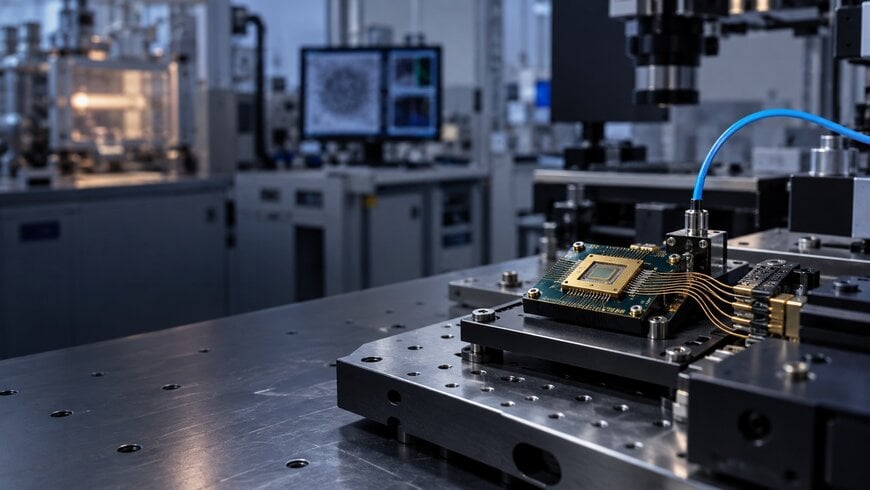
For years, quantum technology was largely confined to university laboratories and government research programmes. That is beginning to change. Quantum processors, sensors and secure communication systems are gradually moving into commercial development, supported by public funding, corporate investment and improvements in semiconductor manufacturing.
The industry is still at an early stage. Quantum computers have yet to demonstrate broad commercial value, while many systems remain expensive and difficult to operate. Quantum sensors and communication technologies are further ahead in certain applications, but they also face challenges involving cost, reliability and integration.
The market should therefore not be viewed as a single industry advancing at one speed. Quantum chips, sensors and communications are following different routes to commercialization.
Market Outlook in Numbers
Market estimates vary because research firms define the quantum sector differently. Intel Market Research values the global quantum electronics market at US$1.45 billion in 2025 and forecasts it to reach US$4.78 billion by 2034, representing a compound annual growth rate of 14.3%. Its estimate covers electronic components and systems used in quantum computing, sensing and communications.
McKinsey presents a broader outlook. It estimates that quantum computing companies generated more than US$1 billion in worldwide revenue in 2025, with revenue potentially reaching US$4.4 billion by 2028. By 2035, McKinsey expects the combined internal market for quantum computing, communications and sensing to reach US$60 billion to US$100 billion. Quantum computing could account for US$43 billion to US$71 billion of that total.
The difference between these figures reflects their market scope. Some studies count only quantum hardware and electronic components, while others include software, cloud services and other parts of the supply chain.
Quantum Chips Move Beyond the Laboratory
Quantum computing chips attract most of the attention in this market. Unlike conventional processors, which use binary bits, quantum processors use qubits. Under suitable conditions, qubits can process information in ways that may help solve certain complex problems more efficiently than classical computers.
Possible applications include drug discovery, materials development, financial modelling, logistics and industrial optimization. These opportunities have encouraged companies and governments to commit significant resources to quantum computing research.
IBM, Google, Intel, Microsoft, Quantinuum, IonQ and Rigetti Computing are among the companies developing quantum hardware. Their systems use different technologies, including superconducting circuits, trapped ions, neutral atoms, photonics and silicon spin qubits. No single approach has emerged as the industry standard.
Progress is often presented in terms of qubit numbers, but a larger processor is not necessarily more useful. Error rates, coherence time, connectivity and control accuracy are equally important. A processor with many unstable qubits may be less capable than a smaller system that performs calculations more reliably.
Qubits are highly sensitive to heat, vibration and electromagnetic interference. Many quantum processors must operate at temperatures close to absolute zero, requiring costly refrigeration and control equipment. Even small variations in fabrication can affect their performance.
For semiconductor suppliers, however, the opportunity extends beyond the processor. Quantum systems require low-noise amplifiers, cryogenic control chips, photonic components, advanced interconnects and specialized packaging. These supporting technologies could become valuable markets before large-scale quantum computers are commercially practical.
In the near term, most companies will access quantum processors through cloud platforms rather than purchase their own systems. Hybrid computing will also play an important role, with classical computers handling routine operations and quantum processors assigned to selected calculations.
Sensors Offer a More Immediate Market
Quantum sensors may achieve wider commercial use sooner than quantum computers. These devices apply quantum effects to measure gravity, magnetic fields, acceleration, time and other physical conditions with very high precision.
Some forms of quantum sensing are already established. Atomic clocks provide the precise timing required by telecommunications, navigation, financial networks and scientific research. Developers are now working on smaller and more affordable models for industrial and mobile applications.
Quantum magnetometers can detect extremely weak magnetic signals. Potential uses include medical imaging, mineral exploration and electrical-system inspection. Quantum gravimeters can measure small changes in gravity that may reveal underground structures, water movement or mineral deposits.
Navigation is another promising area. Aircraft, ships, vehicles and autonomous systems normally depend on satellite positioning. Quantum inertial sensors could allow them to navigate when satellite signals are unavailable, disrupted or deliberately blocked.
These applications provide a clearer path to market because users do not need a complete quantum computing infrastructure. A quantum sensor can be incorporated into an existing industrial, medical or navigation system if it delivers sufficient improvements in accuracy or reliability.
The challenge is to convert laboratory instruments into products that are smaller, easier to operate and capable of working outside controlled environments. Advances in photonics, lasers, semiconductor packaging and signal-processing electronics are helping manufacturers address these requirements.
Secure Communications Gain Attention
Quantum communication is gaining interest among governments, telecommunications companies and financial institutions concerned about data security.
Its best-known application is quantum key distribution, or QKD. The technology uses quantum states to exchange encryption keys and can reveal whether an interception attempt has occurred. Pilot networks have been established in several countries, while satellite demonstrations have shown the potential for securing communications over longer distances.
QKD is not yet practical for every organisation. It may require dedicated optical equipment, specialized detectors and carefully managed network infrastructure. Cost, transmission distance and compatibility with existing systems remain obstacles.
Quantum communication should also be distinguished from post-quantum cryptography. Post-quantum cryptography uses mathematical algorithms designed to protect conventional computer systems against possible attacks by future quantum computers. Because these algorithms can be introduced through software and system upgrades, they are more suitable for widespread near-term adoption.
The two approaches may eventually serve different markets. Post-quantum cryptography is likely to provide broad protection for everyday digital systems, while QKD may be reserved for government, defence and other highly sensitive networks. Both areas are creating opportunities for suppliers of secure processors, optical components, photon sources, detectors and network equipment.
Regional Investment Shapes Development
North America remains a leading centre for quantum development, supported by major technology companies, research universities, national laboratories and venture capital. Europe is strengthening its position through national programmes and collaborative research, with particular capabilities in photonics, precision instruments and quantum communications.
Asia-Pacific is also becoming increasingly important. China has invested heavily in quantum research and secure communication networks, while Japan, South Korea, Singapore and Australia are supporting computing and sensing programmes. Taiwan’s semiconductor industry could play a larger role in fabricating, packaging and testing quantum devices.
The future supply chain will extend beyond companies building complete quantum systems. Foundries, materials producers, equipment manufacturers, photonics specialists and cryogenic technology suppliers will all be required. Partnerships will be essential because few companies can develop every part of a quantum system independently.
A Gradual Commercial Transition
Quantum electronics is making measurable progress, but commercial adoption will happen in stages. Sensors and timing devices currently offer the clearest near-term opportunities. Secure communications are developing in specialized markets, while quantum computing remains a longer-term prospect.
Progress will increasingly be judged by reliability, operating cost and practical performance rather than research announcements or record qubit numbers. Customers will want evidence that a quantum product can solve a real problem better than an available conventional system.
Quantum electronics is not yet ahigh-volume mainstream industry. Nevertheless, advances in chips, sensing, photonics, packaging and secure communications show that the foundations of a commercial market are taking shape.
Article contributed by Kathryn Gerardino-Elagio, Editor-in-Chief, Ringier Trade Media, South East Asia.
