
electronics-journal.com
23
'26
Written on Modified on
Infineon Launches PSOC Control C3 MCUs for Power Applications
The new microcontrollers combine advanced real-time control with Post-Quantum Cryptography for secure industrial systems.
www.infineon.com

Infineon PSOC™ Control C3 Performance Line combines high-performance real-time control with post-quantum support for next-generation power and motor control applications.
Infineon Technologies has introduced the PSOC™ Control C3 Performance Line, a new family of microcontrollers (MCUs) engineered for real-time control in demanding power conversion and motor drive applications. Based on the Arm® Cortex®-M33 multi-core architecture running at up to 180 MHz, the MCUs deliver high control loop frequencies and accuracy. The devices are specifically designed to optimize system efficiency in AI server power supply units (PSUs), solar inverters, electric vehicle (EV) charging stations, and high-end industrial motor controls.
To future-proof industrial cybersecurity, the PSOC Control C3 Performance Line complies with Post-Quantum Cryptography (PQC) requirements for firmware protection, as outlined in the Commercial National Security Algorithm (CNSA) Suite 2.0. The microcontrollers also support Platform Security Architecture (PSA) Level 3 enablement. This dual-standard compliance provides robust firmware verification (including SHA-512 and LMS algorithms) for secure boot, secure over-the-air updates, and encrypted key storage. The architecture integrates zero-wait-state fast analog and digital peripherals, enabling systems utilizing wide-bandgap (WBG) switches to respond to real-time events with minimal latency.
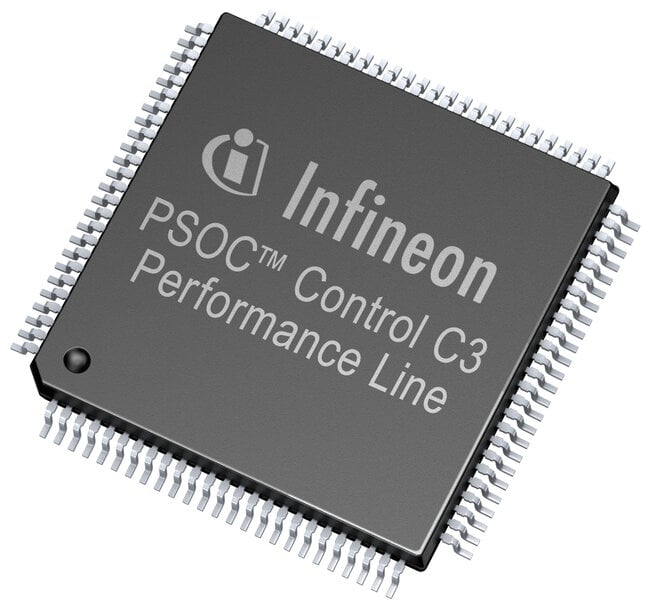
Infineon PSOC™ Control C3 Performance Line combines high-performance real-time control with post-quantum support for next-generation power and motor control applications.
Additional Context
This section provides technological and market background not explicitly detailed in the original release.
The transition toward Wide Bandgap (WBG) semiconductors, such as Silicon Carbide (SiC) and Gallium Nitride (GaN), has revolutionized power electronics by enabling significantly higher switching frequencies and power densities. However, maximizing the efficiency of these fast-switching devices requires digital control loops capable of ultra-low latency and high-resolution pulse-width modulation (PWM). Analog controllers are increasingly being replaced by high-performance MCUs like the PSOC Control C3, which leverage dedicated math coprocessors and high-speed analog-to-digital converters (ADCs) to execute complex algorithms in real time.
Simultaneously, industrial control systems face a looming cybersecurity threat from quantum computing. Standard public-key cryptographic algorithms currently used to authenticate firmware updates could eventually be broken by quantum computers. Because industrial infrastructure—such as EV chargers, smart grids, and motor drives—often remains deployed for a decade or more, manufacturers must adopt Post-Quantum Cryptography (PQC) now to defend against "harvest now, decrypt later" attacks. By integrating hardware-accelerated PQC algorithms and a hardware Root of Trust directly into the MCU silicon, manufacturers can ensure their critical power infrastructure remains secure throughout its lifecycle.
Edited by an industrial journalist, Lekshman Ramdas, with AI assistance.
www.infineon.com
Infineon Technologies has introduced the PSOC™ Control C3 Performance Line, a new family of microcontrollers (MCUs) engineered for real-time control in demanding power conversion and motor drive applications. Based on the Arm® Cortex®-M33 multi-core architecture running at up to 180 MHz, the MCUs deliver high control loop frequencies and accuracy. The devices are specifically designed to optimize system efficiency in AI server power supply units (PSUs), solar inverters, electric vehicle (EV) charging stations, and high-end industrial motor controls.
To future-proof industrial cybersecurity, the PSOC Control C3 Performance Line complies with Post-Quantum Cryptography (PQC) requirements for firmware protection, as outlined in the Commercial National Security Algorithm (CNSA) Suite 2.0. The microcontrollers also support Platform Security Architecture (PSA) Level 3 enablement. This dual-standard compliance provides robust firmware verification (including SHA-512 and LMS algorithms) for secure boot, secure over-the-air updates, and encrypted key storage. The architecture integrates zero-wait-state fast analog and digital peripherals, enabling systems utilizing wide-bandgap (WBG) switches to respond to real-time events with minimal latency.
Infineon PSOC™ Control C3 Performance Line combines high-performance real-time control with post-quantum support for next-generation power and motor control applications.
Additional Context
This section provides technological and market background not explicitly detailed in the original release.
The transition toward Wide Bandgap (WBG) semiconductors, such as Silicon Carbide (SiC) and Gallium Nitride (GaN), has revolutionized power electronics by enabling significantly higher switching frequencies and power densities. However, maximizing the efficiency of these fast-switching devices requires digital control loops capable of ultra-low latency and high-resolution pulse-width modulation (PWM). Analog controllers are increasingly being replaced by high-performance MCUs like the PSOC Control C3, which leverage dedicated math coprocessors and high-speed analog-to-digital converters (ADCs) to execute complex algorithms in real time.
Simultaneously, industrial control systems face a looming cybersecurity threat from quantum computing. Standard public-key cryptographic algorithms currently used to authenticate firmware updates could eventually be broken by quantum computers. Because industrial infrastructure—such as EV chargers, smart grids, and motor drives—often remains deployed for a decade or more, manufacturers must adopt Post-Quantum Cryptography (PQC) now to defend against "harvest now, decrypt later" attacks. By integrating hardware-accelerated PQC algorithms and a hardware Root of Trust directly into the MCU silicon, manufacturers can ensure their critical power infrastructure remains secure throughout its lifecycle.
Edited by an industrial journalist, Lekshman Ramdas, with AI assistance.
www.infineon.com
