
electronics-journal.com
12
'26
Written on Modified on
Fraunhofer IPMS introduces miniaturized Li-Fi TinySpot optical transceiver
The ultra-low-power 5 mW data link provides secure, contactless 20 Mbps communication for space-constrained industrial sensors.
www.fraunhofer.de
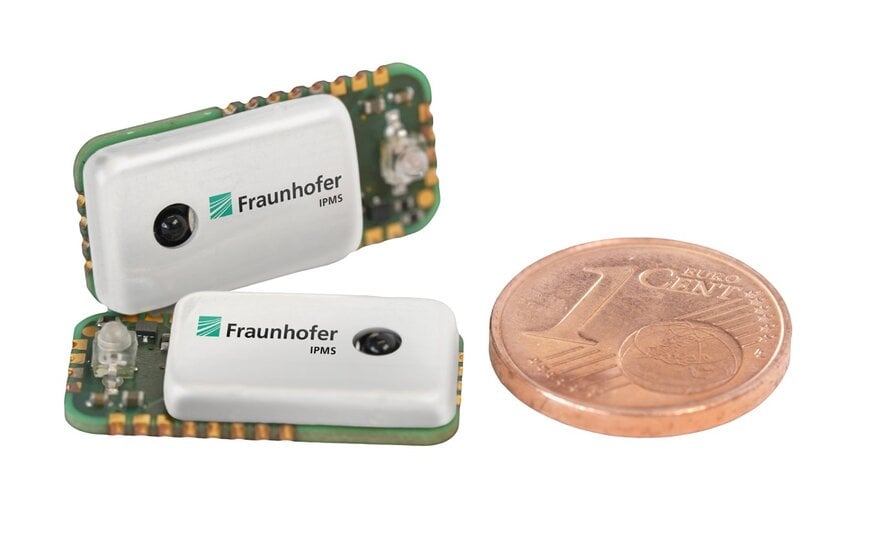
Fraunhofer IPMS has unveiled the Li-Fi TinySpot, a compact and energy-efficient optical transceiver designed for wireless data communication in power-constrained applications. Addressing the limitations of conventional wired connections and radio-frequency interfaces in tight or EMI-critical spaces, the transceiver provides bidirectional full-duplex communication at data rates up to 20 Mbps. By utilizing light instead of radio waves, the device maintains stable, interference-free data transfer over distances ranging from a few centimeters to several meters, making it highly suitable for sensors, wearables, and embedded devices.
Ultra-low power and compact integration
Designed to extend the operating lifetimes of battery-powered systems, the Li-Fi TinySpot consumes as little as 5 milliwatts (mW) of power. Weighing just one gram and measuring 15 mm × 21 mm × 3.3 mm, the transceiver enables densely integrated designs without the need for bulky optics. It supports standard UART and SPI interfaces, simplifying direct integration into microcontroller- and FPGA-based printed circuit boards. Additionally, the technology features an ultra-low transmission latency of just 170 nanoseconds, ensuring highly responsive data exchange for embedded control and condition monitoring applications.
Contactless communication for harsh environments
The optical transceiver serves as a reliable alternative to wear-prone mechanical connectors and slip rings, particularly in tool heads, small rotary stages, and hermetically sealed enclosures where open electrical contacts are vulnerable to contamination. Furthermore, the Li-Fi TinySpot supports SIR, FIR, and VFIR standards, allowing manufacturers to modernize legacy IrDA (Infrared Data Association) interfaces without introducing complex radio-frequency hardware. Operating with Class 1 eye safety, the system provides a secure, contactless data link that is completely immune to electromagnetic interference, ensuring uninterrupted performance in demanding manufacturing settings.
Additional Context: Optical data links in EMI-critical environments
This section details technical specifications and competitive benchmarking not included in the original product announcement.
In highly congested industrial environments, traditional radio frequency (RF) technologies like Bluetooth or Wi-Fi often suffer from packet loss due to multipath fading and severe electromagnetic interference (EMI) generated by heavy machinery, welding equipment, or variable frequency drives. Optical communication (Li-Fi) completely bypasses the RF spectrum, providing an immune, highly secure data channel that cannot be easily intercepted, spoofed, or jammed from outside the immediate physical space. While legacy Infrared Data Association (IrDA) ports provided similar optical links in early industrial handhelds, they were typically limited to half-duplex operation (unable to send and receive simultaneously) and required strict, static line-of-sight alignment. Modern optical transceivers like the TinySpot leverage advanced modulation and full-duplex capabilities, allowing simultaneous, low-latency bi-directional communication, effectively bridging the gap between legacy infrared components and modern high-speed industrial networking.
Edited by an industrial journalist, Lekshman Ramdas, with AI assistance.
www.fraunhofer.com
