
electronics-journal.com
14
'26
Written on Modified on
TDK launches PositionSense 9-axis sensor for physical AI devices
The two-chip solution integrates a 6-axis IMU and 3-axis magnetometer for accurate navigation in GPS-denied environments.
www.tdk.com
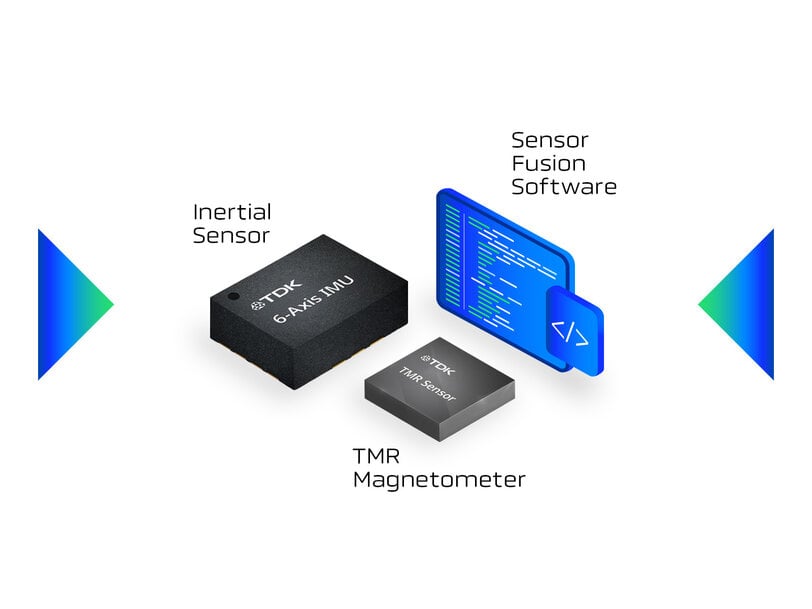
TDK Corporation has announced the worldwide distribution of PositionSense, a two-chip, nine-axis sensor solution designed to deliver precise positioning and navigation for wearables, robotics, drones, and mobile devices. By combining ultra-low-power sensing hardware with on-chip sensor fusion and calibration software, the system provides accurate orientation tracking even in environments without satellite connectivity. The technology targets the growing physical AI market, ensuring reliable "Smart Perception" and navigation for everything from smart glasses in urban areas to humanoid robots operating on complex factory floors.
Integrated IMU and TMR magnetometer
The speed and precision of the PositionSense solution stem from its integrated components. It features TDK's 6-axis SmartMotion inertial measurement unit (IMU), which utilizes vibration-resistant BalancedGyro MEMS technology to provide high-performance tracking with minimal power consumption. This is paired with a 3-axis magnetometer based on tunnel magneto resistance (TMR) technology, delivering high sensitivity, low noise, and magnetic field shock resistance. The hardware is managed by on-chip sensor fusion software that precisely synchronizes timing, processes data immediately upon motion, and executes rapid cross-calibration between the gyroscope and magnetometer.
Hardware configurations for dynamic motion
To address diverse application requirements, PositionSense is available in four distinct hardware configurations offering I2C, SPI, and I3C support at either 1.2V or 1.8V VDDIO. For standard IoT and battery-sensitive applications, the ICM-45608 pairings provide a 16 g accelerometer and 2000 dps (degrees per second) gyroscope full-scale range. For highly dynamic applications requiring greater measurement headroom, the ICM-45689 configurations feature an extended ±32 g accelerometer and ±4000 dps gyroscope range. These scalable options allow developers to easily integrate always-on sensing into compact, power-constrained devices.
Additional Context: TMR technology in spatial navigation
This section details technical specifications and competitive benchmarking not included in the original product announcement.
In spatial navigation and robotics, traditional Hall-effect magnetometers (electronic compasses) often suffer from high power consumption, thermal drift, and susceptibility to external magnetic interference from nearby motors or power lines. Tunnel Magneto Resistance (TMR) technology resolves these limitations by exploiting quantum mechanical tunneling. TMR sensors offer significantly higher signal-to-noise ratios, vastly lower power consumption, and superior sensitivity to minute changes in the Earth's magnetic field compared to conventional Hall-effect or AMR (Anisotropic Magneto Resistance) sensors. When paired with a 6-axis IMU and advanced sensor fusion algorithms, the TMR magnetometer acts as a highly stable absolute reference point, constantly correcting the inevitable drift of the gyroscope to maintain pinpoint spatial orientation in complex, GPS-denied indoor environments like warehouses or urban canyons.
Edited by an industrial journalist, Lekshman Ramdas, with AI assistance.
www.tdk.com
