
electronics-journal.com
19
'26
Written on Modified on
Linear Hall-Effect Current Sensor IC for Inverters
TDK Corporation introduces the Micronas CUR 3020 programmable Hall sensor for C-core concentrators to stabilize current measurement in automotive and industrial inverters.
www.tdk.com
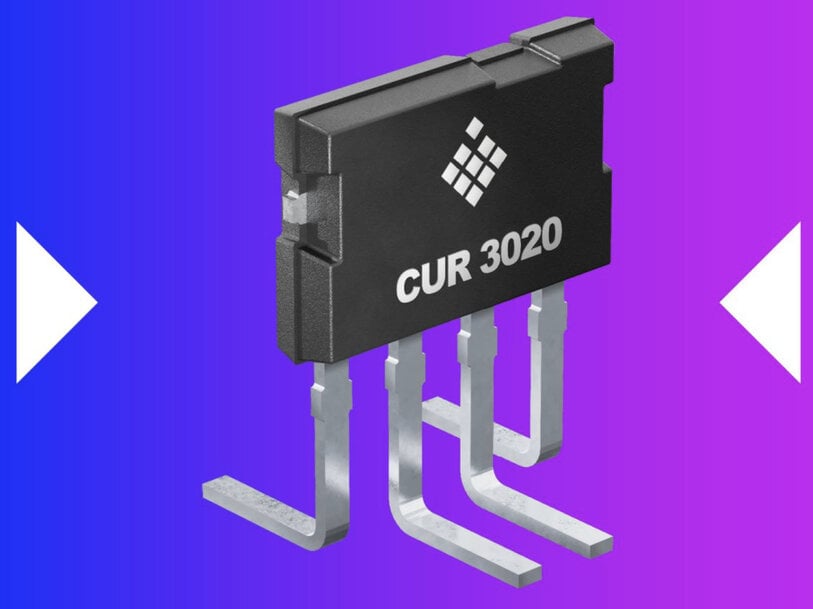
High-frequency power switching and elevated thermal loads in electric powertrains require fast, galvanically isolated current sensing with minimal signal drift across extreme operating temperatures. TDK Corporation (TSE: 6762) addresses this requirement with the Micronas CUR 3020, a customer-programmable linear Hall-effect current sensor IC designed for C-core magnetic concentrators in electrified vehicle (xEV) traction inverters, battery management systems, and industrial power conversion modules.
Engineering Challenges in High-Power Current Measurement
Modern power conversion architectures in electric vehicles and industrial motor drives rely on fast-switching power semiconductors that generate rapid current transients and substantial heat. Monitoring phase and battery currents in these systems requires non-intrusive, galvanically isolated sensing capable of tracking rapid current changes without introducing insertion losses.
In C-core current sensing topologies, a ferromagnetic core with a narrow air gap surrounds the primary current conductor, such as a busbar or power cable. The C-core concentrates the magnetic flux generated by the current onto the Hall sensor IC positioned inside the air gap while shielding the sensing element from external stray magnetic fields. However, air-gap dimensional tolerances, magnetic core hysteresis, and severe thermal cycling between -40°C and 150°C introduce offset and sensitivity errors that can degrade inverter torque control and battery state-of-charge estimation.
Operating Principle and Programmable Sensor Architecture
The Micronas CUR 3020 is a monolithic linear Hall-effect current sensor IC that outputs an analog voltage proportional to the magnetic flux density applied to its integrated high-sensitivity Hall element. To support bi-directional current measurement in AC phase leg and battery charge-discharge circuits, the quiescent voltage output (QVO)—the output voltage at zero magnetic field—is centered at 2.5 V and remains user-adjustable.
To accommodate diverse busbar geometries, C-core magnetic gains, and maximum current ratings, the IC supports a programmable sensitivity range from 4.2 mV/mT to 67.4 mV/mT. Engineers can calibrate both the sensitivity and QVO using an integrated EEPROM via three distinct programming methods detailed in the CUR 3020 programming guide. This end-of-line programmability allows module manufacturers to compensate for mechanical assembly tolerances in the C-core air gap after physical integration.
For fast control loops and rapid overcurrent protection, the sensor features a user-selectable signal bandwidth of 250 kHz or 500 kHz. Operating at 500 kHz enables the control system to detect high-speed switching transients and short-circuit events before thermal damage occurs in the power stage.
Thermal Drift Performance and Diagnostic Protections
Thermal stability across the automotive operating envelope is critical for maintaining measurement precision without complex external compensation algorithms. The CUR 3020 is factory pre-optimized over temperature, restricting maximum sensitivity drift error to 1% and maximum offset drift error to 5 mV across the -40°C to 150°C ambient temperature range. The device is qualified to AEC-Q100 Grade 0 standards and supports an extended hot ambient operating temperature (TA) of up to 165°C for short durations, addressing the thermal peaks encountered inside compact xEV traction inverter housings.
To support system-level fault detection in automotive and industrial environments, the IC integrates multiple diagnostic and protection mechanisms. These include open-circuit broken-wire detection on both the ground pin and supply voltage (VSUP) pin to prevent false current readings during harness or solder joint failures, alongside undervoltage, overvoltage, and reverse-voltage protection on the supply line. Furthermore, engineers can enable or disable separately selectable upper and lower output voltage clamps to define clear diagnostic fault bands outside the normal linear signal range, while programmable overtemperature diagnostics alert the host microcontroller to excessive thermal stress.
Industrial and Automotive Workflow Integration
Housed in a leaded 4-pin TO-92 (UM) package, the CUR 3020 is engineered for insertion into the narrow air gap of slotted ferromagnetic cores. Its primary applications include xEV traction inverters, two-wheeler and three-wheeler propulsion systems, auxiliary inverters, battery management and disconnect systems, and industrial current sensor modules (CSMs) where the IC is integrated with a concentrator, shielding, and housing.
The sensor wafers are manufactured at TDK's semiconductor fabrication facility in Freiburg, Germany, providing vertical production control and long-term supply stability for automotive and industrial equipment manufacturers. Samples of the CUR 3020 are available upon request from TDK.
Additional Context:
This section details technical specifications and competitive benchmarking not included in the original product announcement.
According to additional technical documentation published by TDK-Micronas for the CUR 3020, the analog-interface sensor achieves a response time as low as 0.86 microseconds when operating at its maximum bandwidth setting. Supplementary datasheet parameters specify a typical sensitivity drift error of 0.75% (1% maximum), a typical offset drift error of 2 mV (5 mV maximum), and a maximum linearity error of +/-0.2% (0.05% typical). Ratiometric errors are bounded at a maximum of +/-2.5 mV for offset and +/-0.25% for sensitivity.
The extension of linear Hall-effect sensor bandwidth to 500 kHz aligns with the broader industry transition from conventional silicon insulated-gate bipolar transistors (IGBTs) to wide-bandgap (WBG) semiconductors, specifically silicon carbide (SiC) and gallium nitride (GaN) MOSFETs. While traditional IGBT traction inverters typically switch at frequencies between 8 kHz and 20 kHz, SiC-based inverters and DC-DC converters operate at higher switching frequencies with steeper current slew rates, requiring current sensors with sub-microsecond to two-microsecond response times to maintain phase margin in closed-loop control and trigger hardware overcurrent shutdown within a few microseconds.
Within TDK's internal magnetic current sensor portfolio, the CUR 3020 complements the CUR 4000 multi-Hall-array sensor. While the CUR 4000 is designed for high-precision DC and low-frequency current measurements up to and exceeding 2,000 A with an 8 kHz signal bandwidth and 16-bit SPI readout in an SOIC8 package, the CUR 3020 targets high-speed AC and transient current control up to 500 kHz using an analog interface in a 4-pin TO-92 through-hole package.
In the broader semiconductor market for C-core linear Hall-effect current sensor ICs, the Micronas CUR 3020 competes directly with established automotive-grade devices such as the Melexis MLX91217 and MLX91219. In terms of bandwidth and response time, the CUR 3020 offers selectable 250 kHz or 500 kHz operation with a 0.86 microsecond minimum response time, whereas the Melexis MLX91217 provides a 250 kHz bandwidth with a 2 microsecond response time and the MLX91219 reaches 400 kHz with a 2 microsecond response time. Over the -40°C to 150°C AEC-Q100 Grade 0 range, all three devices specify an equivalent maximum sensitivity drift of 1% and a maximum offset drift of 5 mV. However, the CUR 3020 and MLX91217 both achieve a linearity error down to +/-0.2%, compared to +/-0.5% full scale for the 400 kHz MLX91219. For packaging and sensitivity, the CUR 3020 supports 4.2 to 67.4 mV/mT in a 4-pin TO-92 (UM) package with short-term ambient operation up to 165°C, while the MLX91217 offers a 5 to 150 mV/mT programmable range in a 4-pin SIP-4 VA package rated to 150°C ambient.
Edited by Sucithra Mani, Induportals editor – adapted by AI.
www.tdk.com
