
electronics-journal.com
20
'26
Written on Modified on
Miniature NTC Thermistors for Dense Electronic Assemblies
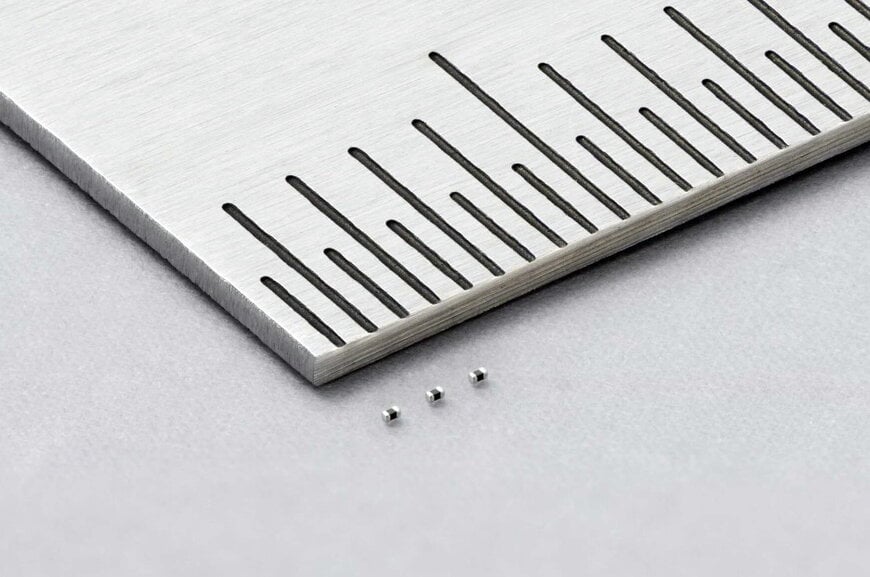
Murata Manufacturing developed the NCU01 series 008004-inch size negative temperature coefficient thermistor to address spatial constraints in high-density electronic assemblies.
www.murata.com
Densely integrated electronic devices face severe thermal management challenges as escalating component densities within mobile systems, wearable technology, and high-frequency communication modules limit available printed circuit board space. In these compact architectures, localized hot spots around processing cores and power management stages require precise thermal monitoring to prevent operational instability, thermal throttling, and component degradation.
Mounting Space Constraints in High-Density Thermal Management
Maintaining reliable thermal supervision in constrained packaging environments requires placing temperature-sensing devices as close as possible to active heat sources. When board space restrictions force an engineer to position a temperature sensor farther away from an operating integrated circuit, thermal resistance across the circuit board material introduces measurement latency and temperature measurement offsets. Rapid temperature fluctuations within active silicon can therefore go undetected, leading to delayed closed-loop cooling responses or premature device failure.
Miniaturizing passive sensing devices to fit these confined areas typically introduces significant production bottlenecks. As physical package dimensions scale downward, maintaining uniform material distribution and precise termination geometries becomes increasingly difficult. For negative temperature coefficient (NTC) thermistors, variations in manufacturing tolerances degrade resistance and material constants, which compromises measurement linearity and overall monitoring accuracy.
Ceramic Processing Yields Sub-Millimeter Temperature Sensor
Murata Manufacturing Co., Ltd. introduced the NCU01 series, an NTC thermistor packaged in an ultra-miniature 008004-inch footprint measuring 0.25 mm by 0.125 mm. The component achieves a 60 percent reduction in mounting surface area compared to Murata's previous smallest 01005-inch format, which measures 0.4 mm by 0.2 mm.
Despite the reduced dimensions, the component maintains tight electrical tolerances. The device delivers a resistance tolerance of ±1% alongside a B-constant tolerance of ±1%. The company achieved these specifications by applying proprietary ceramic material formulation techniques, micro-machining processes, and optimized internal electrode structures designed to maintain structural stability at micro-scale dimensions.
Direct Heat-Source Proximity and Integration Workflows
The primary operational benefit of the reduced footprint is the ability to place thermal monitoring components directly adjacent to localized heat-generating elements. Designers can place the NCU01 inside restricted layout areas, including inside complex system-in-package (SiP) architectures, multichip modules, and high-density interconnect circuit boards.
Shortening the physical distance between the semiconductor die and the thermistor reduces thermal impedance paths. This arrangement minimizes measurement offsets and eliminates detection lag during sudden thermal transients. Key target applications include smartphones, smartwatches, true wireless stereo earbuds, and other compact consumer electronics where board real estate is strictly budgeted.
Sample shipments of the NCU01 series begin in October 2026, with mass manufacturing planned to ramp up during 2027. Initial product variants will offer standard nominal resistance values of 10 kΩ and 100 kΩ, with additional resistance ranges scheduled for progressive introduction.
Additional Context
This section details technical specifications and competitive benchmarking not included in the original product announcement.
The miniaturization of passive surface-mount devices (SMDs) to the 008004 metric scale (EIA 008004, equivalent to JIS 0201 metric) represents an evolution previously achieved in multilayer ceramic capacitors (MLCCs) and surface-mount chip resistors. Transitioning semiconductor ceramic compositions — such as the transition metal oxide spinels used in NTC thermistors — to this physical scale presents unique sintering and mechanical challenges compared to standard dielectric or resistive pastes.
In conventional consumer electronics, standard discrete NTC thermistors historically occupied 0402-inch (1.0 mm by 0.5 mm) or 0201-inch (0.6 mm by 0.3 mm) footprints. As high-speed RF front ends and application processors moved toward miniaturized packaging, the industry transitioned toward 01005-inch sizes. By reaching the 008004-inch standard, discrete thermistors match the dimensional scaling achieved by ultra-miniature decoupling capacitors, permitting uniform pick-and-place nozzle configurations and high-speed solder paste printing alongside other sub-millimeter passives on fine-pitch assembly lines.
Edited by Evgeny Churilov, Induportals Media - Adapted by AI.
www.murata.com
