
electronics-journal.com
22
'26
Written on Modified on
Beckhoff explains how to cut machine builder wiring complexity
Distributed I/O, EtherCAT, and cabinet-free automation platforms like the MX-System eliminate traditional point-to-point wiring bottlenecks.
www.beckhoff.com
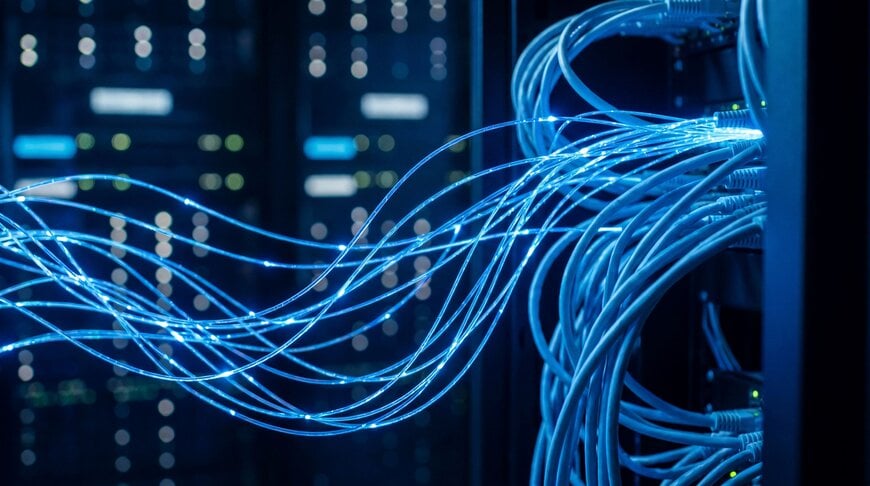
Untangling a drawer full of cables is frustrating enough as a one-off job at home. Imagine doing it for a living, thousands of times over, against a deadline, with no room for a single wrong connection. Machine builders come across a version of this challenge every time they wire a new machine. As machines pack in more sensors than ever before, that job only gets bigger. Here Mark Richards, sales manager at automation and control specialist, Beckhoff Automation UK & Ireland, explains how machine builders can take the time and the risk out of wiring.
Wiring time is more than the time spent wiring
A modern machine can easily carry hundreds of individual connection points once every sensor, drive, actuator and diagnostic feature is accounted for. According to Mordor Intelligence, the global industrial sensors market will grow from $27.46 billion in 2025 to $42.88 billion by 2030. If machine builders keep relying on traditional point-to-point wiring, the problem will only get bigger.
When people picture the cost of wiring, they usually picture someone standing at a control cabinet connecting cables. In reality, that's just the visible part of a much longer process. Before a single cable is terminated, there's design work to plan every connection. Then there's the control cabinet itself, which has to be specified, built and populated. Once the machine is wired, every connection needs to be tested and any faults found during that process need to be traced and fixed, which is often the most time-consuming stage of all.
Rethinking whether you need a cabinet at all
The most direct way to tackle this problem is to reduce the amount of traditional wiring a machine needs in the first place. Rather than running an individual cable from every sensor, drive and actuator back to a central controller, EtherCAT allows a single network cable to carry communication to and from many devices in sequence. Distributed I/O takes this further by moving I/O points out to where the sensors and actuators actually are on the machine.
The next question machine builders are increasingly asking is whether a traditional control cabinet is needed at all. Control cabinet-free automation platforms, such as Beckhoff's MX-System, replace the conventional steel enclosure with modular, IP67-rated function modules that mount directly onto the machine structure itself. Because power supply, control and I/O elements are built into standardised, pre-engineered modules, there's far less cabinet design, panel building and internal wiring to do. Plug-and-play connectors and pre-assembled cables extend the same principle to the rest of the machine, replacing manual termination with connections that simply click into place.
Additional Context: Distributed I/O and cabinet-free automation architectures
This section details technical specifications and competitive benchmarking not included in the original opinion piece.
Traditional machine control architectures rely on a centralized IP20-rated control cabinet housing programmable logic controllers (PLCs), motor drives, contactors, and I/O slices. Every sensor and actuator on the machine requires a dedicated homerun cable routed back to this central enclosure, resulting in massive cable trays, severe electromagnetic interference (EMI) risks, and highly intensive manual termination labor. Decentralized architectures mitigate this by deploying ruggedized, IP67-rated I/O blocks directly on the machine frame, gathering local sensor data and routing it back to the controller via a single high-speed industrial Ethernet cable (such as EtherCAT). Advanced solutions like the Beckhoff MX-System push this paradigm to its ultimate conclusion by completely eliminating the central electrical cabinet. By directly integrating the industrial PC, motion control drives, line filters, and I/O into modular, waterproof baseplates mounted straight to the machine chassis, OEMs can eradicate hundreds of hours of manual panel wiring, wire ferrule crimping, labeling, and point-to-point continuity testing from the manufacturing process.
Edited by an industrial journalist, Lekshman Ramdas, with AI assistance.
www.beckhoff.com
