
electronics-journal.com
26
'26
Written on Modified on
Teradyne Launches UltraFLEXplus S for Edge AI
The compact 24-slot tester optimizes production floor space for high-mix semiconductor manufacturing environments.
www.teradyne.com
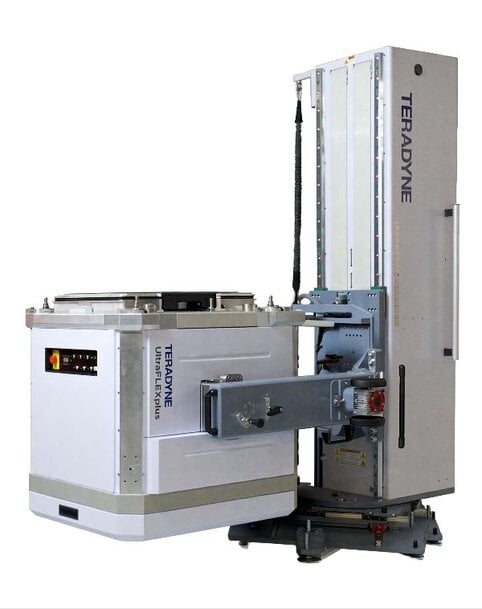
Teradyne has introduced the UltraFLEXplus S tester series, an extension of its automated test equipment (ATE) platform designed specifically for Edge AI semiconductors. The first model, the 24-slot UltraFLEXplus S24, aims to maximize productivity per square meter for integrated device manufacturers (IDMs) and outsourced semiconductor assembly and test (OSAT) providers. This solution addresses the economic constraints of production environments characterized by a high mix of chips and fluctuating volumes.
Reduced Footprint and Software Continuity
Unlike the UltraFLEXplus Q series (with four modules) intended for cloud infrastructures, the S series relies on a single-module architecture to minimize cleanroom footprint. Despite this compact format, the system retains full compatibility with Teradyne’s IG-XL software environment and existing modular instrument ecosystem. This continuity allows engineers to reuse previously developed test program libraries, drastically reducing engineering time and costs during new product introductions.
Efficiency and Application Coverage
Designed to optimize overall equipment effectiveness (OEE), the UltraFLEXplus S24 supports all evaluation phases, from engineering development to mass production, including rigorous thermal testing (at three temperatures). The platform covers a broad spectrum of components, ranging from microcontrollers (MCUs) to multimedia processors and Edge AI devices deployed in the automotive, industrial, and consumer electronics sectors.
Additional Context: The Challenges of ATE Testing for Edge AI (High-Mix, Variable-Volume)
This section details industrial and production dynamics not included in the original press release.
In the semiconductor industry, data center chips (such as massive GPUs and accelerators) typically follow a "low-mix, high-volume" production model, justifying the use of massive multi-module test cells. Conversely, the Edge AI and Internet of Things (IoT) market dictates a "high-mix, variable-volume" model. Outsourced Semiconductor Assembly and Test (OSAT) providers must frequently reconfigure their test lines to switch from evaluating an industrial machine vision sensor to an automotive microcontroller. In this context, cleanroom space is a critical resource, valued at several thousand dollars per square meter. Compact testers (single-module like the S24) increase equipment density (Floor Space Utilization) on the production floor while offering rapid instrument card reconfiguration flexibility to adapt to the specific pin-count and frequency requirements of each new peripheral component.
Edited by industrial journalist Lekshman Ramdas, with AI assistance.
www.teradyne.com
