
electronics-journal.com
30
'26
Written on Modified on
High-Speed Semiconductor Interfaces for Automotive and Robotic Connectivity
Inova Semiconductors introduces communication protocols and lighting control networks designed to optimize distributed intelligence within complex automotive and industrial data ecosystems.
www.inova-semiconductors.de
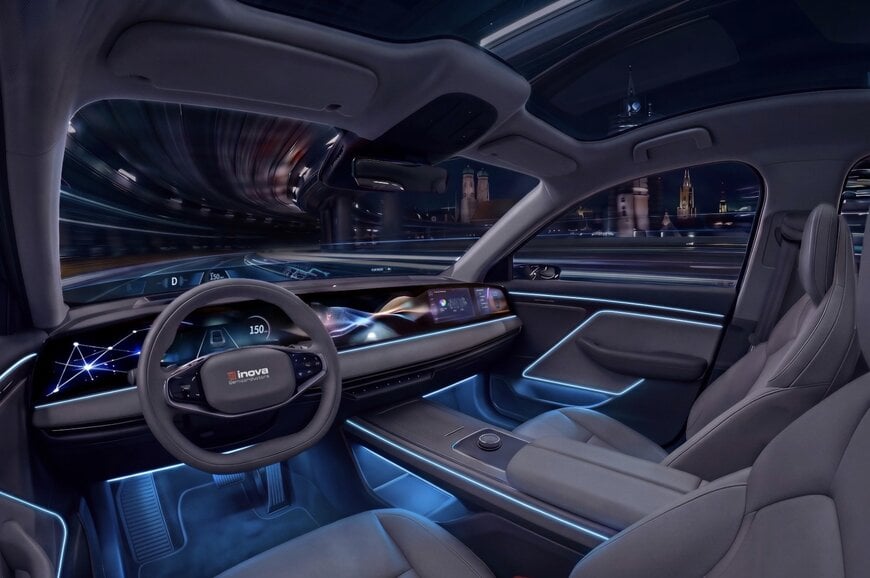
Inova Semiconductors is exhibiting a suite of networking, display, and lighting control technologies at the electronica 2026 trade show in Munich, Germany, from November 10 to 13. Demonstrated at Hall C5, booth 259, these semiconductor solutions facilitate real-time data transmission and hardware integration across the automotive and robotics sectors.
Integrated Lighting and Sensor Control Networks
To address the growing complexity of vehicle interiors, the ISELED and ILaS (ISELED Light and Sensor) platforms establish a localized network for lighting, sensors, and actuators. The ISELED technology drives pre-calibrated smart LEDs equipped with internal temperature compensation to ensure precise, color-accurate illumination. The ILaS protocol extends this capability by linking these localized functions through a shared cabling infrastructure utilizing a segmented daisy-chain architecture. This topological approach supports continuous system diagnostics and fault protection, which is particularly relevant in applications such as interactive interior car door panels that require synchronized actuator responses and precise lighting control.
High-Bandwidth Display and Video Transmission
The transmission of high-resolution video signals over extended physical distances is managed by the APIX architecture. This connectivity standard supports 4K video streaming and integrated display control functionalities within a single transmission lane. The protocol accommodates daisy-chain configurations that can link up to four independent displays per lane. By supporting various display interfaces, the technology minimizes wiring weight and complexity while providing high-performance video routing for automotive infotainment systems and remote robotic operator interfaces.
Low-Latency Virtual Data Channels for Automation
For precision robotics and automated control applications, the APXpress protocol integrates sensors and cameras into a real-time network designed to minimize processing delay. The underlying architecture enables the simultaneous transmission of video, audio, and sensor telemetry across more than 500 independent virtual data channels. Network engineers can individually allocate bandwidth and latency parameters for each channel based on operational priority. Operating at scalable data rates of 4, 8, 16, and 32 Gbps, the system provides the deterministic data handling necessary for complex, time-sensitive automated processes.
Additional Context
This section details technical specifications and competitive benchmarking not included in the original news release.
Within the automotive connectivity and SerDes (Serializer/Deserializer) market, communication protocols are benchmarked primarily on data throughput, deterministic latency, and wiring weight reduction. The APIX standard competes directly with established proprietary protocols such as Texas Instruments' FPD-Link and Analog Devices' GMSL, as well as the emerging open ASA Motion Link standard, for the routing of uncompressed 4K video data.
In the smart lighting sector, the ISELED protocol provides a high-bandwidth alternative to traditional Local Interconnect Network (LIN) buses. While standard LIN operates at a maximum speed of 20 kbps, ISELED delivers 2 Mbps bidirectional communication, enabling the integration of calibrated sensors and high-speed diagnostics directly into the lighting array. Furthermore, the APXpress architecture functions as a specialized high-speed alternative to Automotive Ethernet (such as IEEE 802.3ch). It utilizes deterministic, hardware-based slicing to manage its virtual channels, ensuring dedicated bandwidth without the software processing overhead and variable latency associated with standard Ethernet packet switching.
Edited by Aishwarya Mambet, Induportals Editor, with AI assistance.
www.inova-semiconductors.com
