
electronics-journal.com
30
'26
Written on Modified on
Modular Software and Hardware Integration for Embedded Compute Systems
Tria Technologies introduces a modular software platform and carrier boards to support secure edge computing within the industrial data ecosystem.
www.tria-technologies.com
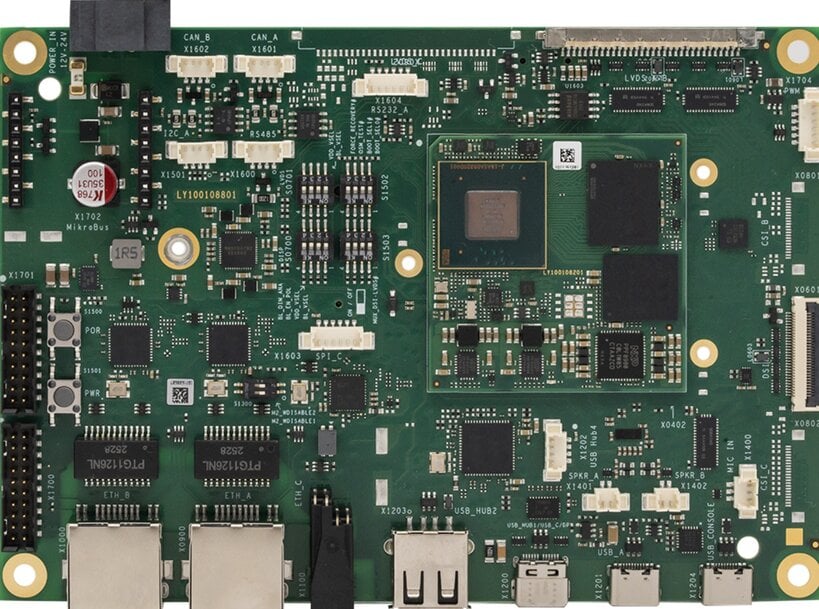
Tria Technologies has released a modular software platform alongside an expanded portfolio of embedded compute modules to facilitate connected product development. This combined hardware and software architecture targets edge AI and industrial automation applications, allowing manufacturers to secure and maintain complex embedded systems without hardware vendor lock-in.
Software Architecture and Board Support Packages
At the electronica 2026 trade show, scheduled for November 10–13 in Munich, Germany, Tria Technologies is exhibiting its new modular software offering (Stand B5.103 and edge lab LIVE! Stand C5.100/25). The software platform establishes a minimalist board support package (BSP) designed to accommodate customer-owned or Tria-supported software stacks. By separating the foundational BSP from the higher-level application software, the modular foundation enables manufacturers to combine independent operating systems, development tools, and security capabilities as project requirements evolve.
Open Standard Modules and Edge AI Hardware
To support the physical deployment of these software architectures, the company introduced the TRIA OSM-SB-EP5. This hardware is an Open Standard Module (OSM) V1.2 carrier board configured to accept Size-S, Size-M, and Size-L form factors. The integration of standardized carrier boards with new OSM and COM Express compute modules is specifically engineered to accelerate hardware development cycles for edge AI and industrial control systems.
Lifecycle Management and Engineering Support
The deployment of connected embedded devices requires ongoing maintenance to address evolving cybersecurity requirements. The combined provision of compute hardware and a modular software starting point ensures that engineering teams maintain complete control over their software architecture long after initial deployment.
“Our customers need more than a board to bring an embedded product to market and keep it running,” stated Daniel Denzler, Vice President of Tria Technologies. “We discuss the whole project: the right hardware, a software starting point that does not lock anyone in, and the support needed as security requirements and products evolve.”
Additional Context
This section details technical specifications and competitive benchmarking not included in the original news release.
The Open Standard Module (OSM) specification defines standardized, machine-solderable system-on-modules (SoMs) to reduce manufacturing costs and physical space requirements. Tria's introduction of the OSM-SB-EP5 carrier board and new OSM and COM Express modules places the company in direct competition with major embedded board manufacturers such as Kontron, Congatec, and SECO.
Benchmarking in the embedded module market relies on standardized form factor compliance, thermal operating ranges for industrial environments (typically -40°C to +85°C), and edge AI processing capabilities enabled by integrated neural processing units (NPUs). Furthermore, the provision of a Board Support Package (BSP) serves as a critical competitive metric. A modular BSP prevents hardware lock-in by providing standard Application Programming Interfaces (APIs) between the silicon and the operating system. Tria's strategy of separating the BSP from the application software stack competes with similar industrial Linux frameworks offered by companies like Toradex and Advantech. These frameworks prioritize long-term maintainability, hardware abstraction, and the security of the digital supply chain over the hardware's entire product lifecycle.
Edited by Aishwarya Mambet, Induportals Editor, with AI assistance.
www.tria-technologies.com
