
electronics-journal.com
03
'26
Written on Modified on
Central Vehicle Computer Architectures for Automated Driving
Infineon Technologies AG integrates microcontroller safety subsystems with Qualcomm Snapdragon Ride platforms to resolve deterministic control bottlenecks in software-defined vehicle computers.
www.infineon.com
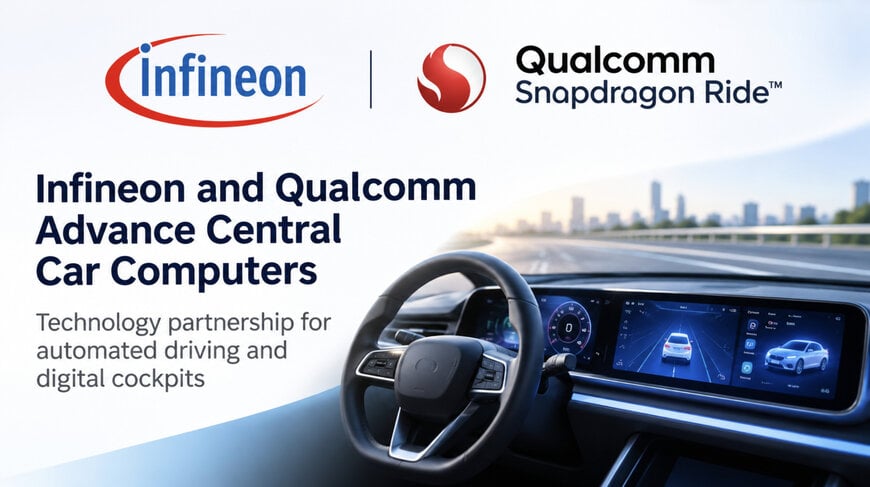
At the electronica trade fair, held November 10 to 13, 2026, in Munich, Germany, semiconductor architectures for centralized computing in software-defined vehicles will be presented for the automotive industry. The technical deployment targets central computing units that host advanced driver assistance systems, automated driving functions, and digital cockpit domains within a consolidated hardware topology.
Core Technology and System Architecture
The reference architecture couples high-performance systems-on-chip with a dedicated microcontroller-based safety and power subsystem. The subsystem utilizes an Infineon AURIX microcontroller alongside integrated OPTIREG power-management circuits to manage real-time monitoring and deterministic execution. System-on-chip platforms handle parallelized artificial intelligence computation and multi-display graphics processing, while the complementary microcontroller executes system health monitoring, orchestrates fail-operational mechanisms, and maintains real-time actuation control. High-throughput data transfer across physical compute layers relies on qualified automotive Ethernet, USB interfaces, and SEMPER NOR flash memory for non-volatile parameter storage.
Deployment and Implementation
Implementation operates around a pre-integrated software bundle developed specifically for the Snapdragon Ride and Ride Flex platforms. The package links the microcontroller firmware with hardware-level safety routines, allowing Tier-1 suppliers and vehicle manufacturers to deploy safety diagnostics without building custom interface layers. Network integration into established in-vehicle topologies occurs over standard CAN and automotive Ethernet channels, providing secured data exchange between high-compute units and decentralized zone controllers.
Industry Applications
The primary application targets software-defined light-duty passenger vehicles and commercial transport requiring domain consolidation. Integrating mixed-criticality workloads into a unified vehicle computer allows engineering teams to merge automated driving perception pipelines with cabin infotainment on shared physical boards. This approach eliminates standalone electronic control units, reducing wiring harness mass, hardware footprint, and physical space requirements inside the vehicle chassis.
Operational Impact and Performance Metrics
By pairing real-time microcontroller monitoring directly with deep-learning compute engines, the subsystem enforces functional safety compliance without interrupting primary computing bandwidth. Dedicated software abstraction layers accelerate deployment by standardizing platform communication, reducing system integration timelines for automotive original equipment manufacturers. Isolating safety-critical execution onto dedicated microcontroller silicon preserves deterministic fail-safe behavior during operating system exceptions on primary computing cores.
"Our collaboration reflects a fundamental approach to centralized vehicle computing, which combines a powerful SoC with a set of specialized components around it, including a safety microcontroller, power management, connectivity and memory devices," said Peter Schiefer, President of the Automotive Division at Infineon. "All these components need to work together seamlessly to help enable safe vehicle operation. Infineon provides essential functional building blocks and integration expertise for building the trust foundation for software-defined vehicles that leverage the power of AI."
Edited by Sucithra Mani, Induportals editor – adapted by AI
www.infineon.com
