
electronics-journal.com
04
'26
Written on Modified on
Compact Computing Module Targets Industrial Edge AI
Tria Technologies introduces the Tria C6C-PLH COM Express module, resolving edge computing constraints in industrial automation.
www.tria-technologies.com
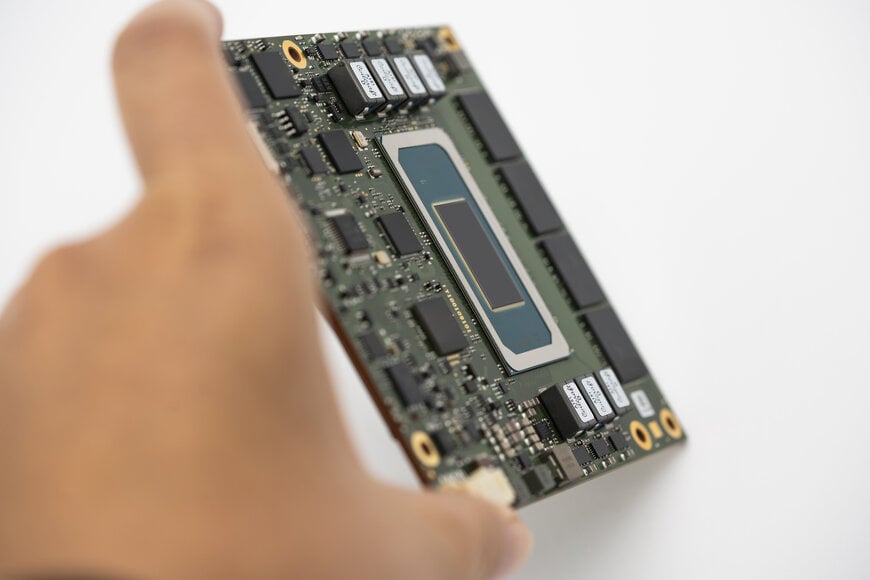
Modern industrial automation and edge computing environments face severe operational challenges regarding local data processing limits and cloud dependency. High-bandwidth machine vision, real-time analytics, and predictive maintenance workflows require massive parallel compute capabilities, yet traditional industrial form factors often struggle to deliver integrated artificial intelligence without excessive power consumption or thermal throttling. Addressing these constraints demands highly dense, standards-compliant compute modules that combine robust processing architectures with industrial-grade reliability.
Tria Technologies has launched the Tria C6C-PLH, a compact COM Express Compact Type 6 module based on Intel Core Ultra Series 3 processors. The system directly addresses the limitations of distributed or cloud-reliant architectures by integrating high-performance CPU, GPU, and dedicated neural processing unit (NPU) hardware directly onto a small footprint, supporting edge AI, robotics, medical imaging, and advanced visualization systems.
Operating Principle and System Architecture
The Tria C6C-PLH utilizes a modular Computer-on-Module (COM) architecture measuring 95 mm x 95 mm, adhering to the PICMG COM Express Type 6 standard pinout. Its internal architecture couples advanced Intel Core Ultra Series 3 multi-core processors with Intel Iris Xe graphics and an onboard NPU, enabling accelerated local inference and media handling. The module relies on non-volatile solid-state memory integration and high-speed multi-lane serial interfaces to communicate with application-specific carrier boards, isolating core compute functions from the harsh physical environment while ensuring high-bandwidth data routing.
Technical Specifications
The module supports processor configurations with up to 16 cores and Intel Iris Xe graphics featuring up to 12 Xe cores. Memory support accommodates up to 96 GB of LPDDR5x RAM, with options for in-band ECC to ensure data integrity in mission-critical applications. High-speed system expansion and peripheral connectivity are driven by PCI Express Gen 4 lanes, USB4 options, and a 2.5 Gb Ethernet controller based on the Intel i226. The platform is engineered to support industrial temperature variants ranging from -40 degrees Celsius to +85 degrees Celsius, 24/7 continuous operation, and hardware-based TPM 2.0 security. Software support includes Windows 11 IoT Enterprise LTSC 2024 and a Yocto-based Linux Board Support Package (BSP).
Real-World Applications
Deployment of the Tria C6C-PLH typically occurs within automated optical inspection systems, industrial robotics controllers, and high-resolution medical diagnostic equipment. In machine vision workflows, the integrated NPU executes real-time visual inspection and anomaly detection tasks directly at the point of capture, eliminating network latency associated with remote server processing. In autonomous guided vehicles and mobile robots, the module handles simultaneous localization, mapping, and sensor fusion workloads while driving up to four independent display streams for operator human-machine interfaces (HMI).
Additional Context:
This section details technical specifications and competitive benchmarking not included in the original product announcement.
Embedded industrial computing has transitioned rapidly from basic x86 single-board computers to highly integrated, heterogeneous processor architectures driven by the demand for localized artificial intelligence and stricter functional safety requirements. Traditional CPU-only embedded systems frequently encountered bottlenecks when running complex machine-learning algorithms or multi-stream video decoding concurrently. The integration of dedicated neural processing units alongside high-execution-unit graphics processors allows modern COM modules to execute inference workloads at significantly lower watts-per-TOPS efficiency ratios.
When compared to previous-generation COM Express Compact modules utilizing earlier Intel architectures, the Tria C6C-PLH delivers marked improvements in graphics performance, memory density limits, and native AI processing throughput. Alternative form factors such as SMARC or Qseven target lower-power, highly space-constrained IoT endpoints, whereas COM Express Type 6 preserves compatibility with legacy heavy-industrial carrier board ecosystems while supporting high-speed I/O like PCIe Gen 4 and USB4. Compliance with Intel Time Coordinated Computing (TCC) and Time Sensitive Networking (TSN) further differentiates the platform for deterministic industrial Ethernet environments.
Edited by Sucithra Mani, Induportals editor – adapted by AI.
www.tria-technologies.com
