
electronics-journal.com
05
'26
Written on Modified on
Multiprotocol System-on-Chip Architecture for Battery-Powered Edge AI
Nordic Semiconductor has introduced a highly integrated processor series designed to bring hardware-accelerated machine learning and concurrent wireless networking to energy-constrained devices.
www.nordicsemi.com
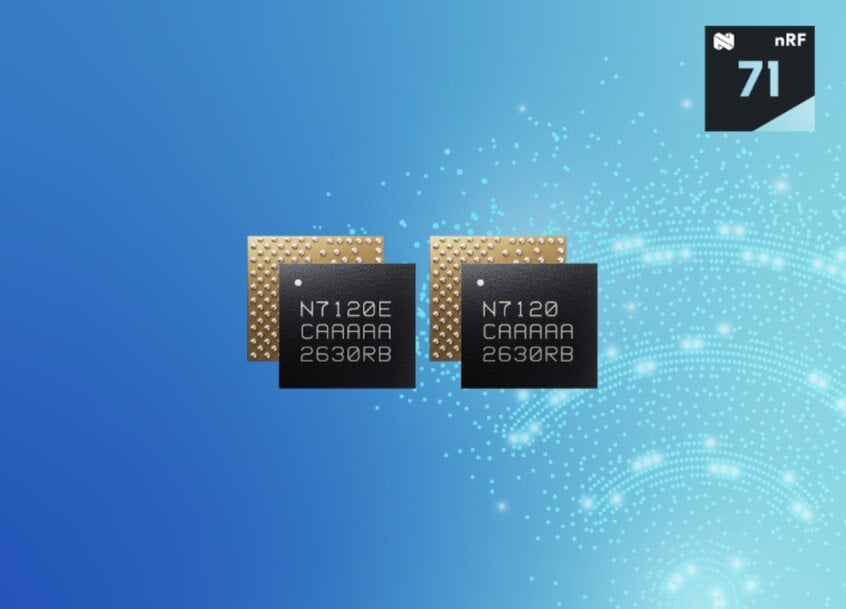
Nordic Semiconductor is releasing the nRF71 series, an ultra-low-power system-on-chip (SoC) that combines Wi-Fi, Bluetooth Low Energy (LE), Thread, and edge artificial intelligence capabilities. This integrated architecture addresses the high standby power consumption traditionally associated with Wi-Fi, making it viable for battery-operated devices within the smart home and industrial IoT ecosystem.
Dual-Radio Architecture and Standby Power Reduction
The nRF71 series features two independent radio modules with separate RF and processing blocks: a Wi-Fi radio and a 2.4 GHz multiprotocol radio derived from the company's nRF54 series. This dual-radio hardware enables simultaneous data reception, allowing devices to maintain persistent Wi-Fi cloud connections while actively processing Bluetooth LE or Thread communications without time-sharing protocols. By optimizing the baseband and power management integrated circuits, the SoCs achieve up to 20 times lower standby power consumption compared to the previous nRF70 generation. This reduction enables battery-powered smart home hubs, Matter gateways, and industrial sensors to sustain multi-year deployment lifecycles.
Hardware-Accelerated Inference and Neural Processing
To facilitate localized decision-making, the nRF7120E variant integrates a dedicated Axon neural processing unit (NPU) alongside a 256 MHz Arm Cortex-M33 processor. This NPU executes machine learning models 10 to 17 times faster than relying on the Cortex-M33 alone, enabling localized keyword spotting, anomaly detection, and image classification without offloading data to an external processor or cloud server. For less computationally intensive tasks, developers can deploy ultra-lightweight models directly on the primary processor using the company's Neuton software.
Both the nRF7120 (dual-band Wi-Fi 6) and the nRF7120E (tri-band Wi-Fi 6E) include 4 MB of on-chip non-volatile memory and 1 MB of user-accessible RAM to support these concurrent wireless and inference workloads. "We are bringing Wi-Fi and edge AI together on the same ultra-low-power platform," notes Kjetil Holstad, Executive Vice President of Wi-Fi and Power Management at Nordic Semiconductor, indicating that the architecture allows next-generation devices to process decisions directly on the hardware without compromising battery constraints.
Additional Context
This section details technical specifications and competitive benchmarking not included in the original news release.
In the highly integrated wireless System-on-Chip (SoC) market, the nRF71 series competes directly with tri-radio microcontrollers such as the NXP RW612 and the Espressif ESP32-C6. A standard industry benchmark for these components is their ability to concurrently manage Wi-Fi 6, Bluetooth LE, and 802.15.4 (Thread) protocols while minimizing deep-sleep and standby current.
While the ESP32-C6 provides a cost-effective RISC-V architecture for Wi-Fi 6 and Thread connectivity, it lacks a dedicated hardware neural processing unit, relying instead on software-based AI execution which can increase active power consumption and latency during inference tasks. Similarly, the NXP RW612 integrates an Arm Cortex-M33 processor capable of managing tri-radio communications but processes machine learning workloads through the primary CPU rather than a specialized NPU. By integrating a dedicated Axon NPU alongside the dual-radio architecture, the nRF7120E offloads AI computational loads from the Cortex-M33, establishing a measurable advantage in inference speed and overall energy efficiency for battery-reliant nodes across the industrial IoT ecosystem.
Edited by Aishwarya Mambet, Induportals Editor, with AI assistance.
www.nordicsemi.com
