
electronics-journal.com
05
'26
Written on Modified on
Qualcomm Dragonwing Platforms Will Power SpaceX Starlink Nationwide Mobile Network
SpaceX integrates advanced Massive MIMO radio and baseband hardware to scale terrestrial high-capacity mobile connectivity while laying the early foundation for future AI-native 6G deployment.
www.qualcomm.com
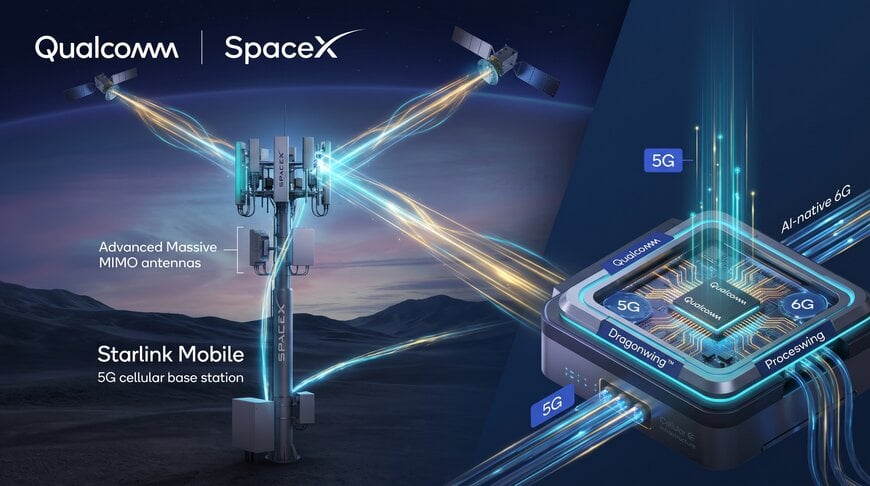
SpaceX and Qualcomm Technologies, Inc. are collaborating to deploy terrestrial 5G digital infrastructure for the nationwide Starlink Mobile cellular network. The technical implementation integrates baseband processing and radio hardware to support high-capacity voice and data traffic in professional telecommunications environments.
Technical Challenge and Partnership Scope
Constructing a nationwide cellular network requires cellular base station deployment capable of sustaining high spectral efficiency and low latency while maintaining strict thermal and energy parameters. Scaling radio access networks across extensive geographic areas demands dedicated processing power per watt to manage high-density mobile connections without unsustainable energy overhead.
The cooperation combines SpaceX expertise in satellite-terrestrial network design with baseband and radio processing platforms developed by Qualcomm Technologies. This complementary integration provides end-to-end base station architecture designed to streamline installation cycles and ensure structural interoperability across multiple frequency bands.
Hardware Architecture and Layer 1 Processing
The physical layer implementation incorporates the Qualcomm Dragonwing QRU100 platform alongside the Dragonwing QDU100 platform, operated with commercial-grade Layer 1 software. The QRU100 platform handles digital front-end processing for Massive MIMO radio units. It executes beamforming, digital pre-distortion, and filtering required for a 64-transmit and 64-receive path (64T64R) antenna configuration.
The QDU100 distributed unit platform executes latency-sensitive Layer 1 signal processing. By offloading computational tasks from general-purpose processors to purpose-built digital signal processors, the architecture achieves high throughput across distributed nodes while reducing operational thermal load and power consumption at the site level.
Implementation and Infrastructure Integration
The terrestrial rollout utilizes standardized Open RAN functional splits between the distributed unit and radio unit interfaces. The modular building blocks allow Starlink Mobile to deploy phased equipment updates across multi-band frequency allocations.
Durga Malladi, EVP & GM, Technology Planning, Edge Solutions, and Data Center at Qualcomm Technologies, Inc., noted the engineering parameters governing the selection: "Building a nationwide network demands high performance and power efficiency at every site. Dragonwing Cellular Infrastructure platforms bring together advanced Massive MIMO, purpose-built processing and commercial-grade Layer 1 software to help Starlink deliver an exceptional nationwide network."
Regarding base station integration, Michael Nicolls, Senior Vice President of Starlink, stated: "Starlink is building the first fully-integrated nationwide satellite and terrestrial network... We’re excited to collaborate with Qualcomm Technologies and leverage their industry expertise and platform to accelerate our timeline to develop our base station end-to-end architecture."
Network Performance and Long-Term Evolution
The 64T64R Massive MIMO configuration delivers spatial multiplexing gains, increasing spectral efficiency in densely utilized RF environments. The resulting network capacity provides continuous terrestrial throughput, complementing orbital non-terrestrial network links to eliminate coverage discontinuities for mobile subscribers.
The modular Layer 1 software stack and programmable hardware framework establish an evolvable foundation for subsequent standard updates, providing an architectural pathway toward AI-native 6G infrastructure.
Edited by Evgeny Churilov, Induportals Media - Adapted by AI.
www.qualcomm.com
