

electronics-journal.com
07
'26
Written on Modified on
Snapdragon X2 Plus Platform for Windows PCs
Qualcomm expands AI-centric PC silicon with multi-day battery life and balanced performance for professionals and creators.
www.qualcomm.com
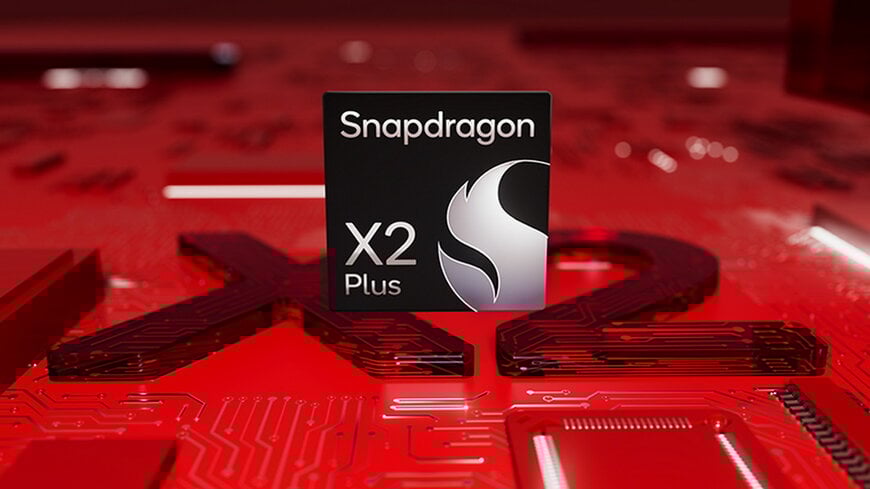
Qualcomm Technologies has introduced the Snapdragon X2 Plus computing platform, a new system-on-chip (SoC) family targeting Windows 11 Copilot+ PCs used in portable workstations and mainstream laptops. The architecture is positioned to support sustained performance with extended battery life and on-device artificial intelligence, addressing workloads in productivity, creative toolchains, and always-connected applications.
Architectural Overview and Performance
The Snapdragon X2 Plus platform builds on Qualcomm’s third-generation Oryon CPU architecture, fabricated on a 3 nanometer process. It is offered in two configurations: a 10-core variant (X2P-64-100) and a 6-core variant (X2P-42-100). Both configurations can scale to approximately 4.0 GHz peak frequency and employ tiered cache sizes (about 34 MB for the 10-core, 22 MB for the 6-core), reflecting Qualcomm’s strategy to segment performance while managing energy consumption.
The integrated Hexagon neural processing unit (NPU) delivers 80 TOPS (trillion operations per second) of AI throughput. Such capacity aims to support local inference for generative features, real-time media processing, and background agentic behaviors in modern laptop operating systems without reliance on cloud connectivity.
Graphics are handled by a Qualcomm Adreno X2-45 GPU with support for standard graphics APIs (DirectX 12.2, Vulkan 1.4) and sufficient capability for everyday visual workloads and high-resolution displays. Memory support includes LPDDR5x up to roughly 9,523 MT/s with bandwidth in the region of 152 GB/s, and storage interfaces include PCIe Gen5 and UFS 4.0 connections.
Differentiation and System Capabilities
Qualcomm positions the X2 Plus around three core pillars: compute performance, AI acceleration, and energy efficiency. Compared with the previous generation Plus silicon, Qualcomm cites approximate 35 percent single-core performance improvement and about 43 percent lower power draw under comparable workloads, results achieved through architecture and process enhancements.
Battery life is a prominent theme; aggressive power management across CPU, GPU, and NPU domains is intended to enable multi-day usage cycles in thin-and-light form factors, aligning with expectations for mobile productivity devices. Connectivity options such as Wi-Fi 7, optional 5G modems, and Bluetooth 5.4 are included to support always-connected deployments, along with enterprise-oriented security extensions at silicon level.
In terms of positioning within the digital supply chain for PC platforms, the X2 Plus seeks to broaden access to AI-centric compute beyond premium tier devices — offering Copilot+-certified capability in machines priced for broader business and prosumer segments. It shares several architectural elements with premium Snapdragon X2 Elite models (including NPU and connectivity subsystems) but scales core counts and GPU clocks for efficiency and cost.
Application Areas and Use Cases
The Snapdragon X2 Plus platform is designed for Windows 11 Copilot+ PCs, which involve AI-augmented workflows, real-time content creation, and mixed productivity tasks such as editing, rendering, and collaboration over high-bandwidth networks. The on-device AI capabilities support scenarios such as live image and video enhancement, natural language agent interactions, and context-aware system behaviors without cloud dependency.
Devices using this silicon are expected to ship in the first half of 2026, and OEMs are positioning them across thin-and-light laptops and convertible form factors where battery endurance, sustained performance, and integrated AI features are prioritized.
Competitive Context
Within ARM-based PC ecosystems, Snapdragon X2 Plus competes with other low-power architectures emphasizing AI and efficiency. Qualcomm’s strategy of maintaining high NPU performance (80 TOPS) across both mainstream and premium tiers differentiates it from architectures that proportionally reduce AI capability in lower segments. Independent benchmarking and compatibility with Windows on Arm application stacks will be key comparative metrics as devices enter the market.
www.qualcomm.com
