
electronics-journal.com
09
'26
Written on Modified on
Infineon Launches Wi-Fi 7 Tri-Radio Platform for IoT
A new single-chip connectivity platform targets low-power IoT deployments by combining 20 MHz Wi-Fi 7, multi-protocol support, and robust operation in congested wireless environments.
www.infineon.com
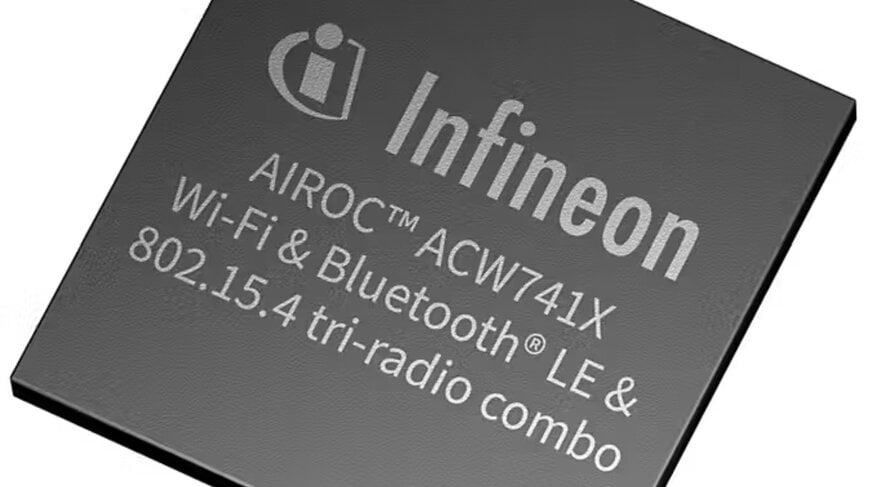
As connected devices scale across homes, commercial buildings, and industrial facilities, IoT designers face increasing pressure to balance reliability, power efficiency, and integration complexity within a secure digital supply chain. In response to these constraints, Infineon Technologies introduced the AIROC™ ACW741x product family, a tri-radio device integrating Wi-Fi 7, Bluetooth® LE 6.0 with Channel Sounding, and IEEE 802.15.4 Thread with Matter ecosystem support.
A 20 MHz Wi-Fi 7 profile tailored for IoT
The ACW741x is positioned as the first IoT-focused device to support Wi-Fi 7 using a 20 MHz-only channel configuration. This profile aligns with the Wi-Fi Alliance’s newly introduced 20 MHz device category for Wi-Fi 7, aimed at lower-bandwidth, power-constrained IoT endpoints rather than high-throughput consumer electronics. By optimizing radio performance around narrower channels, the device targets ultra-low connected standby power while maintaining compliance with Wi-Fi 7 features relevant to IoT deployments.
Managing congestion through multi-link operation
Wireless congestion across 2.4 GHz, 5 GHz, and 6 GHz bands increasingly affects IoT reliability in dense environments. To address this, the ACW741x implements Wi-Fi 7 Multi-Link for IoT, maintaining concurrent links across multiple frequency bands. Adaptive Band Switching allows the device to shift traffic dynamically in response to interference or congestion, improving link robustness for applications such as security cameras, video doorbells, alarm systems, medical devices, and HVAC equipment operating within a shared automotive data ecosystem or building network.
Power efficiency as a design constraint
Battery-powered IoT devices impose strict limits on standby and active power consumption. Infineon reports that the ACW741x’s optimized 20 MHz architecture delivers up to 15 times lower Wi-Fi connected standby power compared with other IoT Wi-Fi solutions currently available. This reduction directly extends battery life in devices such as smart locks, thermostats, and cameras, where Wi-Fi connectivity must remain available without continuous high-power operation.
Integrated sensing and ranging functions
Beyond connectivity, the ACW741x incorporates wireless sensing features intended to add contextual awareness to IoT devices. Support for Wi-Fi Channel State Information (CSI) under IEEE 802.11bf enables device presence and motion detection through signal analysis shared between devices on the same network. Bluetooth® LE Channel Sounding provides secure, low-power ranging with centimeter-level accuracy, supporting applications that require precise proximity or location awareness without additional sensors.
System integration and cost considerations
The device integrates key RF and power components on-chip, including transmit/receive switches, power amplifiers, low-noise amplifiers, power management, and a low-power oscillator. Packaging in a QFN format supports low-cost two-layer PCB designs, reducing system complexity and offering a cost-efficient migration path toward Wi-Fi 7 for IoT manufacturers.
With the extension of Wi-Fi CERTIFIED 7 to 20 MHz-only devices by the Wi‑Fi Alliance, the ACW741x reflects an industry shift toward adapting next-generation wireless standards to the specific performance, power, and integration requirements of large-scale IoT deployments.
www.infineon.com
A 20 MHz Wi-Fi 7 profile tailored for IoT
The ACW741x is positioned as the first IoT-focused device to support Wi-Fi 7 using a 20 MHz-only channel configuration. This profile aligns with the Wi-Fi Alliance’s newly introduced 20 MHz device category for Wi-Fi 7, aimed at lower-bandwidth, power-constrained IoT endpoints rather than high-throughput consumer electronics. By optimizing radio performance around narrower channels, the device targets ultra-low connected standby power while maintaining compliance with Wi-Fi 7 features relevant to IoT deployments.
Managing congestion through multi-link operation
Wireless congestion across 2.4 GHz, 5 GHz, and 6 GHz bands increasingly affects IoT reliability in dense environments. To address this, the ACW741x implements Wi-Fi 7 Multi-Link for IoT, maintaining concurrent links across multiple frequency bands. Adaptive Band Switching allows the device to shift traffic dynamically in response to interference or congestion, improving link robustness for applications such as security cameras, video doorbells, alarm systems, medical devices, and HVAC equipment operating within a shared automotive data ecosystem or building network.
Power efficiency as a design constraint
Battery-powered IoT devices impose strict limits on standby and active power consumption. Infineon reports that the ACW741x’s optimized 20 MHz architecture delivers up to 15 times lower Wi-Fi connected standby power compared with other IoT Wi-Fi solutions currently available. This reduction directly extends battery life in devices such as smart locks, thermostats, and cameras, where Wi-Fi connectivity must remain available without continuous high-power operation.
Integrated sensing and ranging functions
Beyond connectivity, the ACW741x incorporates wireless sensing features intended to add contextual awareness to IoT devices. Support for Wi-Fi Channel State Information (CSI) under IEEE 802.11bf enables device presence and motion detection through signal analysis shared between devices on the same network. Bluetooth® LE Channel Sounding provides secure, low-power ranging with centimeter-level accuracy, supporting applications that require precise proximity or location awareness without additional sensors.
System integration and cost considerations
The device integrates key RF and power components on-chip, including transmit/receive switches, power amplifiers, low-noise amplifiers, power management, and a low-power oscillator. Packaging in a QFN format supports low-cost two-layer PCB designs, reducing system complexity and offering a cost-efficient migration path toward Wi-Fi 7 for IoT manufacturers.
With the extension of Wi-Fi CERTIFIED 7 to 20 MHz-only devices by the Wi‑Fi Alliance, the ACW741x reflects an industry shift toward adapting next-generation wireless standards to the specific performance, power, and integration requirements of large-scale IoT deployments.
www.infineon.com
