
electronics-journal.com
20
'26
Written on Modified on
Toshiba and MIKROE introduce motor driving board
In collaboration MIKROE, Toshiba Corporation introduces a motor driving board to simplify early-stage automotive system design and support engineers working within the automotive data ecosystem.
www.global.toshiba
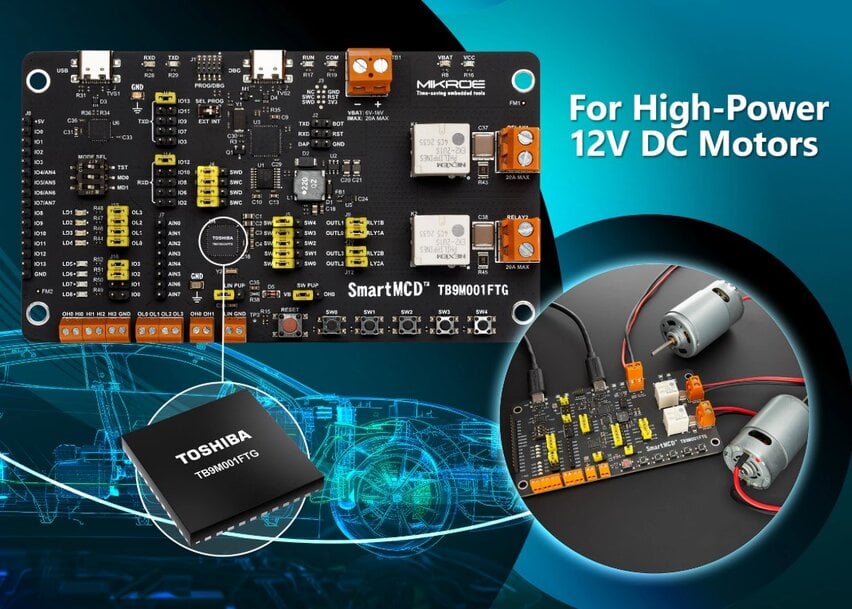
Toshiba Electronic Devices & Storage Corporation (“Toshiba”) and MIKROE have developed a motor driving board that integrates Toshiba’s SmartMCD™ motor control driver to facilitate prototyping of automotive applications. The SmartMCD TB9M001FTG board provides a development platform targeting common in-vehicle motor functions such as wipers, sunroofs, powered windows, and adjustable seating systems, where precise control and diagnostic capability are required.
Context and Relevance in Automotive Development
Prototyping boards such as the SmartMCD TB9M001FTG are pivotal in shortening development cycles for in-vehicle systems, allowing engineers to validate control algorithms, test motor interfaces, and refine hardware configurations before committing to production designs. This is particularly relevant in complex automotive projects where the automotive data ecosystem depends on robust, reliable actuation subsystems that communicate accurately with vehicle networks and sensors.
The board incorporates the SmartMCD device, qualified to AEC-Q100 Grade 1, ensuring suitability for automotive environments with extended temperature and reliability expectations. Additionally, it meets Automotive Safety Integrity Level A (ASIL-A), the ISO 26262 classification for low-criticality systems, by incorporating error detection mechanisms for overcurrent, overvoltage, undervoltage, and thermal shutdown conditions. These features support safer evaluation of motor control functions during prototyping.
Technical Composition and Capabilities
At its core, the SmartMCD device integrates a 32-bit microcontroller based on the Arm® Cortex®-M0 architecture. It includes 16 kB of RAM, 192 kB of Flash memory, and 16 kB of Data Flash, all with error-correcting code (ECC) supporting single-error correction and double-error detection (SEC/DED). These memory safeguards are important for maintaining data integrity in automotive diagnostic and control loops.
The IC integrates four low-side relay drivers capable of forward and reverse operation of two brushed DC motors using single-pole double-throw (SPDT) relays, and two high-side drivers for 5 V and 12 V loads to external components. This driver configuration supports typical automotive actuators with minimal external components, reducing board complexity and aiding rapid iteration.
The board also includes a LIN transceiver for in-vehicle communication, enabling integration with networked control units during prototyping. A fully integrated power management system derives all necessary voltage rails directly from the vehicle battery, easing bench-level tests with representative power conditions.
To support development workflows, the TB9M001FTG board includes multiple configurable general-purpose input/output (GPIO) connectors, selectable via jumpers, and an on-board debugger compliant with the CMSIS-DAP standard. This allows immediate testing and debugging without additional external hardware.
Applications and Early Benefits
The TB9M001FTG board targets a broad range of automotive electromechanical functions where dual brushed DC motor control is typical. Examples include automated window regulators, mirror adjustment systems, and auxiliary mechanisms in both passenger and commercial vehicles. For design teams, the ability to exercise control logic and monitor real-time responses under realistic conditions accelerates design verification and reduces integration risk in later development stages.
By delivering a pre-configured, feature-rich prototyping environment, Toshiba and MIKROE aim to lower engineering barriers and enhance early discovery of functional and interface issues, thereby improving overall development throughput.
Positioning in Automotive Component Development
While numerous development kits exist for motor control ICs, the TB9M001FTG’s combination of automotive qualification, integrated communication interface, and comprehensive debugging support distinguishes it in early implementation phases. Its focus on dual brushed DC motor applications complements broader automotive electrification trends where modular, software-configurable control boards facilitate iterative design and validation.
The Toshiba-MIKROE SmartMCD TB9M001FTG board represents a targeted development platform for automotive motor control prototyping. By integrating safety features, comprehensive diagnostic capabilities, and industry-standard interfaces, it supports engineers navigating the complexities of modern automotive system design and contributes to efficient development within the automotive data ecosystem.
www.global.toshiba
