
electronics-journal.com
03
'26
Written on Modified on
SGP.32 eSIM Architecture for Connected Vehicles
Giesecke+Devrient, Rivian and AT&T implement GSMA SGP.32-based eSIM and 5G connectivity in Rivian’s R2 platform to enable scalable automotive IoT deployment.
www.gi-de.com
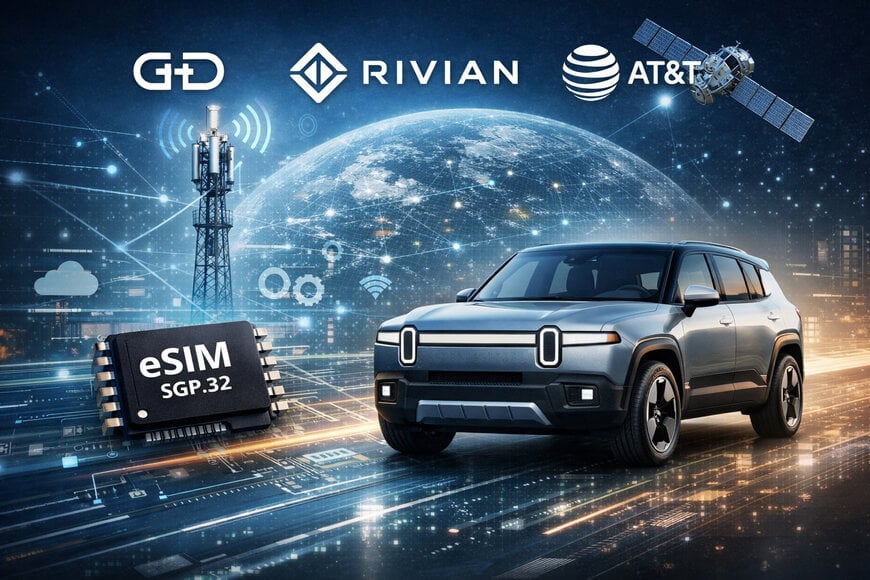
Giesecke+Devrient, Rivian and AT&T are cooperating to integrate GSMA SGP.32–compliant eSIM technology with 5G connectivity into Rivian’s upcoming R2 vehicle platform. The collaboration establishes a remotely manageable, standards-based connectivity architecture for automotive and IoT applications.
Context and Industrial Objective
Modern vehicle platforms increasingly depend on continuous connectivity for over-the-air (OTA) software updates, telematics, diagnostics and digital services. Traditionally, global deployments require region-specific SIM profiles and separate mobile network operator (MNO) integrations, increasing hardware variants and operational complexity.
The cooperation addresses this challenge by implementing GSMA SGP.32, a recently finalized eSIM specification developed specifically for IoT and automotive use cases. The standard enables remote provisioning and lifecycle management of connectivity profiles without physical SIM replacement, supporting a single hardware SKU for global markets.
Rivian, as vehicle manufacturer and system integrator, defines the vehicle connectivity architecture. Giesecke+Devrient (G+D) provides automotive-grade eSIM hardware and the associated eSIM IoT Remote Manager (eIM) infrastructure. AT&T acts as the initial MNO in the United States, delivering 5G network access.
Technical Architecture and Responsibilities
The solution is based on embedded SIM hardware integrated into the vehicle’s telematics control unit. The eSIM complies with GSMA SGP.32, which defines secure profile download, activation and switching using standardized interfaces and cryptographic authentication mechanisms.
G+D supplies:
- Automotive-qualified eSIM components
- Remote subscription management via its eIM platform
- Compliance with GSMA security and interoperability requirements
The eIM infrastructure enables Rivian to:
- Provision connectivity profiles during production or post-deployment
- Switch MNOs remotely if regulatory, commercial or coverage requirements change
- Manage connectivity securely across the vehicle lifecycle
AT&T provides 5G connectivity services in the U.S., supporting high-bandwidth and low-latency data transmission required for OTA updates, cloud-based vehicle functions and connected services. The architecture allows additional MNO integrations in other regions without hardware redesign.
Deployment and Integration
The SGP.32-based eSIM is integrated directly into the R2 vehicle platform during production. Remote profile management supports regional expansion without modification of the telematics hardware.
The system is designed to integrate with existing backend infrastructures for fleet management, diagnostics and digital service platforms. By separating hardware deployment from operator selection, the architecture reduces logistical complexity and simplifies global rollouts.
Application Areas and Operational Impact
Target applications include:
Deployment and Integration
The SGP.32-based eSIM is integrated directly into the R2 vehicle platform during production. Remote profile management supports regional expansion without modification of the telematics hardware.
The system is designed to integrate with existing backend infrastructures for fleet management, diagnostics and digital service platforms. By separating hardware deployment from operator selection, the architecture reduces logistical complexity and simplifies global rollouts.
Application Areas and Operational Impact
Target applications include:
- Over-the-air software and firmware updates
- Real-time telematics and vehicle diagnostics
- Connected infotainment services
- Future digital vehicle services requiring scalable bandwidth
From a technical standpoint, the single-SKU approach reduces supply chain variation and minimizes the need for region-specific hardware certification. Remote provisioning under GSMA SGP.32 improves operational flexibility and supports long-term maintainability in connected vehicle ecosystems.
The cooperation demonstrates how standardized eSIM technology combined with 5G infrastructure can form a scalable digital infrastructure foundation for next-generation automotive platforms.
www.gi-de.com
The cooperation demonstrates how standardized eSIM technology combined with 5G infrastructure can form a scalable digital infrastructure foundation for next-generation automotive platforms.
www.gi-de.com
