
electronics-journal.com
26
'26
Written on Modified on
Toshiba supports dual brushed motor control prototyping
Evaluation platform targets safety-oriented automotive actuator development using an integrated controller architecture.
www.global.toshiba
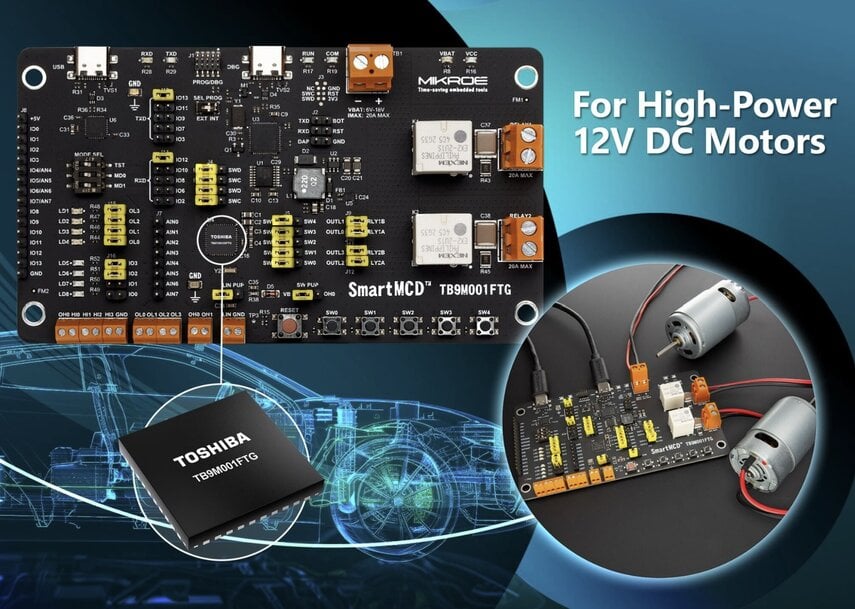
Prototyping of small automotive actuators often requires separate microcontroller, driver, and protection circuitry, increasing development time and validation effort. A new evaluation board built around an integrated motor control device addresses this by combining control, drive, communication, and power functions on a single platform. Toshiba Electronics Europe, working with MIKROE, introduced the SmartMCD™ TB9M001FTG board for this purpose.
Integrated approach for common vehicle actuators
The platform is aimed at body electronics and comfort systems such as power windows, sunroofs, windshield wipers, and seat adjustment mechanisms. These applications typically rely on brushed DC motors that must operate reliably across wide temperature ranges and under fluctuating supply conditions.
At the core of the board is Toshiba’s TB9M001FTG SmartMCD device, designed for automotive embedded systems. It is qualified to AEC-Q100 Grade 1 and supports ASIL-A system requirements, aligning it with safety expectations for many non-powertrain vehicle functions. Protection mechanisms include detection of overcurrent conditions on both low- and high-side drivers, as well as monitoring for overvoltage, undervoltage, and overtemperature events.
Controller, memory, and diagnostics on one chip
The motor controller integrates an Arm® Cortex®-M0–based microcontroller, reducing the need for an external MCU during early design stages. On-chip memory includes 192 KB of Flash, 16 KB of RAM, and an additional 16 KB of Flash data memory. All memory blocks use error-correcting code with single error correction and double error detection (SEC/DED), supporting diagnostic coverage targets in safety-related designs.
This level of integration allows engineers to prototype both motor control algorithms and safety monitoring strategies on the same hardware, rather than distributing these functions across multiple components.
Relay-based bidirectional motor drive
For actuation, the SmartMCD integrates four bottom-side relay drivers. These support the forward and reverse operation of two brushed DC motors using single-pole double-throw (SPDT) relays, a topology still common in cost-sensitive automotive actuator modules.
In addition, two top-side drivers are provided to supply 5 V and 12 V loads for external components such as sensors or auxiliary electronics. A built-in LIN transceiver enables communication with vehicle networks, while the integrated power management system derives all required internal voltage rails directly from the vehicle battery, simplifying board-level power design.
Board-level resources for rapid validation
The SmartMCD TB9M001FTG board measures 130 mm × 73 mm and includes the circuitry required for motor operation and functional evaluation. Multiple GPIOs are accessible and configurable via jumper-selectable routing, allowing adaptation to different sensor inputs, switches, or feedback signals during testing.
An onboard debugger compatible with the CMSIS-DAP embedded emulator standard supports firmware loading and real-time debugging without additional external tools. This setup allows developers to move from initial firmware development to hardware-in-the-loop motor testing on the same platform, shortening early-stage validation cycles for automotive actuator modules.
www.toshiba.com
