
electronics-journal.com
28
'26
Written on Modified on
Microchip Expands Its maXTouch M1 Touchscreen Series
New controllers bring reliable touch performance to displays ranging from 2-inch panels to 42-inch widescreens in modern vehicles.
www.microchip.com
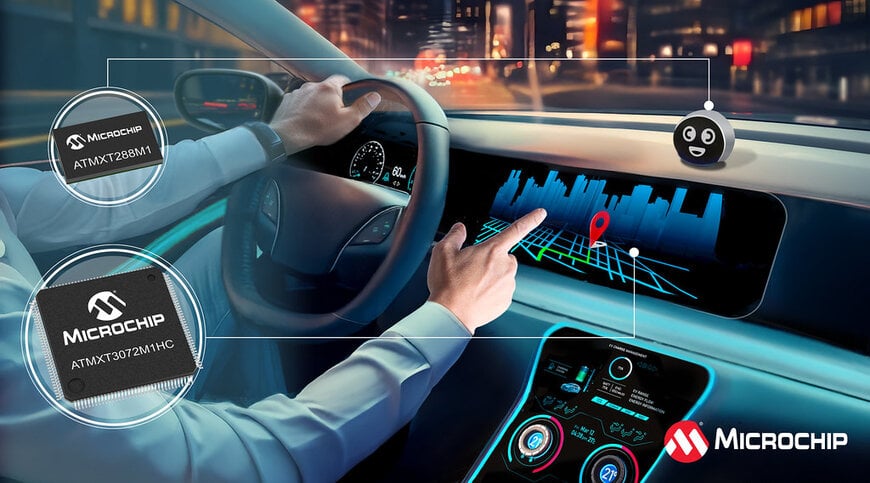
Microchip Technology has broadened its maXTouch M1 touchscreen controller series to address a wider range of display sizes in automotive human-machine interface (HMI) systems, supporting both compact screens of 2–5 inches and large free-form widescreens up to 42 inches. The enhanced series is designed for next-generation cockpit electronics that increasingly integrate OLED and microLED displays for digital supply chain and automotive data ecosystem applications.
Broader Range for Automotive HMI Displays
The new controllers, designated ATMXT3072M1-HC and ATMXT288M1, expand the range of the existing maXTouch M1 generation by covering extremely large free-form widescreen formats and compact display applications. The ATMXT3072M1-HC targets large, continuous touch sensor designs capable of spanning both instrument clusters and central information displays (CIDs), simplifying hardware designs for left- and right-hand drive vehicles with a single controller interface. The ATMXT288M1 targets space-constrained applications such as compact cluster displays or driver-assistant interfaces.
Both controllers are engineered to be compatible with emerging display technologies including organic light-emitting diode (OLED) and microLED panels, which present unique capacitive challenges due to thinner display stack-ups and higher capacitive loads that can degrade touch performance.
Technical Features and Performance
At the core of the extended M1 series is Microchip’s Smart Mutual touch acquisition method, an advanced signal processing approach that improves the touch signal-to-noise ratio (SNR) by up to 15 dB compared to earlier generation controllers. This enhancement mitigates issues such as false or missed touch events, which are critical for large, thin displays where capacitive coupling and display noise can compromise accuracy.
The ATMXT3072M1-HC supports a host-client architecture that presents as a single device to the host microcontroller unit (MCU), eliminating the need for a separate MCU to merge coordinates from multiple sensors. The ATMXT288M1 introduces a thin-profile fine-pitch ball grid array (TFBGA60) package that reduces printed circuit board (PCB) area by approximately 20 percent compared to previous automotive maXTouch products, making it suitable for compact form factors.
Integration and Toolchain Support
Both new controllers are integrated into Microchip’s broader maXTouch ecosystem, which includes development support through the maXTouch Studio integrated development environment (IDE) and the maXTouch Analyzer (MTA) for production testing. Host software drivers are available for a range of real-time operating system (RTOS) platforms, such as Linux, Android, Windows, AliOS, Automotive QNXT and Zephyr, facilitating integration into diverse automotive electronic architectures.
Application Context in Automotive Electronics
The expanded maXTouch M1 series addresses key trends in automotive electronics where larger, high-resolution displays and diverse form factors are increasingly prevalent. These interfaces serve not only traditional infotainment systems but also cluster displays, secondary driver interfaces and integrated controls for advanced driver assistance and software-defined vehicle functions. Reliable capacitive touch performance across these varied display formats is essential for safety, usability and seamless data interaction within vehicle systems.
Functional Relevance and Summary
By extending the maXTouch M1 series to encompass a broader spectrum of display sizes and by enhancing signal-to-noise performance through Smart Mutual touch acquisition, Microchip’s latest controllers provide scalable capacitive touch solutions for modern automotive HMI designs. These technical enhancements are pertinent for automotive electronic engineers tasked with integrating touch interfaces into displays ranging from compact clusters to expansive widescreen formats, within the broader context of the automotive data ecosystem transformation.
www.microchip.com
