
electronics-journal.com
30
'26
Written on Modified on
Compact OSM module targets edge AI platforms
Tria Technologies introduces a 45 mm system-on-module built around NXP’s i.MX 95 for industrial and vision-based edge computing.
www.tria-technologies.com
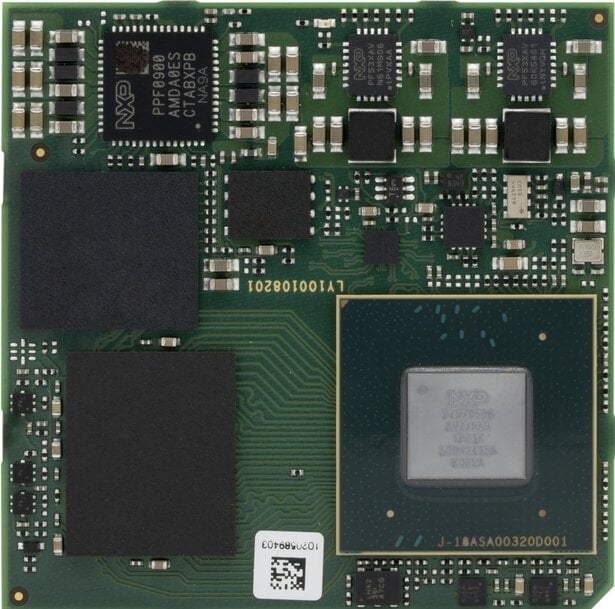
Edge AI, industrial automation, and embedded vision systems require compact compute platforms that combine application processing, real-time control, and secure connectivity. Addressing these needs, Tria Technologies released the OSM-LF-IMX95, an Open Standard Module (OSM) 1.2 compliant system-on-module based on the NXP i.MX 95 applications processor.
Small-form-factor compute for edge deployment
The OSM-LF-IMX95 measures 45 × 45 mm (OSM size L) and is designed for direct soldering onto carrier boards, eliminating the need for board-to-board connectors. This approach supports vibration resistance and space savings in embedded designs used in industrial and mobile edge equipment.
At its core is the NXP i.MX 95 SoC, combining a six-core 2 GHz Arm Cortex-A55 application processor with two real-time processors: an 800 MHz Cortex-M7 and a 333 MHz Cortex-M33. This heterogeneous architecture allows Linux-class workloads to run alongside deterministic control tasks, which is relevant for robotics, machine control, and intelligent sensor systems within a broader digital supply chain.
Integrated acceleration for vision and AI workloads
The module integrates an Arm Mali GPU, a 4K-capable video processing unit (VPU), and NXP’s eIQ neural processing unit (NPU). A dedicated image signal processor supports camera-based processing with AI-assisted vision functions. These hardware blocks target edge workloads such as object classification, production line inspection, and predictive maintenance, where image data must be processed locally with low latency.
By combining CPU, GPU, VPU, and NPU resources on a single module, the design reduces the need for external accelerators in many embedded vision applications.
Security features for connected edge devices
Security is built into the module through an integrated EdgeLock Secure Enclave subsystem. This hardware-based security block supports secure boot, cryptographic operations, trusted provisioning, runtime attestation, key management, secure remote device management, and secure over-the-air (OTA) update mechanisms. Such features are increasingly required in connected industrial and infrastructure deployments where devices operate as part of distributed IoT or edge AI networks.
Memory and high-speed I/O for data-intensive tasks
The OSM-LF-IMX95 supports up to 16 GB of LPDDR5 SDRAM with integrated ECC, addressing reliability requirements in industrial systems. Storage options include up to 256 GB of onboard eMMC flash.
High-speed connectivity is provided through SerDes interfaces supporting SGMII up to 10 Gigabit Ethernet, along with two Gigabit Ethernet ports via RGMII, USB 3.0, and PCI Express Gen 3. These interfaces enable integration with high-bandwidth sensors, networking equipment, and expansion devices.
Additional embedded interfaces include three CAN-FD channels, dual-channel LVDS, MIPI DSI for displays, and dual MIPI CSI-2 interfaces for camera inputs. A QSPI interface allows connection to FPGAs on the carrier board and supports onboard NOR flash, offering flexibility in system design.
Development support for faster system integration
To assist integration and validation, Tria provides a dedicated development platform and starter kit. A Linux Board Support Package based on Yocto is available, with optional support for Android 12 and Windows 10 IoT Enterprise. These software resources are intended to shorten development cycles for engineers building secure, connected edge systems around the module.
www.tria-technologies.com
