
electronics-journal.com
03
'26
Written on Modified on
ADLINK Launches Edge AI Servers Powered By Intel Xeon W
The high-performance server series leverages Intel Xeon W processors to deliver robust computing power and advanced AI acceleration for complex industrial edge applications.
www.adlinktech.com
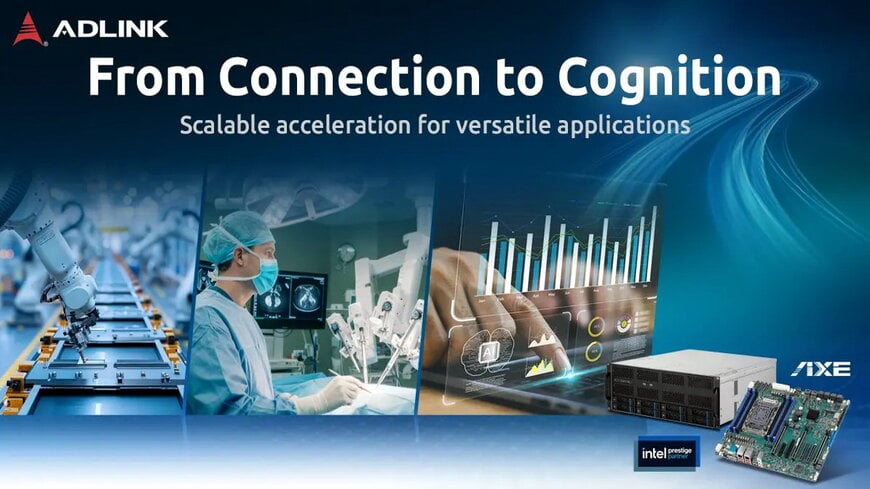
The expansion of the edge AI portfolio through the introduction of server-class systems enables the deployment of compute-intensive workloads, such as generative AI inference and high-end vision processing, across demanding industrial environments. These platforms leverage the Intel Xeon 600 processor architecture to provide the low latency and high reliability required for autonomous robotics, medical imaging, and smart factory automation.
Scalable Architecture for Complex Edge Workloads
The integration of Intel Xeon 6 processors for workstations marks a shift from experimental AI pilots to full-scale edge deployment. The current hardware release includes the ISB-W890 server board and three dedicated GPU servers: the AXE-7440GW, AXE-7420GWA, and AXE-7220GW. These systems are engineered to handle Vision-Language-Action (VLA) workloads and advanced analytics, which are essential components of a modern digital supply chain.
Technical capabilities are centered on high-speed data handling and hardware expansion. The ISB-W890 server board, utilizing the CEB form factor, provides seven PCIe slots, including three PCIe x16 Gen5 interfaces. This configuration allows for multi-GPU scalability, facilitating the high-performance inference necessary for complex industrial tasks. Storage versatility is maintained through multiple M.2 NVMe and SATA III options, ensuring rapid data access for real-time processing.
Purpose-Built Systems for Industrial Environments
To address the specific spatial and environmental constraints of industrial backends, the AXE-7420GWA is designed with a short-depth 4U chassis measuring 550mm. This design optimizes rack efficiency in factory settings while supporting industrial ATX power. By bringing server-class intelligence directly to the site of data generation, these systems reduce the need for cloud-based processing, thereby minimizing latency and enhancing data security.
The hardware lineup is positioned to support a variety of technical use cases:
- Automated Optical Inspection (AOI): Real-time visual intelligence improves accuracy and throughput in semiconductor and electronics manufacturing.
- Medical Imaging: High-end vision processing allows for rapid, sophisticated diagnostic analytics at the point of care.
- Robotics: Support for generative AI and VLA workloads enables more autonomous and responsive behavior in mobile robots and collaborative arms.
Strategic Reliability and Deployment
As industries move toward decentralized computing, the demand for mission-critical reliability at the edge has increased. These platforms streamline the transition from initial AI development to large-scale operation. By providing a standardized, high-performance architecture, the systems ensure a faster time-to-market for integrators developing specialized solutions for the automotive data ecosystem and other high-tech sectors.
The move to Intel Xeon 6 architecture ensures these servers can manage the increasing computational density of modern AI models while maintaining the longevity and support cycles required for industrial life cycles. This development reflects a broader industry trend toward merging high-level data center performance with the rugged, localized requirements of edge computing.
www.adlinktech.com
As industries move toward decentralized computing, the demand for mission-critical reliability at the edge has increased. These platforms streamline the transition from initial AI development to large-scale operation. By providing a standardized, high-performance architecture, the systems ensure a faster time-to-market for integrators developing specialized solutions for the automotive data ecosystem and other high-tech sectors.
The move to Intel Xeon 6 architecture ensures these servers can manage the increasing computational density of modern AI models while maintaining the longevity and support cycles required for industrial life cycles. This development reflects a broader industry trend toward merging high-level data center performance with the rugged, localized requirements of edge computing.
www.adlinktech.com
