
electronics-journal.com
06
'26
Written on Modified on
TDK Enables Vertical Power Delivery Up to 200 A
Stackable point-of-load modules from TDK support high-current, low-voltage power architectures for AI servers, data centers, and edge computing platforms.
www.tdk.com
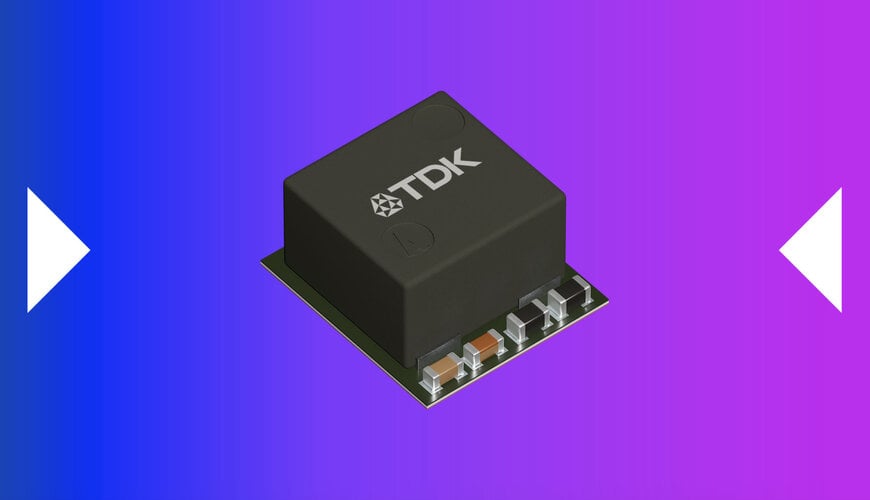
In applications such as AI servers, data center computing, telecom infrastructure, and edge systems, delivering high current at very low voltages close to advanced processors has become a central engineering challenge. TDK Corporation has expanded its µPOL portfolio with a stackable point-of-load power module designed specifically for vertical power delivery architectures beneath high-density processors.
The newly introduced module delivers 25 A per unit and can be vertically stacked or paralleled to provide up to 200 A in total. This approach allows designers to position power conversion directly under FPGAs, SoCs, or ASICs on the reverse side of the PCB, reducing distribution losses while improving thermal performance and board-space utilization.
Vertical power delivery for high-density processors
The module is based on a chip-embedded 3D package that integrates the controller, driver, MOSFETs, power inductor, memory, and bypass capacitors into a single 7.65 × 6.80 mm footprint with a height of 3.82 mm. A thermal impedance of 1.4 K/W supports high current operation even at elevated ambient temperatures, addressing the thermal constraints typical of dense AI and accelerator platforms.
By stacking multiple modules, system architects can scale current capacity without increasing horizontal PCB area. This is particularly relevant for modern AI processors manufactured in advanced process nodes, where core voltages below 1 V and current demands exceeding 150 A are increasingly common.
Electrical performance and regulation accuracy
The module supports input voltages from 4.5 V to 16 V and provides an adjustable output range from 0.6 V to 1.8 V. Ultra-fast transient response, differential remote sensing, and sub-5 mV peak-to-peak ripple enable stable power delivery for dynamically varying AI workloads, high-speed SERDES rails, and mixed-signal environments.
Low spectral noise performance makes the solution suitable for sensitive applications such as medical imaging, optical networks, digital signal processing, and automated test equipment, where power integrity directly affects signal quality.
Digital control and system integration
Digital programmability via I²C and PMBus enables real-time telemetry, adaptive configuration, and fault management for voltage, current, and temperature. This supports predictive maintenance and dynamic optimization in data center and edge environments. Analog voltage configuration is also supported, including compatibility with processor-specific voltage identification schemes used in modern FPGA and ASIC platforms.
The module integrates into standard computing form factors such as PCIe cards, VPX systems, SMARC modules, and 1U to 3U rack architectures. It is already deployed in reference designs powering advanced FPGA and adaptive computing platforms used in AI and machine-learning systems.
Designed for scalable power architectures
By eliminating the need for external compensation components, the module simplifies power-tree design and accelerates development cycles. As part of a broader µPOL portfolio covering currents from 1 A to 200 A, the new solution enables a consistent, scalable power architecture across multiple system tiers, from edge devices to high-performance data centers.
www.tdk.com
