
electronics-journal.com
26
'26
Written on Modified on
Automotive-Grade 650V IGBTs for Auxiliary Systems
ROHM introduces a redesigned semiconductor architecture to improve switching efficiency and short-circuit tolerance in electric vehicle thermal management and industrial motor drives.
www.rohm.com
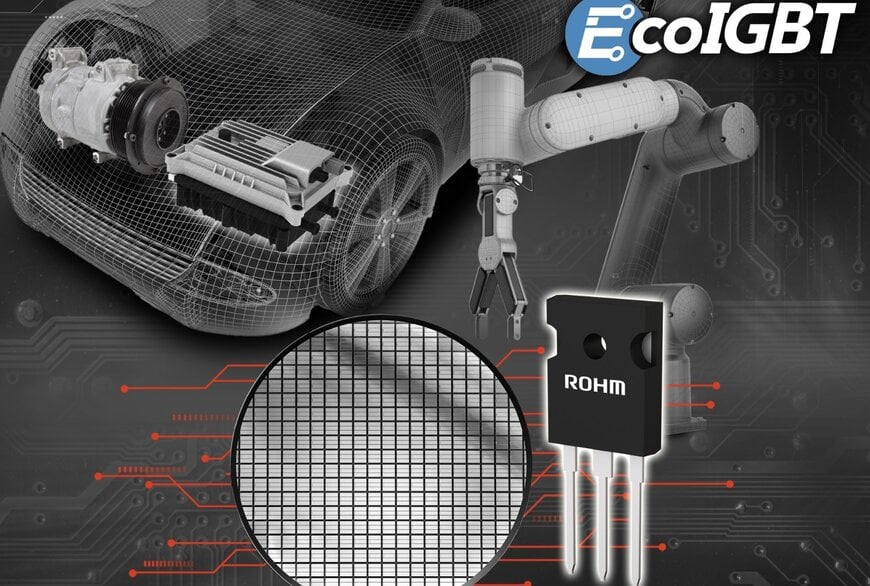
ROHM is releasing its fourth-generation 650V Insulated Gate Bipolar Transistors (IGBTs) designed for high-voltage automotive and industrial power applications. This semiconductor technology provides optimized switching and thermal management for electric vehicle auxiliary systems, specifically targeting electric compressors and high-voltage heaters.
Automotive Auxiliary and Industrial Applications
As the electric vehicle market shifts toward higher operating voltages, manufacturers are increasingly adopting silicon carbide (SiC) technology for high-power traction inverters. However, 650V silicon IGBTs remain the standard switching devices for lower-power auxiliary circuits due to their cost-effectiveness and reliability. Specific automotive use cases include driving electric compressors for climate control and managing power distribution in high-voltage (HV) heaters. In industrial environments, these transistors are integrated into motor drives, heating systems, and manufacturing inverters. The improved current density allows equipment designers to reduce the physical footprint of these power modules, saving valuable space in dense electrical enclosures.
Semiconductor Architecture and Electrical Performance
To meet the competing demands of energy efficiency and operational reliability, engineers redesigned the component's internal process and edge termination structure. This structural revision increases the overall current density while minimizing both conduction and switching losses. The resulting components achieve a collector-emitter saturation voltage (VCE(sat)) of 1.55V.
In inverter and heater circuits, power devices must possess sufficient short-circuit tolerance to endure the time required for system controllers to detect and interrupt overcurrent events. Despite the physical trade-off between lowering conduction loss and maintaining short-circuit tolerance, the new architecture ensures a short-circuit withstand time of 7 microseconds at a junction temperature (Tj) of 25°C. This parameter prevents catastrophic failure during electrical faults. Furthermore, the devices are fully compliant with the AEC-Q101 automotive reliability standard.
Packaging Configurations and Component Availability
The initial component lineup includes 12 discrete products in the TO-247N package, designated as the RGAxxTS65HR and RGAxxTS65EHR series. Additionally, 10 bare wafer variants are available under the SG83xxWN series. Providing both discrete packages and bare wafers introduces critical flexibility into the automotive semiconductor supply chain, allowing module manufacturers to customize their thermal and electrical integration strategies.
Engineering teams are actively developing 12 additional variants utilizing the TO-247-4L package. Future development phases will expand the portfolio with compact, surface-mount TO-263L packages featuring top-side cooling (TSC) capabilities to further enhance thermal dissipation in high-density printed circuit boards. The TO-247N packages and selected bare wafers are currently available through standard electronic component distribution networks.
Additional Context
This section details technical specifications and competitive benchmarking not included in the original news release.
The 650V automotive-grade IGBT market is highly competitive, characterized by the continuous optimization of trench-gate field-stop architectures to balance switching losses with robust short-circuit protection. Comparable discrete power semiconductors in this class include Infineon Technologies' EDT2 series and STMicroelectronics' STPOWER trench-gate field-stop IGBTs. Standard benchmark criteria for this component category focus on the collector-emitter saturation voltage (VCE(sat)) and the short-circuit withstand time (tsc). Competing components typically offer a VCE(sat) ranging from 1.50V to 1.65V alongside short-circuit tolerances of 5 to 8 microseconds. At a VCE(sat) of 1.55V and a short-circuit rating of 7 microseconds, the fourth-generation architecture aligns directly with the upper-tier specifications of contemporary Tier 1 semiconductor suppliers, providing equivalent thermal and electrical safeguards for demanding automotive environments.
Edited by Aishwarya Mambet, Induportals Editor, with AI assistance.
www.rohm.com
