
electronics-journal.com
16
'26
Written on Modified on
Tria Technologies Introduces COM-HPC Module with Edge AI Acceleration
New module integrates Intel processors with onboard AI acceleration to support real-time edge computing in industrial automation and robotics environments.
www.tria-technologies.com
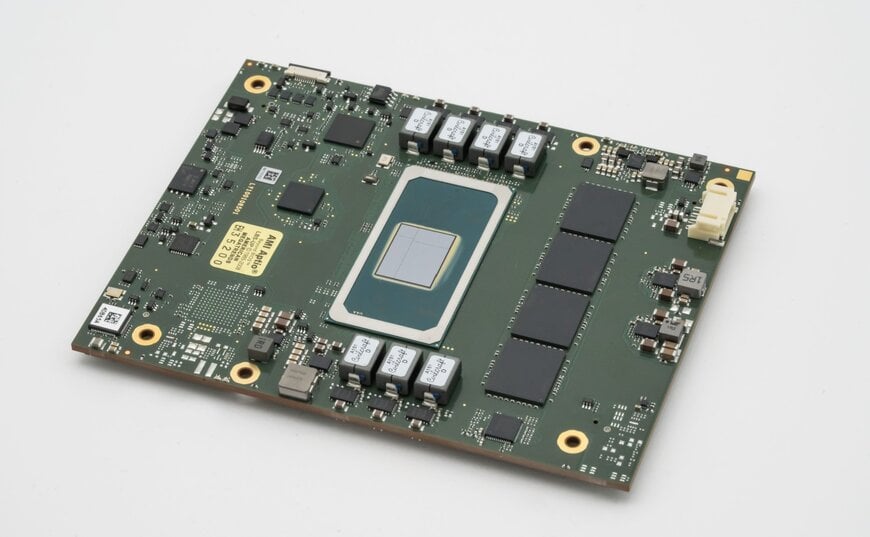
Edge computing platforms are increasingly required to process AI workloads locally, reducing latency and dependence on external accelerators or cloud infrastructure. Industrial automation and robotics applications, in particular, demand high compute density, deterministic performance, and system reliability. In this context, Tria Technologies has introduced a COM-HPC Client Computer-on-Module powered by Intel Core Ultra processors (Series 3).
Integrating AI acceleration at the module level
The COM-HPC Client Size A module combines multi-core CPU architecture with an integrated neural processing unit (NPU) for AI workloads. With configurations of up to 16 cores and an AI performance capability of up to 180 trillion operations per second (TOPS), the module is designed to handle real-time inference tasks directly at the edge.
This integration allows systems to execute AI models locally without relying on external PCIe-based accelerators or cloud-based processing. Such architectures are relevant for robotics, machine vision, and industrial control systems where response time and data locality are critical within a digital supply chain.
Memory, graphics, and compute configuration
The module supports up to 64 GB of LPDDR5x SDRAM with in-band error correction (IB-ECC), which enhances data integrity in continuous operation environments. Integrated Intel Xe graphics with up to 12 Xe cores provide support for visualization tasks and GPU-assisted processing.
This combination of CPU, GPU, and NPU resources enables heterogeneous computing, allowing different workloads such as AI inference, image processing, and control logic to run concurrently on a single embedded platform.
Expansion interfaces and system integration
For system designers, the module provides multiple high-bandwidth interfaces, including PCI Express Gen 5 and Gen 4 lanes, USB4, USB 3.2, USB 2.0, and SATA. These interfaces support integration with peripherals, storage systems, and additional processing units where required.
Display capabilities include support for up to four independent output streams through DisplayPort, HDMI, embedded DisplayPort, and USB-C interfaces. This is relevant for applications such as human-machine interfaces, industrial visualization, and multi-display control systems.
Deployment in edge and industrial environments
The module is designed for applications in automation, robotics, medical systems, spectroscopy, data analysis, and gaming, where local AI processing can replace or reduce reliance on discrete GPU accelerators. By consolidating compute resources on a single module, system complexity and power requirements can be reduced.
Support for Trusted Platform Module (TPM 2.0) enables hardware-based security functions, while extended temperature operation supports deployment in industrial environments with variable conditions.
Design considerations for long-term use
The module is intended for long lifecycle deployments, supporting system architects who require consistent hardware availability and platform stability. This is particularly relevant in industrial automation systems where product lifecycles extend beyond typical consumer hardware refresh cycles.
By integrating AI acceleration, high-speed memory, and flexible I/O within a compact COM-HPC form factor, the platform addresses the need for scalable edge computing systems capable of supporting evolving AI workloads in industrial environments.
Edited by Aishwarya Mambet, Induportals Editor, with AI assistance.
www.tria-technologies.com
