
electronics-journal.com
11
'26
Written on Modified on
Post-Quantum Cryptography Integration in Edge Network Appliances
NEXCOM develops the FTA 5190 edge server to facilitate the migration toward quantum-resistant encryption standards within the global automotive data ecosystem.
www.nexcom.com
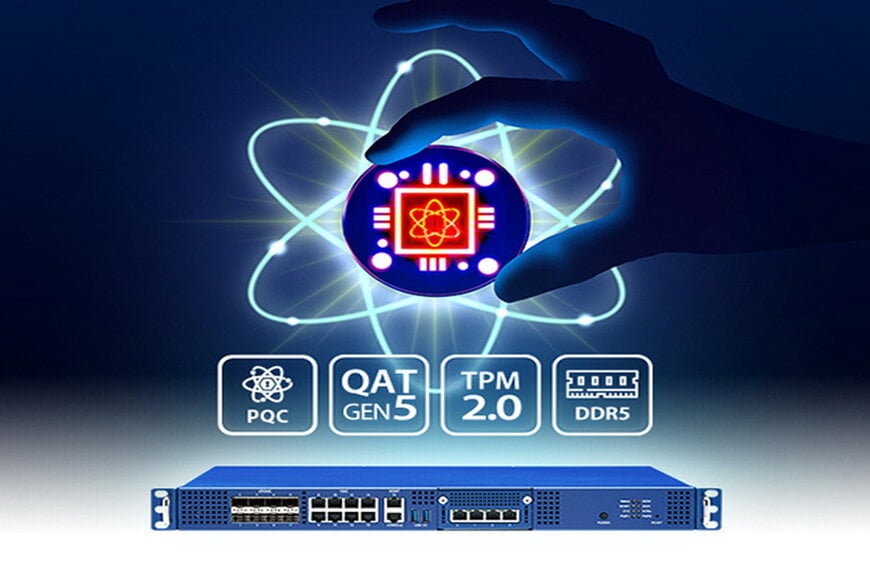
The advancement of quantum computing necessitates a transition to post-quantum cryptography (PQC) to protect distributed environments from potential decryption risks. This shift impacts the digital supply chain, requiring hardware capable of processing complex mathematical lattices and larger key sizes without degrading network performance.
Technical Requirements for Post-Quantum Transitions
PQC algorithms differ from classical asymmetric encryption by utilizing more computationally intensive mathematical structures. These requirements place significant strain on standard CPU architectures, particularly at the network edge where low latency is critical. To address this, the FTA 5190 utilizes the Intel Xeon 6 SoC, featuring up to 36 performance cores and 128GB of DDR5 memory. This hardware configuration provides the necessary computational overhead to manage the increased memory footprint and processing cycles inherent in PQC-ready cybersecurity frameworks.
Hardware-Based Acceleration Mechanisms
To mitigate the performance impact of transitioning to new encryption standards, the FTA 5190 integrates Intel QuickAssist Technology (QAT). This specialized hardware accelerator offloads cryptographic workloads from the primary CPU cores. By executing parallel acceleration of cryptographic operations, the system maintains high data throughput while preserving CPU cycles for secondary edge tasks such as real-time analytics and AI processing.
Validated Performance Metrics
Standardized testing of the FTA 5190 demonstrates its capacity to handle both legacy and PQC workloads within high-density network environments. The platform achieves up to 3.5K connections per second per core when executing PQC algorithms. In hybrid deployment scenarios — where traditional and post-quantum methods operate simultaneously to ensure backward compatibility — the system delivers a 2.1x increase in Transport Layer Security (TLS) throughput compared to non-accelerated configurations. Furthermore, the appliance shows a 2x performance improvement in traditional cryptographic tasks, ensuring that current security protocols remain efficient during the multi-year migration period.
Connectivity and Scalability at the Edge
Effective implementation within an automotive data ecosystem requires high-speed interface density to manage massive data inflows from connected sensors and infrastructure. The FTA 5190 provides eight 25GbE SFP+ ports and eight 1GbE ports within a 1U rackmount form factor. A dedicated LAN module slot allows for further expansion, enabling technical teams to scale network capacity as encryption overhead grows. This modularity ensures that edge servers can adapt to evolving NIST (National Institute of Standards and Technology) standards for quantum-resistant algorithms without requiring immediate hardware replacement.
Edited by Evgeny Churilov, Induportals Media - Adapted by AI.
www.nexcom.com
