
electronics-journal.com
12
'26
Written on Modified on
Infineon Expands High-Voltage SiC Power Modules
The new silicon carbide module variants support 1500 V DC-link architectures in renewable energy and high-power conversion systems.
www.infineon.com
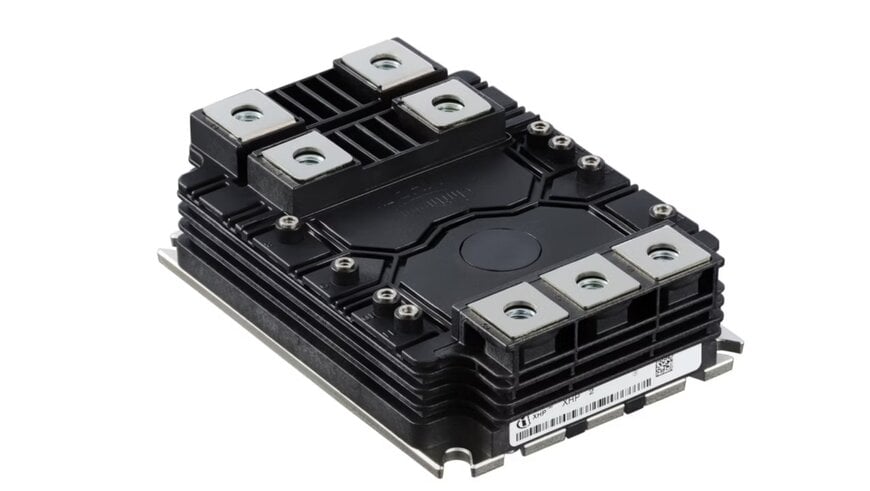
High-voltage renewable energy systems are increasingly shifting toward 1500 V DC-link architectures to improve power density, reduce current levels, and simplify large-scale power conversion. Silicon carbide semiconductors are also being adopted to reduce switching losses and enable higher-frequency inverter operation in applications such as wind power, photovoltaic systems, and battery energy storage. In this context, Infineon Technologies AG expanded its XHP 2 power module portfolio with new CoolSiC MOSFET 2300 V variants for high-voltage energy systems.
The new modules are designed for large power converters operating at DC-link voltages up to 1500 V and are available with on-resistance values ranging from 1 mOhm to 2 mOhm, alongside isolation voltage options of 4 kV and 6 kV.
Higher switching frequencies with reduced losses
The XHP 2 CoolSiC MOSFET modules use silicon carbide technology to reduce both switching and conduction losses compared with conventional silicon-based power semiconductors. Lower switching losses allow inverters to operate at higher frequencies, which can reduce harmonic distortion and decrease the size of passive components such as filters and magnetic elements.
Higher-frequency operation also contributes to increased power density in compact renewable energy systems and industrial power electronics platforms. The modules target applications including photovoltaic inverters, wind power converters, and battery storage systems where efficiency and thermal management directly affect system performance and operating costs.
XHP 2 package supports scalable converter designs
The modules are implemented in Infineon’s XHP 2 package platform, which provides symmetrical switching behavior to simplify paralleling in high-power converter architectures. Symmetrical switching characteristics are important in multi-module systems because they help maintain balanced current distribution across parallel semiconductor devices.
The platform also allows developers to configure efficiency and performance levels according to application requirements. All variants integrate Infineon’s .XT interconnection technology, which is intended to improve thermal cycling capability and operational lifetime in demanding power conversion environments.
Some module versions are supplied with pre-applied thermal interface material to simplify assembly processes and support consistent thermal transfer between the semiconductor module and cooling system.
Demonstrated results in renewable energy systems
Infineon also disclosed system-level test results from renewable energy applications using the new modules. In a wind power demonstration system, the company achieved a power density of 300 kW/L. In battery storage system tests, semiconductor losses remained below 0.7 percent of output power.
These figures illustrate how high-voltage silicon carbide modules are being used to increase converter efficiency while reducing system size in next-generation renewable energy infrastructure and digital power conversion systems.
Edited by Aishwarya Mambet, Induportals Editor, with AI assistance.
www.infineon.com
