
electronics-journal.com
13
'26
Written on Modified on
High-Capacity DDR5 RDIMM Architecture for Artificial Intelligence Infrastructure
Micron Technology has commenced sampling 256GB DDR5 memory modules based on 1-gamma fabrication nodes to optimize performance and energy efficiency in the automotive data ecosystem.
www.micron.com
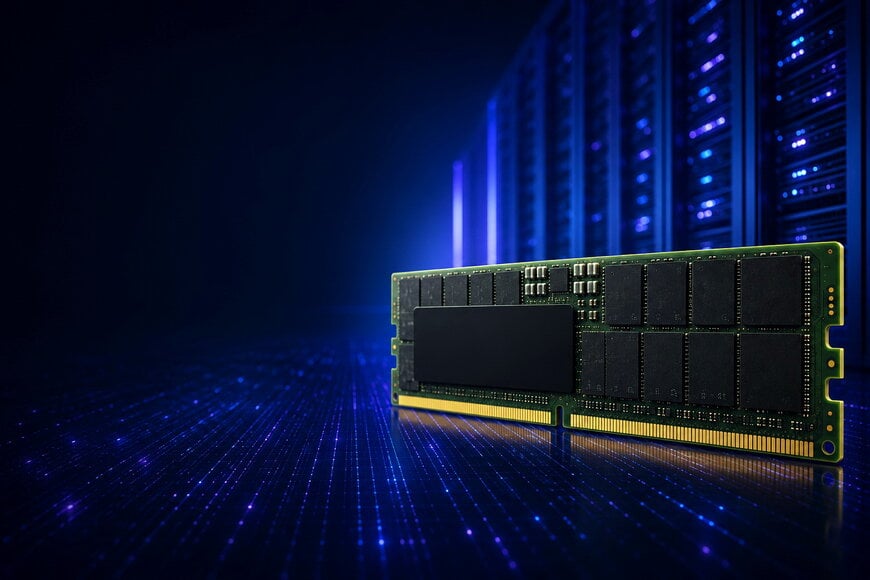
The introduction of 256GB DDR5 registered dual in-line memory modules (RDIMM) addresses the escalating memory requirements of high-core-count CPUs and large language models (LLMs). These components utilize 1-gamma dynamic random-access memory (DRAM) technology to facilitate data transfer rates up to 9,200 megatransfers per second (MT/s), representing a performance increase of over 40% compared to standard high-volume production modules.
Advanced Packaging and Interconnect Technology
The architecture of the 256GB RDIMM relies on three-dimensional stacking (3DS) of multiple memory dies. This density is achieved through the use of through-silicon vias (TSVs), which provide vertical electrical connections passing through the silicon wafers. This method reduces the physical footprint of the memory while maintaining high signal integrity. By integrating these high-density modules into a digital supply chain for server hardware, manufacturers can maximize memory capacity per CPU socket, a critical factor for real-time inference and agentic AI workloads that require massive datasets to reside in near-processor storage.
Power Efficiency and Thermal Management
In data center environments, power density and thermal dissipation are primary scaling constraints. Replacing two 128GB modules with a single 256GB module results in an operating power reduction of more than 40%. This efficiency gain allows hyperscale operators to increase total system memory within existing thermal design power (TDP) limits. The integration of 1-gamma fabrication further optimizes the power-to-performance ratio, ensuring that high-performance computing (HPC) clusters can sustain 9,200 MT/s throughput without exceeding the cooling capacities of modern server racks.
Ecosystem Validation and Implementation
Micron Technology is currently engaged in co-validation efforts with server ecosystem enablers to ensure compatibility across diverse hardware platforms. This process involves testing the 1-gamma DDR5 RDIMM against current and future server architectures to verify timing parameters, voltage stability, and error correction code (ECC) reliability. Raj Narasimhan, senior vice president and general manager of the Cloud Memory Business Unit at Micron, noted that the combination of 1-gamma DRAM with 3DS and TSV packaging allows servers to achieve higher performance levels, assisting architects in scaling infrastructure for AI and HPC applications more effectively.
Comparative Technical Context
When compared to existing DDR5 solutions, the 1-gamma based modules provide a significant shift in bandwidth and capacity. Standard DDR5 modules often operate between 4,800 and 6,400 MT/s; the jump to 9,200 MT/s provides the necessary headroom for high-bandwidth memory (HBM) alternatives in scenarios where standard DIMM slots are preferred for cost or modularity. The 256GB capacity point also doubles the density of the previous 128GB industry standard, effectively halving the number of physical slots required to reach specific memory thresholds in enterprise servers.
Edited by Evgeny Churilov, Induportals Media - Adapted by AI.
www.micron.com
