
electronics-journal.com
15
'26
Written on Modified on
80 V MOSFETs for 48 V Automotive Systems
Toshiba Electronics Europe expands its automotive power semiconductor portfolio with 80 V MOSFETs designed for higher efficiency and automated optical inspection compatibility.
www.global.toshiba
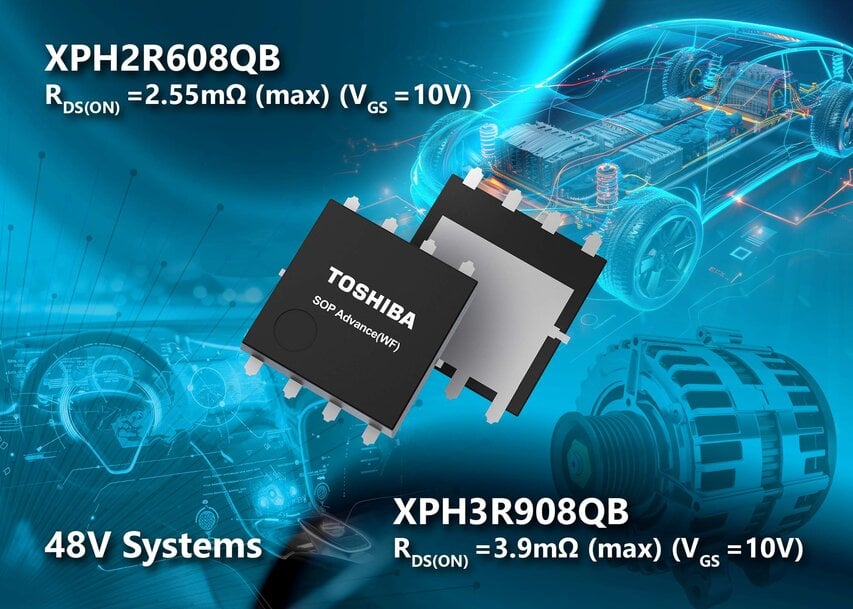
Toshiba Electronics Europe GmbH has introduced two AEC-Q101-qualified 80 V N-channel MOSFETs intended for 48 V automotive power architectures. The new XPH2R608QB and XPH3R908QB devices target applications including BLDC motor control, non-isolated DC-DC converters, switching power supplies, and automotive load-switching systems. The components are based on the company’s latest U-MOSX-H semiconductor process and use a wettable-flank SOP Advance package to support automated optical inspection in automotive electronics manufacturing.
Expansion of 48 V Automotive Power Electronics
The introduction of 48 V electrical subsystems in vehicles has increased demand for power semiconductors capable of handling higher current densities while maintaining low conduction losses. Applications such as electric compressors, electric pumps, active suspension systems, and mild-hybrid drivetrains require efficient switching devices to reduce thermal load and improve energy management within the automotive data ecosystem.
The new MOSFETs are designed to address these requirements through reduced drain-source on-resistance, or RDS(ON), which lowers conduction losses during operation. According to Toshiba, the XPH2R608QB achieves a maximum RDS(ON) of 2.55 mΩ with a typical total gate charge of 95 nC, while the XPH3R908QB provides a maximum RDS(ON) of 3.9 mΩ with a typical gate charge of 63 nC. Both specifications are measured at a gate-source voltage of 10 V.
Lower RDS(ON) values reduce power dissipation in switching circuits, which can improve converter efficiency and decrease heat generation in compact automotive electronic systems. Reduced thermal stress can also contribute to longer battery operating life in 48 V vehicle architectures.
Wettable-Flank Packaging for Production Reliability
Both devices are housed in Toshiba’s SOP Advance wettable-flank package. The package incorporates a copper-clip internal connection structure intended to reduce package resistance and improve thermal dissipation characteristics.
The wettable-flank design also supports automated optical inspection (AOI) during PCB assembly. By improving solder joint visibility, manufacturers can inspect mounting quality more effectively without relying solely on X-ray inspection methods. In automotive electronics production, AOI compatibility is increasingly used to improve traceability and assembly reliability for safety-critical systems.
Applications in Automotive and Industrial Systems
The MOSFETs are designed primarily for N-channel BLDC motor drive circuits and non-isolated buck DC-DC converters used in automotive subsystems. Additional applications include variable-speed drives, switching power supplies, and load-switching circuits in both automotive and industrial environments.
Although optimized for 48 V systems, the components are also suitable for 28 V automotive electrical architectures. Toshiba stated that the broader U-MOSX-H automotive MOSFET family also includes the XPQR8308QB, which uses an L-TOGL package designed for higher thermal dissipation requirements.
Semiconductor Efficiency and Competitive Positioning
In automotive power semiconductor design, performance is typically evaluated through parameters including RDS(ON), gate charge, thermal resistance, and package reliability. Lower conduction resistance improves efficiency, while reduced gate charge can decrease switching losses in high-frequency converter designs.
The combination of low RDS(ON) and AOI-compatible wettable-flank packaging positions the new devices within a growing segment of automotive-qualified MOSFETs developed for 48 V electrification platforms and high-reliability digital supply chain manufacturing environments.
Toshiba Electronics Europe stated that it will continue expanding its automotive MOSFET portfolio to support evolving vehicle electrification requirements and additional automotive power applications.
Edited by an industrial journalist Sucithra Mani with AI assistance.
www.global.toshiba.com
